You May Now Enter

By: Kit Maude

Eckersley had a loopy artist in her guest room and a boy begging at her door. Both were proving to be troublesome. The artist was loopy in the sense that he was probably insane, but also because he was stuck in a loop. Like the beggar boy, he appeared one day at Eckersley’s door announcing that he had a new performance project that he hoped to rehearse in Eckersley’s guest room. Because he was an old friend of Eckersley’s he was allowed in. He refused to say much about the performance.

The beggar boy came to Eckersley’s door at least once a week asking for clothes, food, and anything he might be able to sell. Also money, of course. Sometimes, usually, Eckersley gave him something, but sometimes she didn’t happen to have anything on her, or was in a bad mood. Occasionally, she was simply irritated by this boy who came so regularly to demand things for nothing.
Read more

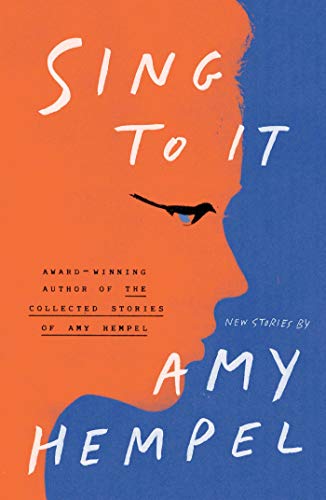
Book Review: Sing to It by Amy Hempel

By David Holloway

Sing to It: New Stories is the first new work from Amy Hempel in a decade.

The first thing to notice in this collection is the variety of story lengths and tempos. Of the fifteen stories in Sing to It, ten are less than two pages long. Modest of plot, names and setting, the title story is only one page long. But “Cloudland,” the last in the collection—more a novella than a story—runs for sixty-two pages. The reader might imagine the briefer stories to be a sign of the times, a nod to flash fiction. But it’s more likely to be a choice of substance, not form, from a genius of succinct narrative. Throughout this collection, and especially in these shortest pieces, the haiku-like prose is condensed and concentrated. Intense and sparse, there is a bleached and stripped quality to Hempel’s writing. Her narrators, reluctant to yield up their secrets, force us to read between the lines. The reader is left, generally, with a lot of work to do.

Read more

Book Review: Norco ’80 by Peter Houlahan

By David M. Olsen

We just got our asses kicked, didn’t we?” Deputy Andy Delgado says to Deputy Rolf Parkes while in the hospital after an eye surgery to remove bullet shrapnel. This exchange, found in the new book Norco 80: The True Story of the Most Spectacular Bank Robbery in American History by Peter Houlahan, captures the sentiments universally shared by the police after their forces were eviscerated by five masked and heavily armed men in the wake of a botched bank robbery in Norco, California in 1980. Norco is an expertly rendered accounting of these events that reads like a crime thriller and courtroom drama, with all the brutal gravity of a true story. This is true crime at its best.

Read more

Attending a Reading: Jamel Brinkley’s “A Lucky Man”

By AM Larks

It is almost 11:45 a.m. on a rare sunny day in Berkeley and instead of being outside, I am sitting in the basement lecture hall of Berkeley City College that smells vaguely of feet. My cell phone doesn’t get reception, so I cannot distract myself from my impatience and anxiety. I am anxious because I want to like this panel of authors, because I deeply respect the moderator, and because I need something to write about, to tie into, my review of Jamel Brinkley’s collection A Lucky Man.

Read more

Book Review: Things You Won’t Tell Your Therapist, by Colleen Kearney Rich

By: Felicity Landa

Things You Won’t Tell Your Therapist might appear at first glance as a simple collection of flash fiction, but the breadth of emotion that Colleen Kearney Rich has achieved in her stories is something to be admired. Writers often shy from flash as one of the more difficult formats to capture depth, but Rich runs full force into the form. Rich’s language is cut to the bones, but her details are visceral and real. She steers the reader through her characters’ anxieties, while reminding us of our own. The stories in Rich’s collection are fierce in their simplicity, stolen moments of seemingly quiet lives

Read more

A Sensible Man

By  Julia María Schiavone Camacho

Portuguese Macau, China. Fall 1937.

Fairy tales never come true. Patricia would warn her daughter, if she ever had one, not to believe in storybook endings. A girl raised sensibly, not spoiled. Her own daughter. Angélica. Perhaps she would create her own tale, featuring a sensible prince. And some practical advice. Be sure he really is sensible, Angélica. Sensible as well as trustworthy and good, before you give your heart away.

Now she lumbered down the narrow passageway above the main plaza. Her shoulders slumped, her chest ached. For once she might be able to cry.

Read more

The White Card by Claudia Rankine – A Conversational Review

By: AM Larks & AE Santana

Claudia Rankine is the author of five collections of poetry, two plays, numerous video collaborations, and is the editor of several anthologies. Rankine has won the PEN Open Book Award and the PEN Literary Award, the NAACP Award, and the National Book Critics Circle Award for Poetry, and was a finalist for the National Book Award for her book Citizen. Rankine is the recipient of the Poets & Writers’ Jackson Poetry Prize and fellowships from the Lannan Foundation and the National Endowment of the Arts, in addition to other honors and awards.

The White Card by Claudia Rankine is two-scene play that features one black character, Charlotte Cummings, a Yale MFA graduate and a highly successful contemporary artist; and four white characters: Charles Hamilton Spencer, a “well-respected philanthropist” and “lover of contemporary art,” his wife Virginia Compton Spencer, the Spencers’ son Alex Compton-Spencer, an activist who is “deeply involved in current American politics,” and Eric Schmidt, the Spencers’ trusted art dealer. The Spencers invite Charlotte over to dinner in an attempt to convince her to sell her art to them.

The Coachella Review contributors A.E. Santana and A.M. Larks reviewed this play in an interview style with questions, responses, and replies in order to capture the conversation that theater, and specifically The White Card, is meant to evoke.

Read more

Evolution

by: Leila Bilick

I.

Each April, I walked among crushed tulips
after the last snow
and headstones for fallen soldiers,
my favorite for James Miller, last of the Minutemen,
“I am too old to run,” inscribed in the stone.
I imagined him falling to his knees
delivering himself, negating himself
as the red storm blew in.  

Read more

Then and Now: David L. Ulin, On Writing “The Bed”

Welcome to a brand new feature on TCR’s blog, Then and Now, a series in which writers reveal and dissect the early literary attempts that helped form their current work. This week, David L. Ulin takes a look back at his story, “The Bed.”


THE BED
by David L. Ulin

Annie’s grandfather died on a Sunday in summer. My vacation had just begun. At work on Friday, his heart became irregular, and he was gone within forty-eight hours. I watched Annie buckle over the phone, saw her face pale and her red hair fall into disarray. She went home to San Diego that night.

And Monday was my grandfather’s birthday. I met my parents, and together we went to pay our respects.

I should say I’d been thinking about Annie since she left, but that’s not really true. More about her grandfather, and mine. In my grandparent’s apartment, he lay in another room, and we sat on a couch, listening through the wall for his snores.

My grandmother offered drinks and asked about my brother.

“He’s okay,” my father said, not looking up from a large paperback book of color photographs.

My mother smiled from her end of the sofa. “His classes just started.”

“So I heard,” her mother said.

My father coughed and lit a cigarette.

“No one comes to visit anymore,” my grandmother said. In the other room, her husband snored.

Read more