
Reviewed by Tommy Ebrahimi
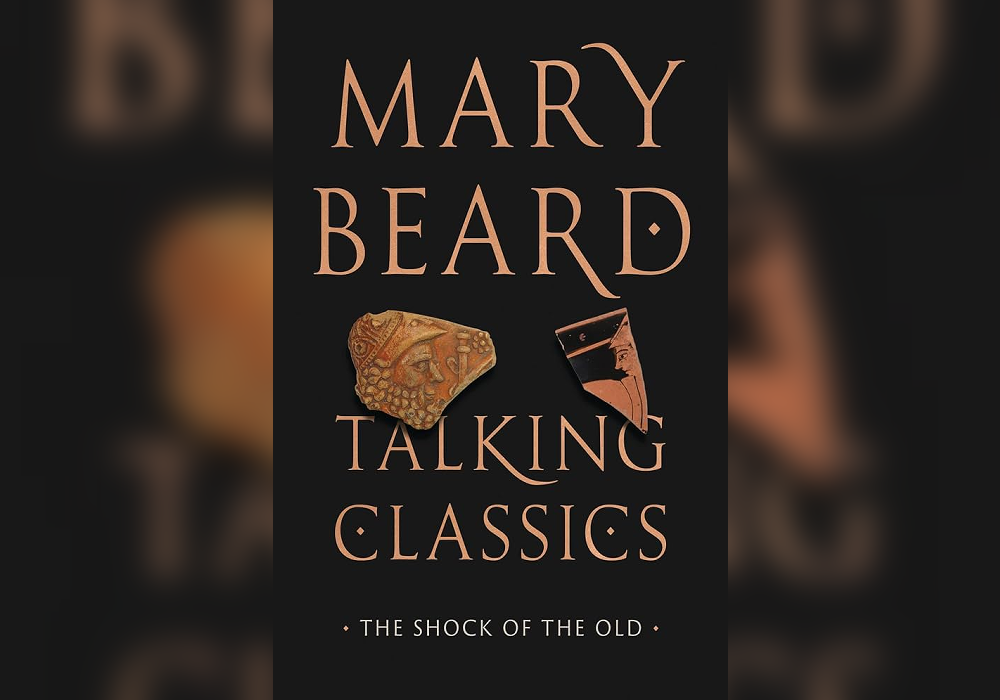
If there’s such a thing as a rock star in the study of ancient classics, Mary Beard deserves the title. Her book SPQR: A History of Ancient Rome is an approachable starting point for the Rome-curious, and she’s often tapped for cultural and historical commentary by television networks and publishers alike. Between her publicity bona fides and a long career in academia, most notably at Cambridge, Beard holds an important place in the modern field of classics. She attempts to embrace this role of standard bearer in her newest book, Talking Classics: The Shock of the Old.
Adapting a series of lectures given at the University of Chicago and the University of Edinburgh, Beard blends memoir and academic inquiry to answer a single question: What is the point of the classics? The result is a svelte book packed with interesting ideas but lacking the in-depth analysis that Beard’s work is known for. While this comparatively shallow dip into the topic is uncharacteristic of her work, Beard aims to spark interest in the ancient world, and Talking Classics achieves this through its brevity.
Beard splits the book into four major sections framed around that central question—the point of classics—and makes her case for the field. While she insists she isn’t trying to sell the reader on her area of study, the book is an argument, or perhaps a defense. Beard begins with wonder, focusing on her own personal experiences with the ancient world. Anecdotes from her early years in the West Midlands—afternoons spent deciphering Latin text at a local museum, summers spent excavating the Roman ruins—are paired with an exploration of the famously well-preserved streets of Pompeii, where she guides the reader around the city, points out details, and builds narratives. In one instance, she paints “an image of the colorful life in a Roman bar… complete (almost) with a soundtrack in street Latin,” rendering the scene in a nigh-romantic light. This is Beard in her natural element: blending the personal with the historic and opening the ancient world for students and readers alike.
The book progresses by latticing ancient, medieval, Victorian, contemporary, and personal points of view to build a robust, at times prickly image of the ancient world. Beard opens the chapter “How to Be Modern?” with the history of the Aphrodite of Knidos. While contemporary viewers may interpret the statue as a famous if overanalyzed work of art, its true history is one of scandal and controversy. In the ancient Greek world, the statue’s flagrant nudity wasn’t considered artistic, it was transgressive, a fact that generates a cavalcade of questions for Beard. What sparked a change in the representation of the female body for these ancient artists? What impact does that have on the male gaze in the Renaissance and beyond? And how did these quasi-punk art objects become markers of tradition and conservatism?
This is where Beard’s writing shines. Instructive, but never didactic, Beard leads the reader to a series of facts and invites them to piece them together to form their own conclusions. Her language is clear, unambiguous, and dusted with a wry sense of humor. Beard pairs open-ended questions with carefully chosen anecdotes, transposing a well-paced lecture onto the page. She supplies the raw material—the dates, the names, the narrative—providing the reader with the opportunity to develop the logic and intellectual frameworks. The question of modernity above is one such example, but these questions are legion in the book. How do we reconcile our understanding of the city of Rome, ancient and modern, with Benito Mussolini’s renovation projects in the 1930s? Why would British instructors demand students write ancient Greek with accent marks despite its native speakers never using them? Beard’s secret power as an educator, on full display here, is her ability to elicit the best ideas from the reader, not herself.
This approach does come at cost: namely the sacrificing of depth for breadth. The book is vanishingly slim, just shy of two hundred pages. While Beard covers a lot of ground, she never homes in on a single idea. In the final chapter, where Beard makes her case for studying classics, the author relegates one of the quintessential issues of the day—artificial intelligence—to a parenthetical, noting that “AI landed in the classroom” just as her career was ending. She gestures to challenges and possibilities, but never elaborates on either. Beard frequently refers to a younger, upstart generation of classicists bent on burning the field down and starting over. The author introduces some of their ideas—what if we studied the Greek city-states alongside contemporary society across the Americas and the Indus River Valley instead of Greco-Roman poetry, for example—but never dives into the details. Elsewhere, Beard notes, once again in parentheticals, that mainland China is adding more courses in “western classics” than anywhere else in the world. This briefly noted terminology is freighted in intellectually captivating ways, but Beard doesn’t offer commentary—the very same commentary she has happily supplied to periodicals and TV stations throughout her career. As a result, the book feels uncharacteristically lackadaisical for a thorough, hard-working educator like Beard. While even her asides spark curiosity, she seems disinclined to delve deeper in the book.
This may be a feature, however, and not a bug. One of the most compelling arguments Beard makes in favor of the classics as a discipline, field of study, career, or hobby is, “It teaches you to read difficult things.” While some of the book’s ideas may be oddly truncated, that is by design. Beard’s slim retrospective isn’t a highlight reel of the ancient world, nor is it a cheat-sheet; it’s a quick-start guide. Beard’s goal is to inspire readers to do this work on their own—she might have a response to the question of AI in the classroom, but this professor wants you to go find your answer. In this way, the book is less memoir or lecture than it is collection of frameworks, paradigms, and tantalizing ideas that can launch the reader into their next great obsession.
In this manner, Talking Classics stands as Beard’s invitation to her world. Come, be inspired by the distant past, and find what sparks your curiosity. Following in the footsteps of the museum curator to whom she dedicated the book, Beard has opened the display case. It’s up to us to discover what’s inside.
 Tommy Ebrahimi is a San Diego-based writer enrolled in UC Riverside’s Palm Desert MFA Program, where he serves as an associate editor for The Coachella Review. His work has appeared in Open Ceilings, Matchbox Magazine, and elsewhere.