
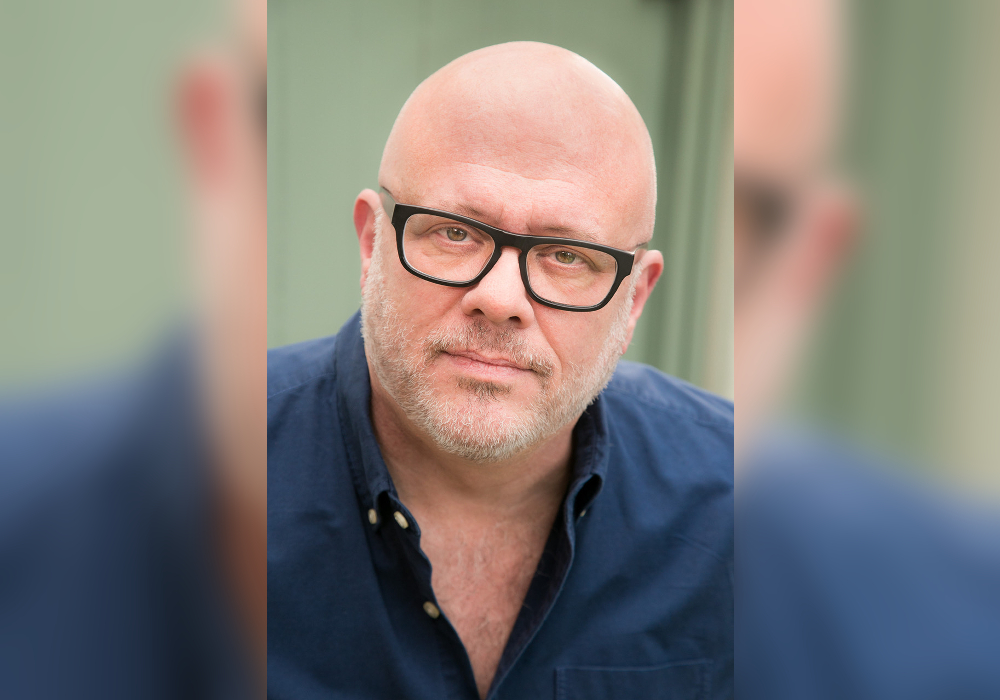
By Geordie Stock
Tom Provost is a true hyphenate. He has Hollywood credits as an actor, screenwriter, and director, which are three disciplines that he’s also taught at the university level during his time at Pepperdine and Chapman. He also has professional experience as an editor and producer. He’s just finished his first novel, which he describes as a combination of Flannery O’Connor, Stephen King, and Raymond Chandler. And on top of all that, Tom is an alumnus of the UCR Palm Desert MFA Program, home of TCR.
Most recently, Provost is credited as co-writer on current theatrical release Young Washington, a military drama that paints a portrait of George Washington as an ambitious young soldier rising through the ranks of the Virginia Regiment in the mid-18th century. With writing partner Diederik Hoogstraten and writer-director John Erwin, Provost delivers an adventure story that doesn’t have to stretch too far from the honest, compelling reality of George Washington’s humbling maturation as a military leader in the years before he’d go on to become the pre-eminent founding father of America.
The Coachella Review talked to Tom Provost about his experience writing an American icon, his approach to telling stories that are stranger than fiction, and what it means to release this movie on the cusp of the country’s 250th birthday.
The Coachella Review: As an alum, what was your experience like in the UCR-PD program?
Tom Provost: I had a blast! I already was a fairly established writer, so initially I just went for the degree. I’m now a full-time professor at Chapman University, and at the time I knew I needed the MFA to be able to at some point get a full-time job as a professor. I actually gave the speech at my cohort’s graduation, during which I joked that when I first started I was a little snotty about it; I know everything. I’m not going to learn anything. But it ended up being a great experience for me. I learned so much. I’ve now become very close friends with Joshua Malkin, he and John Schimmel taught me so much.
If I had it to do over again I probably would’ve switched and done fiction because I’m such a fiction nut. I actually just finally finished my novel, and the UCR residency helped me do that. So I had a great experience. I learned a lot more than I snottily thought I would, and it was so much fun.
TCR: I’d love for you to talk a little bit about your role in creating this movie, Young Washington. You’re credited as a co-writer with your writing partner, but the director John Erwin also has a writing credit. How did this project come to you, and what was it like working with a writer-director?
TP: My writing partner Diederik Hoogstraten was my student at Pepperdine. He was older, a journalist approaching fifty at the time who was married with kids and decided he wanted to do something different. He went to the screenwriting program at Pepperdine and took three of my classes, and we became very close and ended up writing some things together.
The director is John Erwin, and Young Washington is his vision. I used to joke that I always prided myself on arrogantly saying, Nobody knows more about movies than I do. Then I met John, and I was like, Okay, he wins. He knows so much about movies, but his other obsessions are the American Revolution and World War II. Diederik and I actually met with John to pitch for a World War II project they were developing, and whenever you go to a meeting with somebody, you try to find out as much as you can about them. I found out that John also loved the American Revolution.
My mother was an American history professor who taught from the Revolution through the Civil War and Reconstruction. That was her specialty. She taught that for years. Mom did her best when I was growing up to instill her love of American history into me and my brother, but I wanted nothing to do with it. All I wanted to do was talk about movies and books. Both my parents died young, but I think Mom is laughing down from heaven because I have now had to immerse myself in this world that she loved so much. In the pitch meeting when we first met with John, I very cleverly threw out that my mom loved Churchill but also that her biggest obsession was the American Revolution. So, two hours later when we left, we had been hired to help him write this.
John is so busy that he could have sat down at some point and written it himself, but he knew that was going to be very difficult. When we came on, we knew that he would eventually rewrite it. So we worked out all the story beats with him through a series of meetings, and once we had the outline down, we went and did our draft. Then before shooting, John did his pass on it, which is what you see in the movie.
TCR: I was watching this thinking of George Washington almost like Superman. And as many have said, the issue with writing Superman is that he’s flawless, invulnerable, in many ways a god, so how do you give him problems? While George Washington isn’t invulnerable, he does occupy an iconic, almost mythological place in American history. What was your approach to writing George Washington, to instill in him flaws and challenges to facilitate a satisfying character arc?
TP: As you said, Washington is a figurehead, he’s a statue, he’s on the dollar bill. He’s the father of our country and there are all these myths about him. But he was a regular guy just like any of us. Washington was a great man, and we wanted to examine that life and ask how he became great. Part of the approach was [to] look at who he was as a young man and try to figure out how his experiences made him into the American icon that’s up on a pedestal.
When I started reading about him, I was like, Wow, this is a movie. Like, he starts a global war. He starts off as an arrogant, ambitious, self-centered, ego-driven young man who wants to be an officer in the British Army, which ironically is everything he ends up fighting and toppling. Only through a series of disastrous failures does he learn humility and realize the way he should be a great man is to be more of a servant leader and focus on the people around him as opposed to himself. You know, he didn’t really even want to be president. He just agreed to it because ultimately he knew it was going to be the best thing for this burgeoning country. But if he had not had all these successive disasters and failures that really humbled him, I don’t think he would’ve become the man that he did.
TCR: You brought up a key to Washington – at least as he’s represented in this film – which is his ambition. And I really like your portrayal of him, because he seems like a guy who’s not quite at home almost anywhere. His ambition sort of alienates him from those friendly, cool, funky Virginians, and yet that same ambition is not enough for the British officers. And while certainly everything starts on the page, so much of this is in William Franklyn-Miller’s performance.
TP: Isn’t he great?
TCR: He’s really, really surprising. I’m not sure I’ve seen him before–
TP: No, he’s new. John very much wanted a new somebody.
TCR: It’s a performance that’s worthy of the character in a way that I wasn’t quite prepared for. In terms of your approach to the character, you mentioned his ambition and needing to ground him in reality, in youth, in the mistakes he made… What was it like to then see that translate to film via William’s performance?
TP: As a writer in Hollywood… I say this joke all the time, but it’s painfully true: writers are lower than craft services on a movie set. I saw this great quote by Louis Mayer the other day, and I’m paraphrasing, but he said, “The most important person in Hollywood on a film is the writer, and we must do everything we can to never let them know that.” Once we finish our drafts and they go off to make the movie, we’re done. I mean, John was nice enough to have Diederik and I on the set for one day, which was actually a pretty amazing experience for me, but I kept hearing about these wonderful actors they were casting; Sir Ben Kingsley, Andy Serkis, Kelsey Grammer, Mary-Louise Parker. But I knew from the beginning that this movie lives or dies with George. And are they going be able to find a good George?
The first time I saw the movie I was just bowled over. I was like, Wow, that young man is gonna be a big star. I think he’s that good of an actor, and of course he’s gorgeous to look at, right?
TCR: He’s a pretty fellow, for sure.
TP: And a very sweet guy as well. And ironically British, you know! He’s a Brit.
TCR: They always play the best Americans, don’t they?
TP: They do, exactly. So I was thrilled when I finally saw the performance. I was just like, Wow, okay. Now we have a movie because we have a great George.
And we call him “George” which is probably disrespectful, but I do believe Washington felt apart his whole life. He was like 6’3″ and everybody else at that time was like 5’7″ or 5’8″ so he towered over everyone. And as Diederik, John, and I were writing it we were joking that he was basically like Tarzan because he was in amazing shape, this huge physical specimen. He could do these physical feats that no one else could do. He loved the outdoors, he loved running through the woods with his hair flying, which is why he loved doing the surveying. So just his physicality set him apart from the upper class, and his refinement set him apart from the commoners and colonists. And then he doesn’t get the girl that he loves!
I think for most of his life he did feel just a little bit apart from everyone; physically he was different, mentally he was different, and I don’t know this for sure but I would suspect he lived, in some ways, a lonely life.
You know, we love movies and love talking in movie terms. And so when we were kind of beating out the story, there’s that scene where he goes and meets his friend Christopher Gist down in the beer hall. And John was like, It’s just like a scene in Titanic where Leo brings Kate down into the depths of the ship. And I had to laugh, because I do love that movie as cheesy as parts of it are. But I remember even the first time I saw that, I’m like, Okay, James Cameron, I don’t care what the fuck you say, but I want to be up top in a tux and not down there sweating and dripping. I think probably more than the other two writers, I kind of relate to George’s desire to be a part of the upper crust.
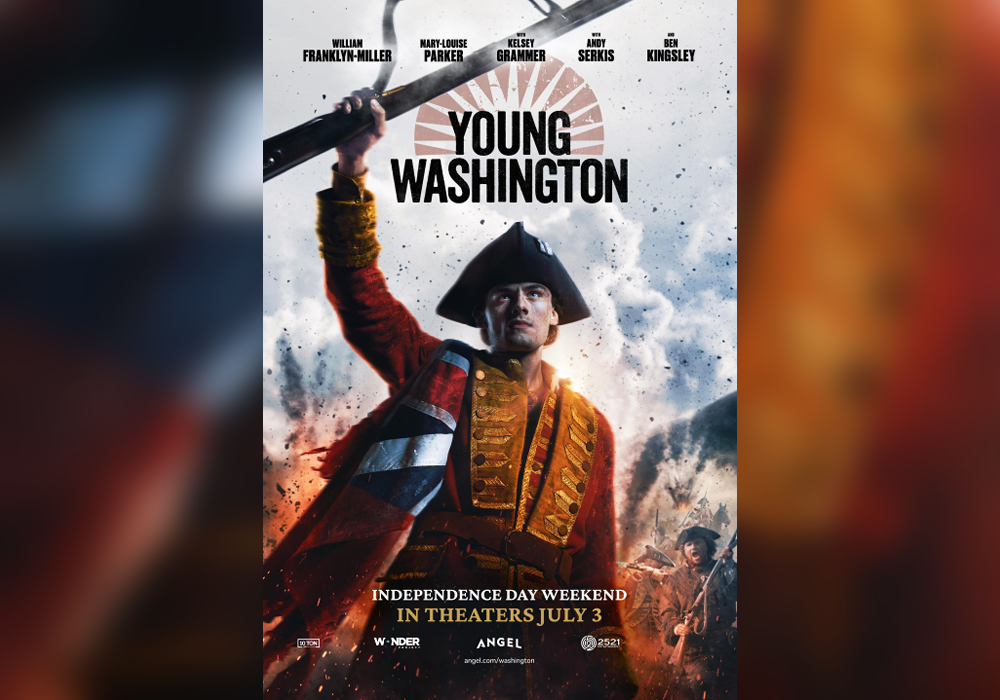
TCR: I think that really comes across in the performance, his struggle with the class difference that he feels from both directions. I love his slight awkwardness with the Virginians, because those guys are just this side of vulgar. They’re slamming beers, violently toasting, spilling all over that dingy beer hall. And then you see George next to them, this guy who has had a British officer tutor his whole life but who still wants to fit in with them because these are the people he aspires to lead.
I was really impressed with the craft on display in this movie. The style of it is beautiful, it’s gorgeously shot, and there’s wizardry going on here between digital effects, locations, and sound stages. It really lent an authenticity and a sense of scale. It felt like a magic trick in the best way in terms of modern movie making. You spent a day on set. What was it like to see this story realized on this canvas?
TP: It’s not an expensive movie in terms of Hollywood. It’s under thirty million, and they did an amazing job. It’s mostly real. They shot in Ireland, mostly, for two big reasons: it’s two-thirds cheaper so you get an enormous bang for your buck, and it’s very hard in the modern United States to find an area where you don’t see telephone poles and fences. But you can still get that in Ireland.
They had these amazing costumers, and there are some special effects in terms of a few bombs and probably added soldiers, but for the most part they had all those people out there. They built Fort Necessity. They built the French fort. The day I was at the set was the day they shot that opening shot of the movie where George jumps out of the stagecoach and he’s running through that and there’s bombs going off –
TCR: What a good day to be there.
TP: Oh my gosh. Yeah. I mean, I saw it all. I saw George shoot the guy off the horse, get on the horse and ride off. And I kind of made a fool of myself because I started crying. I was standing next to John and the camera and I just started crying because those specific pages in the script I had written myself. And I was so overwhelmed to see what I wrote come to life. It was a great day for me.
TCR: That’s a wonderful day. Because that opening moment essentially functions as a bookend in this film. And it was executed very well; I was getting The Revenant vibes.
TP: John was very emphatic that scene would be the opening of the movie; We’ve got to immerse the audience right in the middle of this. And it’s a great way to open because the joke on the set was that they were making a combination of Sense and Sensibility and The Revenant.
TCR: The DNA of this movie feels very American. It features a guy who’s entrepreneurial, he’s got a DIY education, he’s pushing into places where he doesn’t “belong,” and as you mentioned he’s incredibly ambitious. On top of that, there’s a thread of faith running through this story. So it’s pretty complex; you’re making a movie that is in part Sense and Sensibility, part The Revenant, and part The Patriot. How do you approach balancing all those threads?
TP: To be honest, the approach was Let’s just tell the story. And in terms of the way these stories are normally done, I think it’s very historically accurate. There are certainly changes. Kelsey Grammer’s character is a combination of two people. Christopher Gist, George’s best friend, doesn’t die in Fort Necessity. He dies in a different way than in the film. But there were enough people at Fort Necessity and we felt like, from a movie standpoint, it was okay to go ahead and have it be Christopher because that’s the fastest, most succinct way we can convey what George felt at that moment. And he met Sally, who I believe was the love of his life, shortly after she was married. So from a movie standpoint we changed the timeline on that a little bit. But the feelings are 100% accurate.
You know, the country is clearly very divided at this point but we really hope and believe – and at the preview screenings this has been borne out – that people on both sides of the aisle can enjoy the movie. Because it’s not a political film. And any of the faith stuff that comes up is just part of the history. Everyone who surrounded George for his whole life audibly said This divine hand is guiding you, and it just had to be part of the story. So we felt like we weren’t making a religious film, it’s just what happened. It’s what people said about him. One of my favorite moments is [at] the river, because they knew they were going to die on that little island in the middle of the river and there literally is no physical way that river could have frozen. But it did. There are all these examples of a divine hand guiding him. Whether somebody believes in God or doesn’t, something’s going on.
We tried to get this in the movie, there just wasn’t enough time, but the only time that George left the country was when Lawrence contracted tuberculosis and they sent him to Barbados for the weather. And George goes with him. And when George is in Barbados he gets smallpox and almost dies. But once you have smallpox, you’re not gonna get it again. So years later, during the Revolutionary War, when everyone’s being ravaged by smallpox, George had already had it. So he’s able to not get sick and maintain being this great general. There are all these little things in his life where you’re like, Okay. There was a plan here going on.
TCR: There are these fateful moments in his story, but there are also explicit mentions of God. When you’re making a project with Angel Studios and The Wonder Project, what was the relationship like with regard to the narrative thread of faith in the story? Is there a back and forth on that? Was there an explicit understanding reached with regard to that subject?
TP: If there was anything like that, I, as one of the co-writers, was not involved. I know that Jon is very much an apolitical person. He doesn’t really even enjoy talking about it. His life is movies, and he loves storytelling. It’s just not something he’s interested in. So I know that he did not want the movie to be political or religious. Any mention of faith or God or the divine hand guiding George, that’s what happened. He was just trying to be historically accurate.
I had no dealings with Angel. I did have dealings with the new company, The Wonder Project, and they’re wonderful people. They are interested in doing movies that have something positive to say. But they can be dark! I mean, this is a PG-13 movie. There’s a lot of violence in this. It’s not a G-rated movie.
TCR: There are some incredible performers here in supporting roles, and the thing I like about their roles is that there’s no stunt casting here. They all have something to chew on. Kelsey Grammer really has an air about him as Fairfax, something that plays nicely off of Washington’s arc. Sir Ben Kingsley is so lovely in his few scenes. Mary-Louise Parker has this wonderful emotional role. And then Serkis, who just seems to be having a ball, gets a great part to play.
TP: Isn’t he awesome?
TCR: He’s charming as hell, which you would expect. When writing the script, did you have any sense of the kinds of performers that would be in these roles?
TP: We did not. So every time I heard Hey, Sir Ben Kingsley’s playing Robert Dinwiddie, I was like, What? He’s what? The way you sometimes cast is you’re finding actors who basically have nothing to do in a very short period of time. Kingsley was able to shoot that out in a day or two. Serkis was just a couple of days. They figure out how to shoot them and get them out so it’s not taking a lot of their time.
And those parts were fun to write. One of my favorite things that was changed is that George Washington’s mother was a pain in the ass and a very clingy woman. She never wanted him to leave Mount Vernon. The second time Washington was running for president she [famously wrote] letters to the editors of newspapers saying Don’t vote for him. So in our version, she’s not the most likable person. The big scene when George has come back from the disastrous Valley of Necessity and she comes out, when we wrote that was with Kelsey Grammer’s character. Because I don’t think she ever would’ve done that. But John, in his movie wisdom, softened her up and gave her that scene. And I think it was probably a smart thing to do.
There’s also a lot of controversy about Andy Serkis’ character, because in some ways he was a fool. I mean, he had a four-poster bed and a big chest of drawers and a piano that went with him into the wilderness. And at night when they were camping, you would just hear somebody playing the piano for him out there. Some historians make him out to be just an utter fool. And then other historians are like, No, he wasn’t. He was a really good general. And I think this is shown in the movie. He just was in over his head and had absolutely no idea what was going to happen. And “Who would’ve thought?” is exactly what he said before he died.
I feel very blessed that we got those actors. And I think the fellow that plays Lawrence is wonderful. The colonists are great.
TCR: They are. They’re so charming.
TP: That’s something Diederik and I invented, those two guys. They were just kind of a compendium. We needed a couple of people to indicate what the colonists at that time might have been like. Those two actors are Scottish, and so when I met them, I was like, Okay, you guys may be the best actors in the movie, because they were so different.
TCR: For this movie to come out now, in a divided nation on the cusp of a massive anniversary, is interesting on multiple levels. You’ve already said this was not created to be a political movie, and it doesn’t come off as such. But what are your thoughts about telling a story about this man, this legendary mythological character, at this specific moment in time?
TP: In one sense it’s a fluke, because when we were hired to do the movie it was planned to be shot and released two years ago. But because of John’s schedule and the production process it ended up not being shot until last summer. And then at that point, obviously you’re like, Well, let’s get this thing in the can and get it released in time for the birthday. So it wasn’t planned, it just happened. I think from a marketing standpoint it’s very smart, because there’s not really anything else like it out there.
I think sometimes we lose track of just how vicious things were back then when it comes to politics. There’s a wonderful book by William Safire called Scandalmonger that details political life back then. And sometimes it makes even what’s going on today look tame. In one sense, our political divisiveness has always been on display. What I’ll say about division is that I think there are going to be people on both sides who react to the movie in a certain way because of what they believe.
But I think if people can go in and approach the movie from a more objective standpoint, they’re going to enjoy it. They’re going to see a piece of history that is also kind of a great action-adventure movie. There are going to be some people who are going to pre-judge the movie. I can’t stop that. But I do feel like if people go into the movie with an open mind and accept it for what it is, they might appreciate it. And we’re hoping that it can foster a little bit of unity in celebration of this grand experiment.
 Geordie Stock is a writer with nearly two decades of production experience in the gaming industry, currently pursuing an MFA in creative writing at UC Riverside Palm Desert. He is based in the San Francisco Bay Area where he lives with his longtime romantic companion, Karl the Fog.