
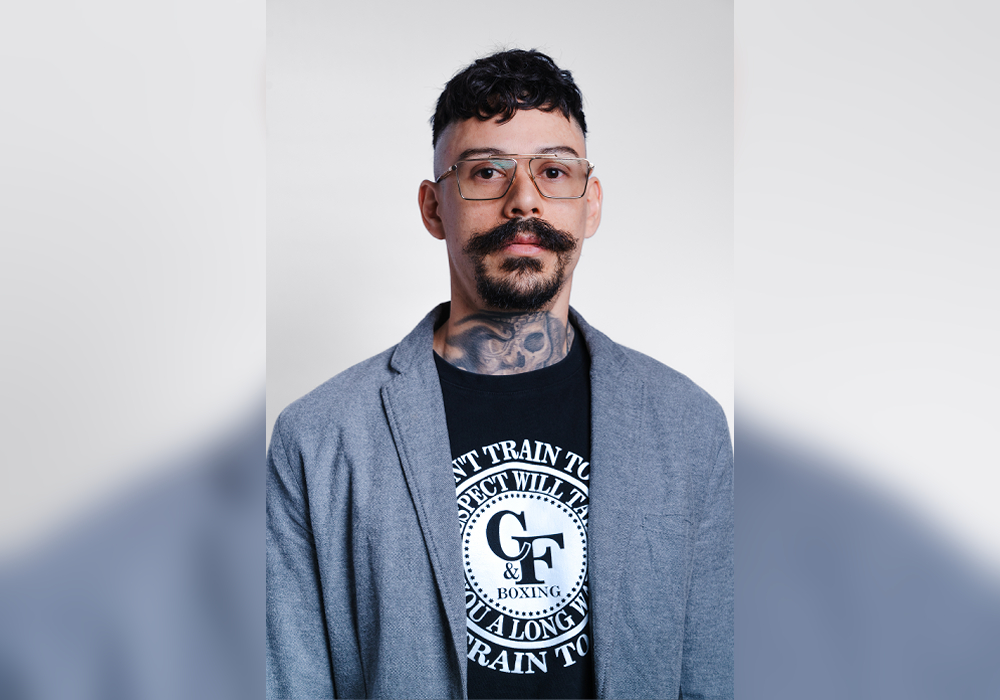
By Angelo A. Williams
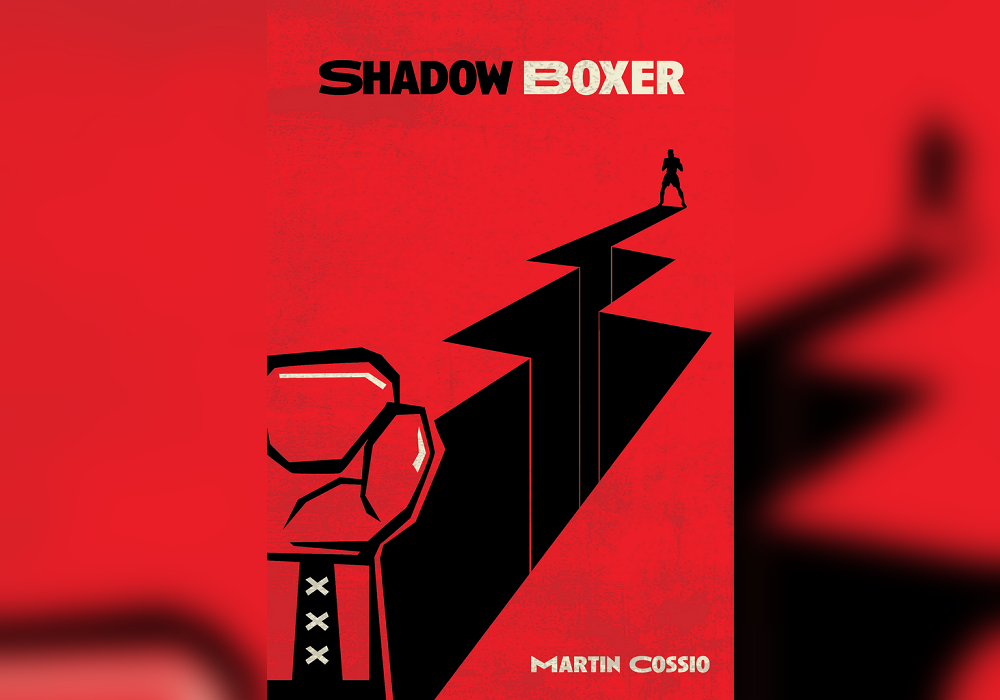
Martin Cossio is a first-generation Mexican American poet-teacher-boxer from San Bernardino, California, a graduate of the UCR Palm Desert MFA program, and the winner of the 2021 Golden Triangle International Haiku Contest. His debut poetry collection, Shadow Boxer, “chronicles the author’s gym journey from skinny-fat underdog to super-welterweight live dog.” In a short suite of poems, Cossio explores the entrails of masculinity, each line a razor-sharp indictment that cuts both ways, flaying the writer and his readers, exposing the ultimate boxing match with oneself. Indeed, he is shadowboxing; his words, gloved weapons that strike at his lethargy, lack of confidence, and loss, open his skin and soul to the perils and possibilities of vulnerability.
The Coachella Review spoke with Martin Cossio about poetry, boxing, masculinity, and identity, topics that expose the ways the ring and the page became connected for him.
The Coachella Review: Before we get into Shadow Boxer, talk a bit about how you got started writing poetry; where did the writing begin for you?
Martin Cossio: I was twenty when I decided, you know what, I’m going to try this. I used to skateboard. That was my identity. I was a skateboarder. When I stopped doing that, I felt like I wasn’t anybody. Going back to the whole identity thing, I needed something.
I realized I was the type of music listener who homed in on the lyrics. I was always more intrigued by how things were said in songs than anything else. I thought, Maybe I’ll try writing song lyrics. I’m not in a band or anything, but I’ll try my hand. What’s closely related to that? Poetry. I think I can write poetry. I’m going to try it. Even though I knew nothing about it.
One time, I found myself at the Mt. SAC library. I was in there thinking I needed a book for inspiration, a model text. I came across this hardcover that said Robert Graves on it. I picked it up and I remember reading it like, This is cool. The way he was rhyming, it wasn’t just ABAB. I stole the book. I needed this book.
Things got a little dark because I ended up catching a DUI and had to do a little time. In jail, that’s where I started writing poems after what I read in this book. Basically, I told myself, If I come out of here with ten poems, I’m going to keep going. I will have proven to myself that I could do it. I needed a new identity.
I came out of there with poems, and I just kept going.
TCR: When did poetry become more than something you were doing privately? When did you begin to see it as something you could revise, workshop, send out, and publish?
MC: What really cemented it was when I signed up for a creative writing course at Valley College. The professor ended up becoming my unofficial mentor. He’s the one I dedicate the book to. He was a good teacher and a fellow form poet. He tailored the curriculum for me, had me put together a chapbook, send poems out for consideration. I got five poems published. That was like, Oh man, I’m good. They’re not great poems, but you need to feel encouraged to keep going.
That’s a big takeaway. You have to keep going, whatever you have to tell yourself.
TCR: What role did the writing program play in helping you move toward a book?
MC: At some point, I started putting together my own chapbooks. It felt good doing that, but eventually I was like, I want recognition. I want somebody to want to publish me.
That’s when I thought about the program. I was subbing, so I was able to focus on the writing program. Most people don’t publish coming out of the program. I didn’t do this to not get a book out eventually. It was weighing on me that I hadn’t. I graduated in 2020, and the manuscript I had been working on and revising is still pending. I still haven’t published it, and I still want to.
But I had to accept that sometimes you need to write something else. I didn’t really mean to do it, either, but I knew I was stuck in a rut. Maybe in the back of my mind, [I knew that] changing things up, immersing myself in something new—something different—my writing would benefit from that. That’s where Shadow Boxer came from.
TCR: Let’s talk about Shadow Boxer. What came first for you, the writing or the boxing?
MC: Writing, for sure. That’s been the goal [for a long time], to put out a book. I just had to step away.
At that time, I kind of felt like I needed to just get my priorities straight. I was a bit out of shape and going through stuff, and I had always wanted to join a boxing gym and could never afford it. I just decided it was time. It made sense.
I was full of doubts because I had a compound arm fracture fixed with a metal plate. I started hearing voices like, You’re too old, or Maybe you shouldn’t, or You’re a teacher. You’re a writer. You need your brain. But I just followed through. I had to prove it to myself, and I never stopped showing up no matter what.
Naturally, the inspiration for this book came from talking to my boxing coaches. This is something I talked about at the UCR Spring [2026] residency. I had never written a poem in response to something I heard, but when I heard these different things the coaches would tell me, they would stay with me. Then one day I knew: I have to write something in response. It just kind of happened like that.
TCR: The book feels like a memoir in poems. Early on, you start to reveal things about yourself, about relationships, birth, desire, disappointment, and the kind of human stuff men often do not talk about. Was the previous manuscript a memoir? And how did you begin covering that intimate ground in this work?
MC: I have an impulse to document where I allow myself to be vulnerable. I’m honest.
The way I see it, it’s kind of like how you said. These are things we all experience to some extent. We just might not talk about them, especially as men. I think the page is the place for that. Some people take pictures. I like to write pictures.
The previous work is poems also. It’s full-length, and darker. You probably get an idea of what that was like from this book. But I think it’s just the sense of urgency here. I actually felt time with a capital T.
I did the program while I was subbing and then became a teacher. I started to feel like, where is my life going? What’s our future going to be like? Maybe it needed to happen that way because now I’m in a completely different place. Even the trajectory of my writing changed. I became more purposeful. Before, I would second-guess myself, but with these stream-of-consciousness poems, I was just like, I’m going to start it and I’m going to finish it. Then the whole collection came together from there.
TCR: The way the book responds to what your boxing coaches tell you—about boxing, about life, about your body, about your name. It’s not just metaphor. You metabolize the coach’s words, and through the writing, it comes out as something altogether different. How did that happen as a craft choice?
MC: I’m glad you noticed that. I think I learned a lot about myself with this experiment.
First and foremost, I was a writer. When you’re that, you’re always perceiving the world a certain way, or you’re receptive to whatever you hear and experience. As a teacher, we talk about the transferability of a skill. Can you learn how to analyze a text? How do you apply that in a different situation? Subconsciously, I was also trying to figure out how to write the next thing, or how to make the writing work, taking it in a different direction. This is actually the sequel to a manuscript that I’m still trying to get published. I wasn’t having success with that, so I wanted to take a different approach with this one.
It’s kind of weird the way it played out because it has that meta quality to it, but I think the metaphor lends itself to that.
TCR: The poems that begin with the coaches—Coach Pedro, Coach Robert, Coach Ruelas—feel almost like a book within the book. They’re one-on-ones between you and these coaches. Did you take notes on what they said, or did the advice come back to you later?
MC: I took them one at a time. After I wrote two of those poems, I realized this is the heart of the collection.
I already had the poem at the end and “Shadowboxing,” but I didn’t know they were all going to end up in this boxing-themed poetry collection. When I wrote two or three of the coach poems, I thought, I get the form of the collection. This is the heart, and these other poems are going to help support them. They are the heart because that’s where the transformation is taking place.
Honestly, I didn’t write all the ones there could have been. I was selective with the things I decided to respond to. When I hear something, I know whether I can write a poem about it or not. Sometimes I won’t write it right away. Most of them I didn’t. Maybe that’s the true test. You hear something and it stays with you. How long does it stay with you? When I found myself remembering what was said, even after I said I was going to write it but didn’t right away, it kept coming back. It was like I kept hearing it. Then [I’d think], Today’s the right time to write this poem. That’s more intuition.
TCR: Shadow Boxer reminds me of an axiom by Ishmael Reed, “writing is fighting.” In this collection, you turn that on its head: fighting is writing. How do you respond to the connection between what you do in the ring and what you do on the page? Are they the same? Do they have the same goals?
MC: They are similar, and you’ve got to be conscious of form. I’m a form poet, I think. The prose blocks are meant to be reminiscent of rings. When I was in that headspace, the ring also made sense because your number one concern should be your form. Are you holding a proper stance? Being conscious of form in the ring and in writing is important. At least, it’s important for me.
TCR: You begin the book with an introduction entitled “Tale of the Tape.” In boxing, a tale of the tape is a comparison of two fighters’ record, weight, and reach. But the battle you lay out in the introduction is a bout against yourself. What were you doing there in terms of boxing form and poetic work?
MC: If you’re a boxing fan, you see the tale of the tape come up on the screen before any fight. It’s familiar. I remember reading a collection, Fighting Is Like a Wife, and she did that in there. I thought that was cool. So that’s a borrowed form.
I’m thinking about bettering myself and getting in shape, but also acknowledging that I’m going to be older. You always hear blank American, whatever it is. I’m more of an American Mexican because I’ve realized I can and should embrace who I am. Growing up, in school, we were discouraged from speaking Spanish. It was different times, and I think that affected me. Now I have a different notion about what it means to be American. Deep down at heart, I’m a Mexican, but I’m a patriot, too.
I tell my students, when you do the pledge in my class, all around the room I have flags from all over. Each represents a student I’ve had. Then you have the American flag that’s standing out there. No one else does the pledge anymore, but I tell them that flag, the American flag, is all these flags, too. I can prove it to you. This flag is Geo from Argentina. This one is this kid. I try to show them it represents something much bigger.
TCR: In the poem “Shadowboxing,” you use sound as a device—the “ping-ping.” It makes the poem dramatic. It takes the reader beyond simply reading and makes the poem an experience. Why did you include sound as part of the craft structure?
MC: You hear it, and everyone knows that sound, even if they don’t know it. It works. It’s effective subconsciously. That was the best way to describe what it felt like just living life, day in and day out. I feel like I’m fighting to be seen. Going back to subbing, if you do it long enough, you start feeling dehumanized.
One thing I did was try to intensify it every time. I don’t know if you noticed, but the amount of lines from one ping-ping to the next shortens. It [quickens]. Sound signifies a lot. In my classroom, I actually use a call bell: one ping means stop, look, listen, two pings mean fight!—with your assignment. Over time, the students just know. Poetry is sound, right? The music of language. You have to find the music in the words.
That poem was four beats per line. I was like, What am I doing wrong here? Should I make this longer? One beat less helped create that sense of urgency.
TCR: Your work talks directly about the body, men’s bodies, your body. Men do not often talk about self-love, self-loathing, fear, and transformation in public with such openness. Why were you interested in your own body as a subject?
MC: There was a day when someone questioned my fitness to be a father. For the first time in my life, I had to acknowledge I had fallen out of shape. I’d always been a limber guy, and it was a tough swallow. That was the turning point. For me, being out of shape wasn’t just being out of shape. It was being out of shape because I let this lifestyle happen that was incongruent with the future I wanted, the future I envisioned. Having that extra fat was a reminder of something that was holding my mind. I rationalized it like, if I lose this, then I can have that. I’ll gain that.
TCR: There is a line in the poem “Coach Pedro says it takes balls to be a boxer”: “Because I couldn’t own myself, I resolved to rage against myself by worshiping excess.” Talk to me about that line.
MC: I’ve always been a little morbid, always thinking about death. Subconsciously, when I was doing all the partying and stuff, it was a way to rebel against [my mortality]. I grew up Catholic, so I started thinking about what the church says about [desecration]. I was trying to figure out why I was living that way, why I was doing that to myself. They say you have to acknowledge the problem before you can fix it. That was my way of working through [life], but it wasn’t the right way. It’s not the right way to think about the body we’ve been given. It’s hard to talk about.
TCR: Every poem feels like a battle that culminates in the last one, “Living Up to My Name.” It’s the ultimate fight for self-definition. How did that poem come to you?
MC: My name has been kind of a loaded thing as long as I can remember. In Spanish, my name is pronounced Mar-teen. [The Spanish way,] that’s how I’ve always identified, but then that becomes complicated as you get older.
That poem actually came before I even knew I was writing this book. Because there were aspects of boxing in it, I eventually realized identity was tied into the theme. It ended up finding its place there at the end.
My dad shares the same name. Growing up—I think it’s kind of sad to say this, but I don’t think he ever supported my endeavors. He never liked that I skateboarded. He never liked that I got into heavy metal. Boxing was one thing we had in common. He got me into boxing as a kid. He would order the pay-per-views and everybody would come over. I’ve been a fan, and he’s a fan. Maybe a part of me wanted to show that I could do it.
As a boxer, I’ll show what I’m about, and then I’ll be given the right name. I’ll feel better about my identity. I’ll have that.
TCR: Talk to me about the process of publishing Shadow Boxer. You finished the program, you were working on the other manuscript, and then this collection emerged. How did it become a published book?
MC: [A Finishing Line Press] annual contest. I didn’t win, but my chapbook and some others were still accepted. The way the press does things, they rely on their authors to help promote the book, but they do a lot. I appreciate everything they’ve done and the way they worked with me. They promote it, and they guide us through promoting ourselves. They show us how to reach out to different outlets, how to do the press release, what things you need to do to get set up for when it comes out. They expect their authors to take initiative, and I’m okay with that. Especially as a starting point, I love that this is a women-owned press and I had zero affiliation with them, and they accepted me for publication. That’s an endorsement. Somebody else said this is worthy of publication.
There’s a lot of background work that goes into it. I thought you finish editing, send it out, and then it’s accepted and published. But there’s a lot of back and forth. You have to think about the cover. You have to think about a lot of things. Currently, I’m sending it out for reviews. Now it’s published, so instead of sending it out for consideration to be published, it’s sending it out for consideration to be reviewed. That’s a whole other phase.
I’m also pushing it locally. It’s hard. The pre-sale is what determines the success of the book. At least with this press, your royalties are based on how many sell during the presale period. I was trying to push it locally. I took it to San Bernardino libraries. It was disheartening to hear, “Well, when it comes out, you can donate a copy, and if we like it, then we’ll shelve it.” I’m a local author. I live down the street. You guys can’t help me?
I get it, and I’ve already donated one to the big branch, but it sucks that it’s hard to get people interested and to get them to support. But pushing books wasn’t the goal. The goal was getting endorsed by somebody, somebody else saying this is worthy of publication. I can check that off.
TCR: What are you working on now? What is next for you as a writer?
Cossio: A collection of love poems: loveliness, my lady-bug. I’m already sending it out.
I met this girl last summer, coming up on a year ago, on a field trip by chance. Have you heard of Footsteps to Freedom? It’s a company that does educational tours of the Underground Railroad. They put out a call and let us know they could send so many of us on this trip if we wanted. I had heard great things about it, so I signed up.
Anyway, I met this girl, a fellow teacher, at the airport right before we got on the plane. We did the tour together. It was wild. Something different. I’ve always wanted to explore the tender side of poetry. We’re going to go from Shadow Boxer to ladybugs.
 Angelo A. Williams is a nonfiction writer, professor of Ethnic Studies, former political staffer, and MFA candidate in Creative Writing at UC Riverside, working on a memoir about fatherhood, ACES, CPTSD, and generational inheritance. A former staff writer for the Sacramento Observer, he has published in The Source, Rap Pages, Word in Black, and the Los Angeles Sentinel, and authored “Crossroads Traveler” in Tough Love: The Life and Death of Tupac Shakur. He narrated Discovery Channel’s The Crimes That Changed Us: Rodney King and hosts the fatherhood initiative podcast This Is How Dads Do It.