
Reviewed by Tommy Ebrahimi
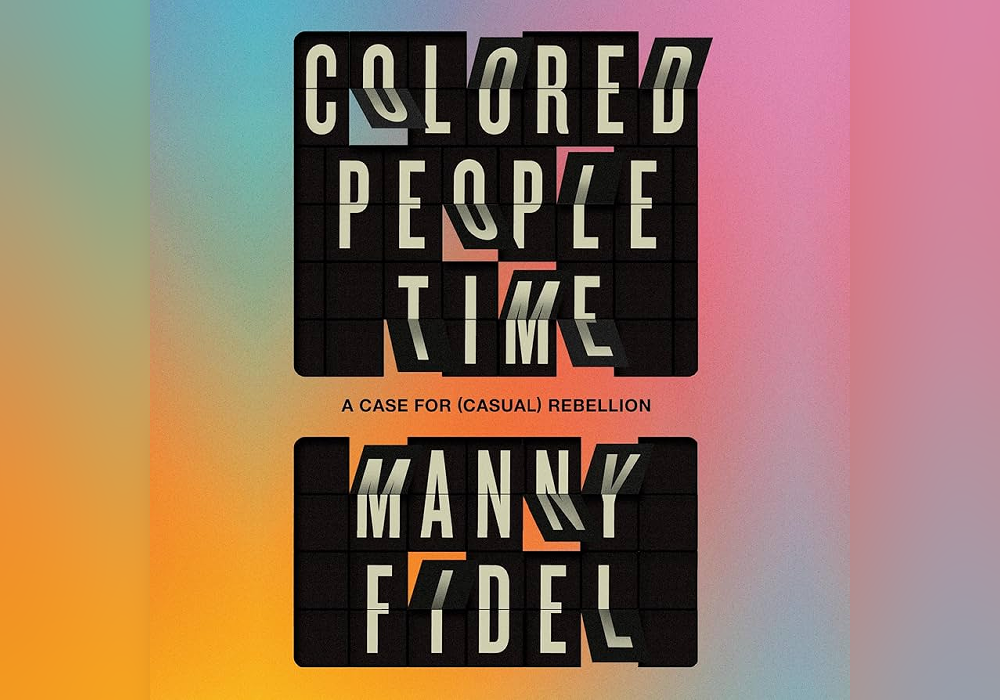
Colored People Time, the debut collection from writer-producer Manny Fidel, is an uneven read. Driven by Fidel’s personable and at times overly colloquial style, the assembled essays and criticism focus on time’s influence over identity. Essays about 9/11’s irrevocable shift in the author’s worldview, for example, appear alongside eulogies for the summer of 2016, the dying days of neoliberal optimism. Following in the feminist tradition, Fidel’s aim is to make the personal political, but he never quite threads the needle, always hedging to the personal. A few essays are truly affecting, demonstrating a keen sense of self-awareness and growth, but most of the book feels stuck in the past, both literally and critically.
Appropriately, the book’s first essay, “From Time,” tracks the arc of creation from the Big Bang to Fidel’s life, and exhibits many of the book’s characteristic. Fidel’s voice jumps off the page, both casual and jocular, but feels mismatched with the grandeur of his subject matter: the literal creation of time and space. Early on, Fidel compares cosmic space dust to “Mountain Dew [flowing] through the veins of a Call of Duty enthusiast in 2009 who will try not to call me the N-word after losing in an online match.” The imagery may be humorous, but the tonal discrepancy of the comparison undermines the author’s point about history’s influence on self-concept. It’s not a one-off. Quips about the Michael Bay Transformers films, the Dallas Cowboys, and redlining freeways on Mars are latticed with anecdotes about slavery in the United States, the legacy of colonialism, and the climate crisis that threatens the planet. Instead of softening the totality of human history and its horrors, Fidel’s language and humor chip away at significance.
By evoking the dying planet and space-faring oligarchs in the opening piece, Fidel intimates that time is of the essence, and then promptly turns toward the past. This is not a problem on its own—the past isn’t past, as William Faulkner once put it—but the writer’s arguments and perspectives seem mired in late 2010s politics. This is particularly palpable in “Summer ’16,” Fidel’s rendition of post-election grief. Framed as a eulogy, the essay mourns the last, best summer that millennials of color experienced in New York City before they “found themselves having to explain social justice in the personal sphere.” In 2017, this might have read as heart-aching, even wistful, but in 2026 it comes across as tone deaf. Fidel skims over his countless hours of thankless, uncompensated DEI-focused labor, preferring to recount the halcyon nights fueled by Drake’s “One Dance.” The essay isn’t mourning a loss of innocence so much as it’s mourning a loss of ignorance. Systemic racism was an issue well before the 2016 election, but Fidel had the luxury of ignoring it in wealthy, liberal New York City. Fidel doesn’t grieve the loss of blue-sky optimism or the “Yes, We Can” Obama years, but the blissful ignorance that era afforded him. The impression left is of a Bed-Stuy knowledge worker upset that he can’t brunch anymore.
This reluctance to address the moment reappears in “Melanintendo,” a critique of Black representation in video games. Centered around Barret, a character from 1997’s Final Fantasy VII, Fidel constructs a well-trodden argument about harmful stereotypes reinforced by the game’s English translation. What would have been a hot-button issue in 1997 or a topical reexamination in 2017 is merely a starting block in 2026. Indeed, Fidel’s most recent example of Black representation in games is from 2018. Final Fantasy VII’s remake, the ostensible impetus for the essay, was released in 2020. If the conceit of the essay is to reexamine Fidel’s response to the character and how it has not changed, there’s an obligation to investigate the underlying conditions of the failure in representation. Here, Fidel’s arguments feel perfunctory and under-researched; while he correctly identifies a harmful representation and the importance of representation in media, he hyper-fixates on the game’s insensitively translated dialogue to build his argument at the expense of nuance and depth. He compares Barret’s original Japanese dialogue with the translated English script, pointing out what went wrong, but never asks how it was lost in translation. Later, when Fidel laments the lack of customization options for Black-presenting characters in games, he doesn’t connect it to a cause (such as the scarcity of Black developers) or a solution (such as a burgeoning African games scene). Instead, the writer designs a hypothetical game featuring “a Black person who was also the most boring human being of all time.” This extended thought exercise is Fidel’s strongest point in the essay—normal, everyday characters and stories are just as important as bombastic, heroic representation—but it doesn’t quite bind the essay together. Criticism is a new field for Fidel, who is a journalist. Still, that makes the essay’s untimely arguments and perfunctory research even more ponderous.
When Fidel aligns content with style, blending his humor with personal experience, the book finds its footing. In an essay about the harrowing, sobering experience of being robbed at his high school graduation party, Fidel balances trauma with compassion and pragmatism, balancing the dialectical truths of violence and desperation nascent in every crime. When he tells the offender to “enjoy the twelve dollars, bro,” he earns the humorous, emotionally freighted quip. In the collection’s ultimate essay, “In Time,” Fidel explores his evolving relationship to his Eritrean heritage, the nation, its people, and their government. Early on, he admits that his “adolescent activism was devoid of a crucial layer of context,” and frames the essay around this endeavor to understand, connect, and empathize. This lens—earnest, humble, curious and open—makes the essay feel vital, timely, even necessary. Identity is forged in relation to place, which is governed by nation-states, which are subject to the vicissitudes of time. Identity and time: forged and reforged. Unfortunately, these essays are the exception, not the rule.
The book’s struggles with content and framing overshadow Fidel’s unique voice, which is the book’s strength. His ability to nestle tender, delicate moments among such relatable and approachable stories and language makes the funky critical comparisons and imprecision all the more maddening. Colored People Time is a crossed-up debut with a fresh, unadulterated voice. It’s a shame the ideas don’t keep pace.
 Tommy Ebrahimi is a San Diego-based writer enrolled in UC Riverside’s Palm Desert MFA Program, where he serves as an associate editor for The Coachella Review. His work has appeared in Open Ceilings, Matchbox Magazine, and elsewhere.