
Reviewed by Tommy Ebrahimi
The multiverse is a compelling, if embattled, narrative device. When executed well, stories that play with the multiverse invite audiences to consider the constantly changing permutations of narrative pieces as they skip across realities. The multiverse functions as whatever you need it to be, and it’s always out there: to be discovered, to be traversed, to be understood. In The Subtle Art of Folding Space, John Chu’s debut sci-fi novel, the multiverse is an extended metaphor for institutions—family, work, government—and the incumbent burdens they place on veterans and newcomers alike. While Chu offers a nuanced perspective on these intricate, almost draconian entities, the metaphor is unsustainable over the course of the narrative, ultimately undermining the novel’s worldbuilding and message.
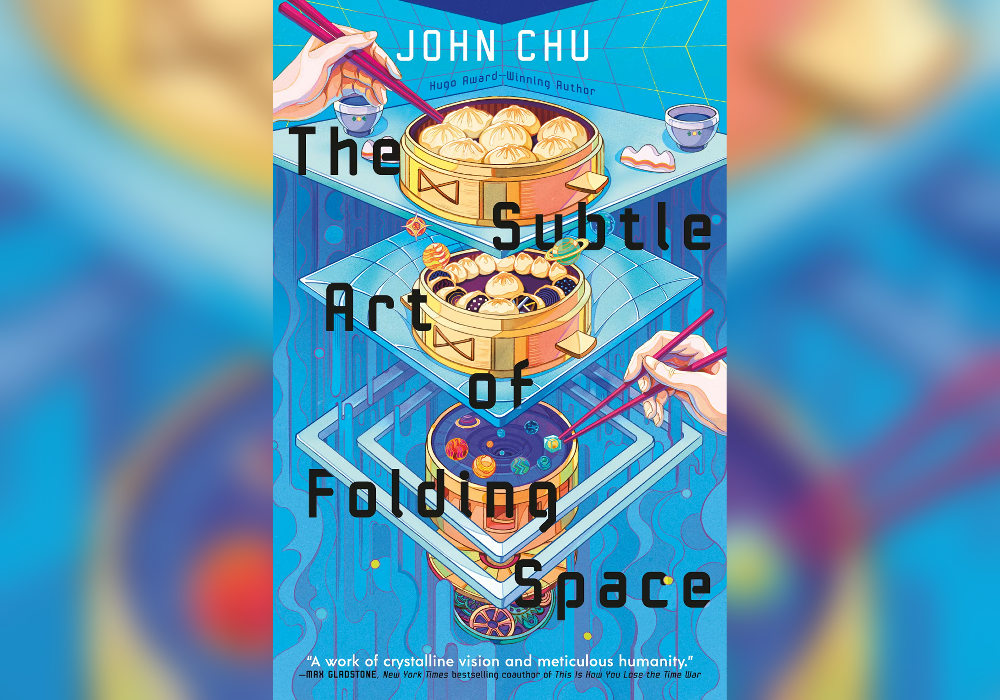
Chu’s multiverse is rendered in physical infrastructure: a thrumming rat’s nest of pipes, netting, and slap-dash repair jobs. In these “skunkworks,” the results of coin flips and quantum mechanics physically travel down the same jury-rigged piping. Each universe’s skunkworks is housed in a different reality, meaning each skunkworks exists within “the matryoshka doll that is the nested universes.” Accordingly, each skunkworks has a team of engineers who design, build, and maintain the integrity of the skunkworks and multiverse. Ellie, the book’s protagonist, and her cousin Daniel are members of the secret society of engineers who do this clandestine work. The worldbuilding draws on Chu’s experience as a microprocessor architect and feels unique for it; razor-thin significant figures and implications of mathematical recursions factor into the story in logical yet mind-bending ways.
This take on the multiverse is inventive and inviting, so it’s a shame that the novel does not take full advantage of it. Despite the myriad of “transparent, crystalline structures” and physically impossible spaces that allegedly constitute the skunkworks, Ellie and Daniel spend a lot of time visiting with people in various parlors, dining rooms, offices, and hotel lobbies, all of which are confined to the same spot in the same universe, the greater DC-Maryland-Virginia area. Even as the narrative kicks into gear and the characters begin investigating conspiracies and navigating interpersonal complexities, the story never strays far from home. When the pair do jump into the skunkworks, scenes take place in familiar locations—a library, an office, another library. Crafting an intentionally mundane multiverse could work for a story with a more comedic or slice-of-life tone, but Chu gives the characters vague, apocalyptic stakes with multiversal implications. Someone is manipulating the mechanics of the skunkworks, altering the rules of time and space, sparking a daisy chain of catastrophe. The nested nature of the skunkworks and the narrative’s stakes necessitate that conflict spills over into other universes, and must be met there, but Chu parks Ellie and Daniel in the same part of the same universe for most of the novel.
Chu’s rendition of the multiverse takes on a more symbolic role in The Subtle Art of Folding Space, though the metaphor doesn’t quite hold up over the course of the novel. The skunkworks stand in for the intricate institutions that govern lives. Ellie struggles not only with the hierarchy and methodology of her field, but with the expectations of and obligations to her Taiwanese-American family. It’s not hard to connect the knotted, gnarled pipes of the skunkworks to the coping mechanisms people use to survive their families. It’s virtually impossible not to see that Ellie is the only person keeping the universe and her family together. But Chu attempts to push it further, grafting the metaphor onto the workplace and even the government, where expressions of the idea lack the obvious vitality that the familial obligation angle exhibits. When Ellie and Daniel uncover a conspiracy in the skunkworks, it theoretically casts doubt over everyone in their secret society of engineers. In practice, however, the suspects they find are invariably suspicious and the allies are uniformly trustworthy. Never do the protagonists have to second guess themselves, never are they betrayed. When Ellie and Daniel question the latter’s boss, a primary suspect in their investigation, they’re heavily primed to disbelieve him. So, when the man is uncharacteristically civil with Daniel and offers Ellie a job, it doesn’t read as compelling political machination as much as an overly telegraphed set-up in a spy-thriller. The bureaucratic politics of the skunkworks don’t gel with the metaphor because the dangers are so easily sidestepped, the enemies so clearly signposted. Instead of enhancing the metaphor via a deepening of the characters’ struggle, the politics and intrigue become a distraction from Ellie’s familial entanglements, which are the beating heart of the story.
Chu’s tendency to weave the metaphor into every aspect of the novel weakens the book’s central dramatic question: how will Ellie reconcile her abusive sibling relationship with her cultural obligations to family? It becomes a predictable pattern: a trauma resurfaces, Daniel reports that it isn’t normal, and Ellie wonders if her relationship with her sister will ever be repaired. The skunkworks as a metaphor is compelling, but Chu returns to the well too often, robbing it of its strength. This tendency for repetition bleeds into the character writing, too. Ellie and Daniel’s interactions tend to play out in two ways: the skunkworks-newbie Ellie sets out to understand a problem, reaches a breakthrough, then has the wind taken out of her sails as the veteran Daniel forges ahead. Alternately, Ellie and Daniel meet with a person of interest, Daniel makes a social faux pas, Ellie shoots him a look and then endeavors to get the information they need. In living rooms and basements and funeral parlors and hotel lobbies and the chassis of the universe, interactions play out in these two generalized scenarios. These repetitions so didactically demonstrate the character’s strengths and weaknesses that it’s easy to forget that Ellie is getting a PhD in physics or that Daniel is in a healthy long-term relationship. The telegraphed dynamic, like the story beats, ultimately flattens both characters.
The Subtle Art of Folding Space is a book stuck between strong concepts and poor execution. The story’s multiverse is unique and interesting, yet the plot limits itself to a small part of it. The metaphor built upon the skunkworks is intuitive, even revealing, but overexposure dulls its power. While the core of the story—Ellie’s relationship to her sister—resolves in a compelling, fresh way, the narrative around it struggles, alternating between obvious and opaque. A tighter focus on the sisters would make a strong short story, while a deeper exploration of the world, its mechanics and its operators, would fuel a compelling sci-fi epic. As it stands, though, the novel is caught in the middle.
 Tommy Ebrahimi is a San Diego-based writer enrolled in UC Riverside’s Palm Desert MFA Program, where he serves as an associate editor for The Coachella Review. His work has appeared in Open Ceilings, Matchbox Magazine, and elsewhere.