Bright Orange Candy

By: Anne McGouran

Kate is a Burmese-Indian octogenarian with scornful dark eyes in a heavily lined face. The top of her head just about reaches the height of my armpit.

“My husband dropped dead in his surgery at age thirty-two. To support my five little ones, I taught at a private girls’ school in Dharamsala. I adored the teaching but not the housework. Housework is just a bourgeois fetish.”

“Dharamsala…was that in the sixties?” I ask.

“Yes, during the first wave of Tibetan emigrations. Did you know I tutored the Dalai Lama’s niece? Not the brightest bulb, that one”—Kate stares off into the distance…  into the Outer Himalayas—“I was always the first person up in the morning. I’d pour warm milk and curd into a chati, cover it overnight with a blanket, then churn it for our breakfast. The nuns all adored my lassi. I still get letters from Sister Veronica. That slyboots used to slip Santra Goli candies into my mailbox when I was having a hard time with the spoiled rich students. Sister V. and I are the last ones standing. Soon enough we’ll leave our bodies so nature can work her magic. Our energies are continually recycled, you know. We pass from death to life over and over again. It’s nothing personal, really.”

Read more

TCR Talks with Helena Echlin and Malena Watrous

By: D.M. Olsen

When I found out that Helena Echlin and Malena Watrous, two instructors I’ve taken classes from at the Stanford Online Writer’s Studio, were collaborating on a YA novel, I was curious about their work. When I heard what their book was about, I was even more intrigued. A book about “mean girls with superpowers,” sounded entertaining and original. The protagonist, fifteen-year-old Laurel Goodwin, wakes up to find her older sister, Ivy, missing from their shared bedroom and is forced to team up with mean girls from Laurel’s high school to find her.

After reading the book and seeing all the amazing reviews online, I caught up with the authors, who graciously agreed to do a brief interview for The Coachella Review.

Read more

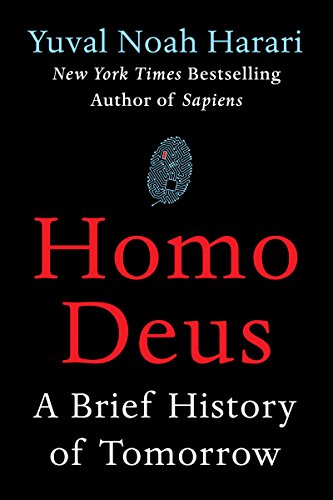
Book Review: Yuval Noah Harai’s “Homo Deus: A Brief History of Tomorrow”

By: A.E. Santana

Who would like to know the future? To know and understand the coming changes to our environment, society, and the individual? Whereas Yuval Noah Harai doesn’t claim to be omniscient or a fortune teller, his book Homo Deus: A Brief History of Tomorrow paints a picture of what may be in store for humanity in the next fifty or a hundred years. Harai does this not by making psychic predictions but, instead, by carefully examining history, biology, psychology, and technology. With a copious amount of research to back up his claims, Harai gives a detailed hypothesis on the next steps of human evolution—taking people from Homo sapiens to Homo deus. Whereas Harai gives intelligent, thorough explanations, it is through his clear, clever, and often humorous writing that he connects with readers.

Homo Deus: A Brief History of Tomorrow is broken up into an introduction and three parts: “Homo Sapiens Conquers the World,” “Homo Sapiens Gives Meaning to the World,” and “Homo Sapiens Loses Control.” Each part delves into the rise and fall of societies, provides an intimate look at biology and psychology, and discusses the growth of technology as it pertains to Harai’s claims. It is by understanding these topics, Harai suggests, that people will be able to understand how society may progress into the next stage of human evolution.

Read more

Book Review: Megan Stielstra’s “The Wrong Way to Save Your Life

By: A.M. Larks

Nothing other than fate can attribute to my review on Megan Stielstra’s book, The Wrong Way to Save Your Life, which took place a week after the events in Charlottesville (which occurred on August 12, 2017), when I was supposed to have received it a month prior. During the last week, the fear for our country has increased, it is undeniably pervasive and palpable. This fear is in every conversation, every communication, and every action or reaction. Fear is exactly what Stielstra tackles in her book. Stielstra ties the broad and the specific by examining fear at its roots, fear in her own life, and fear in everybody’s lives. Written before the November 2016 election, she comments on the fear rhetoric building at that time (which seems to have reached a violent pinnacle with Charlottesville), claiming that we must work through fear by confronting that which lies on the other side. Her words are startlingly prophetic:

Read more

Book Review: Laurent Binet’s “The Seventh Function of Language”

By: John Flynn-York

Laurent Binet’s first novel, HHhH (short for “Himmlers Hirn heisst Heydrich,” which, translated, means “Himmler’s brain is called Heydrich”), was a fictional reconstruction of the assassination of the Nazi Reinhard Heydrich. The novel’s narrative fluctuated between past and present, history and story. In the past, Heydrich rises to power in the Third Reich, committing unspeakable atrocities along the way, while two operatives—the Czech Jan Kubiš and the Slovak Jozef Gabčík—plan to kill him. In the present, the narrator grapples with this story and how best to write it, drawing on books, museums, and other references to recreate it in detail. The brilliance of the book came from the tension between these perspectives. What does it mean to recreate history? Can we understand the way historical figures understood things—that is, can we get inside their heads? Can we ever know the truth? In other words, HHhH was as concerned with what it means to tell a story about history as it was with the historical events themselves.

Binet’s new book, The Seventh Function of Language, similarly takes its inspiration from a real event: the accident that claimed the life of the semiologist Roland Barthes. Out of this incident, Binet spins a madcap tale of intellectuals run amok that is by turns wildly entertaining, mildly frustrating, and intellectually captivating—and only sometimes faithful to the historical record.

Read more

Bienvenidos a Pilsen

By: todd Gastelum

One

I was used to rebooting my life: CTL+ALT+DEL and voilà, tabula rasa.

About to turn thirty, it was time for me to move. Once again, I was leaving a boyfriend I’d taken up with in a previous life. Once again, it was me who fucked things up. Now I needed my own place. I was hoping for the top floor of a brick three-flat, preferably with hardwood floors, a bay window, and crown molding. Somewhere near the 18th Street stop on the Blue Line with a view of buckled chimneys, waltzing antennas and the Baroque twin towers of St. Adalbert’s.

That’s not the apartment I found.

My new place was the rear unit on the top floor of an architecturally featureless building, whose ground floor taquería would eventually add another ten pounds to my frame. The apartment had been recently remodeled with a coat of white matte and cheap beige linoleum that still reeked of glue. There were just three rooms: a bedroom, a bathroom, and a kitchen/dining/living room too cramped to qualify as open concept. All the doors were standard-issue Home Depot as were the kitchen cabinets and bathroom fixtures. The tiny window over the kitchen sink gazed into a narrow air shaft, and the double-paned windows behind my futon framed an alley with a backbone of splintered utility poles and drooping cables. If I lived a dozen floors higher, I’d have been able to see the lake, but I didn’t and I couldn’t. I had no link to the natural world—only the constant rumbling of big rigs speeding toward the Stevenson Expressway.

Read more

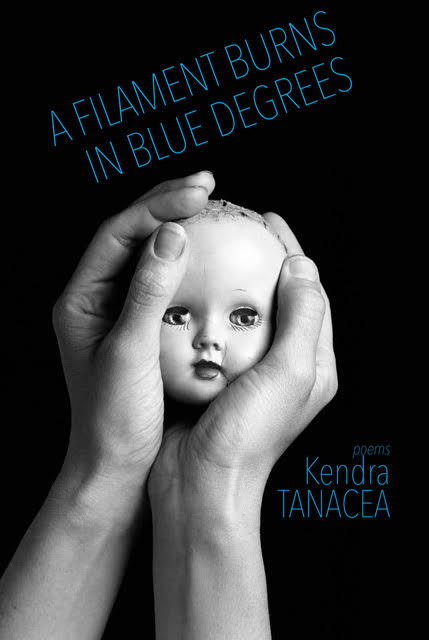
Book Review: Kendra Tanacea’s “A Filament Burns in Blue Degrees”


BY: Catherine M. Darby

A Filament Burns in Blue Degrees by Kendra Tanacea is a haunting first collection of poems released this year by Lost Horse Press. Tanacea is a master of the moment—not straight-on moments, but rather, ones full of visuals and emotions that transport the reader into Tanacea’s world. In this world, the reader becomes a lover, beloved, betrayed, friend, child, and want-to-be-mother, all while ruminating about life and the fullness it can offer.

Her poems intelligently meander on corners of braided rugs and peep through keyholes to see what life is beyond that usual existence of life, her words intoning the mysteries and science of the universe.

In “Keyhole,” the narrator looks through the keyhole of a locked door, straining to see “what is out of sight.” The words deliver full sensory experiences of an ever-widening life:

There is the scent of man, of woman, of cedar.
The eye shifts, straining in its socket.
French doors open onto a veranda
overlooking an ivy-walled garden.
The round moon is rising, giant and yellow.
Star jasmine, star jasmine!
An eye can see far beyond
its scope: solar systems, galaxies,
the Milky Way’s skid of stars.
All atoms, revolving around one another.

Read more

Book Review: Alice Anderson’s “Some Bright Morning I’ll Fly Away”

By: Kaia Gallagher

In Some Bright Morning I’ll Fly Away, Alice Anderson proves she is a survivor no matter what life throws at her. Her memoir recounts a decade-long battle to protect her three children from a vengeful, violence-prone ex-husband. The courts provide little help, encouraging family reunification rather than assuring the safety of an abused spouse.

Anderson is no stranger to hardship. Early in her writing career, she recounted her determination to overcome her father’s sexual abuse in an award-winning book of poetry. Human Nature is a harrowing description of a young girl’s fight for a future despite a childhood filled with incest and violence. It won the 1994 Elmer Holmes Bobst Award for Emerging Writers.

Despite her early success as a poet and international fashion model, Anderson is haunted by her past: “Something about [being a model] made me feel used up, consumed, like I was the little girl my father gobbled up all over again, his sexual abuse consuming in a drunken, hungry rage all the best parts of me until I was nothing, but a pretty, performing doll.” She becomes ripe for a relationship with Liam, her ex-husband whom she sees as someone trying equally hard to escape his family demons. Her spiral down into acquiescence is gradual, with an ever-tightening noose that threatens to erase not only Anderson’s very identity but also her life.

Read more

Rubber On Wheels


by jim kelly

Side by side at a stoplight, engines revving, roaring. “Teach them a lesson?” Fat Leonard shouts. My big brother, riding shotgun, nods. Turning, he hollers for me to “hold on.” Fourteen, drunk, I have nothing to hold on to. Below me, cement, the floor having long since rusted out, fallen away. For safety’s sake my feet rest on a single, hopping-around piece of jammed-in two-by-four. Junker with a crap paint job, a scrounged joke of a thing with a monster engine dropped in. Engine with more power than this stripped down, rattly ass car was ever meant to handle. Beside us a shiny new, daddy-bought, big engine Buick. Front seat and back, it’s full up with shouting guys. Pointing at us, laughing, calling names.

It’s summer 1964 and the muscle car is king, faster the better. Late nights in a shut down Shell station. The one Fat Leonard runs. His call when to quit pumping gas, close down, then open up for his friends to work on cars. Allowed, if I keep shut, I watch, all eyes, all ears, as my brother and his buddies turn junkyard finds into hotrods. Dross into dreams. A tiny, greasy front radio with a single, broke-tip antennae plays and quits, plays and quits. Somebody shakes it. Somebody punches it. Off and on rock and roll, at no set intervals, all night long. Ragged bits and howling, truncated pieces. Blue air thick, molten at the top of the tire racks from all those cigarettes, one after another. Drained, stomped flat beer cans kicked out of the way, piling up.

Read more