
A grocery store forty-five minutes west of Chicago seemed as good a spot as any to find a talent scout. I’d heard of kids getting discovered at shopping malls or even in the street, so why not me, and why not here? Even talent scouts had to shop for food. Any one of these people inspecting the bananas in the produce section or rushing their children past aisles of sugary cereals could be one. People got discovered all the time, and I felt that it was my turn. It was a wonder I’d made it all the way to six years old without being discovered.
Behind me, the produce section transformed into a stage, the broccoli into backing singers. The cold fluorescent overhead lighting became a warm spotlight on me. I vaulted into whatever Disney song had my attention at the time—most likely “Part of Your World” from The Little Mermaid or Belle’s opening number from Beauty and the Beast—did some pas de bourrees to give the words more life, and waited for the applause.
Next to me, my mother checked her list, the paper’s edge ragged from the notebook she’d torn it from. She signaled for me to keep walking. The stage dissolved. I searched the faces of my audience, but saw no eyebrows raised in awe, no smiles that conveyed how lovely my singing certainly was.
I closed my mouth and quickened my pace to keep up with my mom. I was not discovered that day, nor at the next store. But I was convinced I would be soon.

Church was where I first understood the power of song. The choir’s rich harmonies would flood from the balcony down to the pews, past the stained-glass windows on the sanctuary edges, to the table at the front where communion would be served, and where the words, “This do in remembrance of me,” were carved into white stone. The contemporary music team, from the raised stage-like area at the front, would fill the space with soft electric guitar, gentle drums, piano, bass, and their beautiful voices. The sound would vibrate through my feet and chest, making me feel warm, hopeful, connected, whole. We’d sing “Make a Joyful Noise to the Lord,” and I wouldn’t understand what other kind of noise a person could make when we were there, in that space, wrapped in song.
Since birth, I’d been known as a shy child—something the adults and other children in my life reminded me of regularly. While there was perhaps some truth to that assessment, it also began to feel like a cage others placed around me. When I observed the church music leaders—some of whom were professional musicians—they appeared serene, set apart, free, communicating something average speech couldn’t. It was a sort of magic I could almost, almost touch. I longed to be cloaked in a gift like that—one I could share with others and that I thought would help me finally be seen.
Elementary school passed without any talent agents spotting me—not even at Kohl’s or JCPenney. But I threw myself into dance classes, asked for piano and flute lessons, and joined church and school choirs. And in eighth grade, I set my sights on something I was certain would bring me glory: the middle school musical.
On audition day, I sat in an uncomfortable folding chair, waiting my turn. When a pretty, thin, popular girl sang a pitch-perfect rendition of “The Sun Will Come Out Tomorrow,” I shrank in my seat. I grew more conscious of how my stomach stuck out over my jeans, how my frizzy hair refused to be tamed into the pin-straight styles of the late ’90s. I had the glasses and braces of a classic nerd. No boys liked me. I spent Friday nights watching movies with my parents or reading books alone in my room. The girl onstage thanked the director, flashing a metal-free smile. She probably spent her Friday nights with friends at sleepovers, giggling, sharing beauty tips.
If I got a good part in this musical, maybe that could change things for me. Maybe I would get invited to her sleepovers.
Finally, the organizers called my name. As I stepped onstage, an invisible hand slammed into my chest, squeezing its fingers into my throat. When I opened my mouth to sing, the sound was not the rounded, pure sound I heard when I sang in the shower, in my room, or in grocery stores. It was as if a tiny, overzealous gremlin was holding onto my mid-section with both hands, shaking me back and forth, laughing its mocking, mirthful laugh. It didn’t have the decency to grant me even thirty seconds of stardom before stealing the spotlight.
I had to fight. I squeezed my stomach against the monster’s force, willed it to skedaddle. But it was no use. My pitch went sharp, then wavered, and never recovered. Every moment on the stage felt like torture. By the time I stopped singing, I was trembling all over. I conceded my defeat, avoided eye contact with the director, and hurried off stage, where I belonged.
I grew up in a quiet house. If music was played at all, it would be Vivaldi or Beethoven for a special occasion dinner, or Bing Crosby or Amy Grant at Christmas. Occasionally, the sounds of the Rolling Stones or Lynyrd Skynyrd would waft up from the basement while my dad lifted weights. Sometimes, my brother would play his Three Doors Down and Creed CDs for me. As far as music at home was concerned, that was it.
In my early teen years, Wednesday evenings would be spent in a dark church basement, where an enthusiastic youth group band, led by an even more enthusiastic youth pastor, guided us through teachings, songs, and activities. Guitars, drums, and voices reverberated off the walls and floor, amplifying the intensity I felt when I sang about mercy, goodness, and salvation. My whole body would swell with warmth, my chest pulsing with something I couldn’t quite name, but I had to believe was God.
These were the years of big, belty pop voices: Christina Aguilera, Whitney Houston, Celine Dion, Mariah Carey. I tried to hear my own voice in ’90s and early 2000s Top 40 radio, but I only heard power in those voices, not the softness of my own.
I didn’t even hear the elements of my voice in my peers who got the leads in musicals and the solos in choir. Maybe I was only ever meant to blend in, letting the edges of my voice be smoothed over by others. It felt safer to let others lead; to follow the ones who knew better, who seemed like they didn’t have stage-hogging performance anxiety gremlins visiting them every time they tried to sing a solo.
My sophomore year, one of my friends told me she’d started taking voice lessons. This friend had an angel’s voice and always got the solos. She had plans to pursue music in college. She was well-liked and charismatic. Maybe if I took lessons from her teacher, I could also have the voice of an angel and start to get solos. Maybe I could change into someone my peers looked up to and welcomed into their fold.
That spring, I nervously approached a white house with a brown roof, framed by tall trees with wide branches, like a cottage in an enchanted forest. Inside, I stepped into a world of richly saturated handwoven rugs, bright bohemian pillows, decorative lamps, and an embrace of colors and textures like nothing I’d ever seen. This was not the typical Pottery Barn aesthetic of middle-class suburbia. At the center of the living room was a black baby grand piano. Finally, my gaze settled on my teacher, a smiling woman with puffy brown hair, kind eyes, and bright lipstick.
“It’s nice to meet you, Stephanie. I’m Vicki,” she said.
I smiled and took her invitation to sit. To my surprise, she didn’t have us jump right into the music. She asked me about my experience with singing, what I wanted out of voice lessons, what I liked about music, what kind of music I wanted to sing. I didn’t know how to answer most of these questions, especially the last one. I was afraid of not seeming knowledgeable or saying the wrong thing. So I said, “Whatever you want to teach.”
When we moved to the warm-up, her low, operatic voice filled the room with warmth. I followed her lead, and as we climbed the scale, some small piece of my anxiety released.
I showed up at her house after school every Tuesday for the next two and a half years. When she asked, “How was your day?” I wasn’t sure how to respond. But she would wait patiently, her eyes bright, genuinely curious.
Whenever I mentioned a day was hard or that I felt lonely or anxious, she never glossed over those sentiments or told me how I should or shouldn’t feel. “Whatever we’re feeling, whatever we bring with us from our day, we hold in our bodies. It impacts our singing, whether we want it to or not,” she said.
I’d never heard an adult—or anyone—say that. My parents didn’t make me feel bad for having and expressing emotions. But I often felt like my thoughts, feelings, and experiences were bigger than the “minute to pout” I believed I was allowed. I’d grown up hearing from pastors and other leaders I trusted that focusing on myself was selfish. That my body (my “flesh”), which was governed by emotion, was always trying to lead me astray. And that to fully express anger, disappointment, or any “negative” emotion would result in broken relationships and isolation. I’d internalized the idea that to be emotional was to be out of control.
But in that soft, colorful, musical home, Vicki saw the parts of me I had convinced myself had no right to dwell in my body, and welcomed them. When I would criticize myself for going sharp or flat, she’d stop me and say, “I’d like you to imagine yourself as a small child. How would you speak to that child?”
We worked on scales, matching pitch, and sight singing. I sang show tunes, jazz standards, and Italian arias. And she taught me to be gentle with myself.
One Sunday, when I was seventeen or eighteen, I stood next to my mother in church. After the final chord from the final hymn was released, we turned to put the hymn books back in the pews, and I caught my mother’s eye. “You know, your voice has gotten a lot better,” she said. “Before, you were just OK. But now you’re actually pretty good!”
She meant it as a compliment, but I thought back to my grocery store performances, my auditions and recitals. I imagined a trap door opening up right there in the pews and I wanted nothing more than to jump into whatever pit lay beneath it, let it close over me, and hide for the rest of time. Maybe my childhood antics had, in fact, sent any potential talent agents running in the opposite direction. Maybe my six-year-old self, so confident, so proud, had been wrong, and I’d been wrong about my self-perceived talents my whole life. I wouldn’t be the first one to overestimate their singing abilities, as American Idol had taught me. Maybe my own opinion, my barometer of “good,” couldn’t be trusted.
After high school graduation, I moved 1,000 miles south to Fort Worth, Texas, for college. I joined a church with a vibrant college student ministry. This was a more conservative version of Christianity than what I had grown up with. But the church’s music helped ground me in the familiar and connected me to a new community.
One day, one of my friends from the college ministry asked if I would fill in on the college music team on Sunday. “We’re down a singer. You have a nice voice and I know you like music,” he said.
My heart stopped. He had no idea of the significance of his request. I felt like I was wandering down the grocery store aisles, and praise be to sweet baby Jesus, a talent scout had plucked me from the tomatoes.
This was my long-awaited chance to break free of the stereotype of the “shy girl.” I imagined stepping on stage with a full gospel choir behind me, swaying, clapping, and an audience—I mean, congregation—feeling closer to God, all because of me.
That Sunday, I stepped up to the microphone in front of the small room where the college students gathered after the main service. I did my best to hit my cues, match pitch, carry the melodies I knew well and had sung dozens of times. I’d been to enough church services to expect no applause, but my heart brimmed with gratitude when one of my friends told me I did a good job.
But the next Sunday, and every Sunday after that, a different young woman led the college band. My friend never told me why he never asked me back, but he didn’t have to. This other young woman’s mezzo tones and rich, full voice added depth to the melodies and harmonized with the other lead singer’s tenor in ways I could only dream of.
I pushed the visions of stage lights and spotlights out of my mind and dutifully returned to the place where my voice could disappear into the congregation. I felt ashamed of my desire to lead music. Maybe I was just being prideful. I’d been told that Christians were supposed to make a joyful noise and praise God with all our talents, but maybe that didn’t mean me.
After college, I would often tell people, “I have a good choir voice because it blends in well with others. There’s nothing unique or special about it.” I continued to sing in choirs as I was able, hiding among the other sopranos. At home, in the sanctity of the shower, I’d enjoy the feeling of my voice reverberating through my chest and off the tile walls. When I’d feel sad or anxious, I’d sing, and I’d feel a little better. I didn’t care if housemates heard me, but I never ventured to let anyone else hear.
One night in my mid-twenties, at a friend’s birthday party—after more drinks than I’d like to admit—karaoke suddenly seemed like a great idea. My inhibitions gone, I grabbed the microphone as “Hot and Cold” by Katy Perry blasted through the crowded basement bar. The room blurred slightly, but the voice coming through the speakers was clear and confident and…mine? After, a friend of a friend slurred her words and said, “Girl, you are a singer! A SING-ER!” I blushed and attributed the compliment to the alcohol.
A few years later, during choir rehearsal in grad school, with no prompting, a young woman sitting next to me in the soprano section said, “You have a really good voice. Like, really good.” I thanked her but didn’t know what to make of the compliment. Something still grabbed my throat in a chokehold when I’d attempt to sing sober outside of the confines of a choir, the shower, or anywhere strangers could potentially pick out my voice.
But she planted a new doubt about the doubt that already existed in me. I started recording audio and video of myself singing and kind of liked what I heard. But I still didn’t know who to believe. Was I delusional, or was there some grain of talent that could be cultivated? In church, I’d learned the self was prideful, arrogant, sinful, not to be trusted. Was I good or not? I needed someone else to tell me.
In my late twenties, I still went to church every week, gathering with hundreds of other congregants. Singing in church had become the only time I felt any emotional connection to God. I’d watch the music team at the front of the church, longing to be up there with them, wondering if leading worship could help fix some spiritual deficiency in me that seemed to be growing larger.
By twenty-nine, I knew I liked how my voice sounded in my self-tapes and in the pews. I’d also given a name to that gremlin who always stole the microphone from me: performance anxiety. I wondered if maybe I would feel less inadequate in a setting where my voice was meant to be part of a larger crowd anyway.
I showed up to the church music team audition with a ukulele I’d clumsily learned four songs on. I followed the music director into the big multi-purpose space in the back of the building to find an unoccupied piano. To my dismay, six or seven people were having some sort of meeting around a large table in that room. The last thing I wanted was a bigger audience. While I avoided eye contact, the music director asked if they wouldn’t mind if we used the piano on the other side of the space and sang a bit.
My throat fought against the familiar monster’s grip. After a short warm-up, the music director picked a familiar worship song and asked me to sing. The notes from my mouth came out shaky and off-key.
I asked if I could sing a different song. I pulled my ukulele—which now felt like a toy—out of its case and strummed the chords to “Have You Ever Seen the Rain?” I couldn’t focus on supporting the notes or letting them resonate. I could only focus on the clamp around my chest and throat, and how everything was going wrong, which only made everything go worse. We were both relieved when I stopped before the second verse.
He nodded. “I really appreciate you coming by today.” He paused, grimaced, then smiled, “Yeah, unfortunately, your voice just isn’t strong enough.”
I looked to the floor.
He fumbled for words. “I mean, you have a lovely voice, especially when you were singing that last song, but yeah…it’s just not what we need.”
I thanked him for his time and walked home, my face burning with shame. I felt foolish for even trying. Maybe my pride had indeed distorted my vision of myself.
My emotional connection to my faith continued to wane, but I believed I needed to stay faithful and obedient, as my pastors had taught me. And I hoped that by immersing myself in the church community, it would fix whatever seemed to be broken in me spiritually. So I found other ways to contribute over the next few years: leading small group Bible study sessions during the week, holding babies in the nursery so their parents could listen to the sermon in peace, and occasionally reading passages of scripture from the front of the church.
But toward the end of 2019, I was struggling to make it out of bed on Sunday mornings. Talking to people after the service felt cumbersome. Even singing from the pews felt joyless.
When the pandemic hit, the closure of the physical church building came as a relief. For a month or two, I joined the virtual services, but with the world at a standstill, the things my body had been trying to tell me came rushing out from behind the mental barriers I’d carefully constructed. I finally found the courage to excavate and explore the doubts and questions I had been suppressing for years, to face the fears associated with them.
At first, my break from church was meant to be temporary, but it became indefinite. The worship songs I’d once found comfort in became triggers for my anxiety. It no longer soothed me to sing songs about my brokenness without a God I wasn’t sure I believed in anymore.
I piled my piano keyboard with folded laundry and stacks of paper. I’d bought it for a brief stint playing piano on the church music team before they hired a music director. Even after my name disappeared from the schedule with no explanation, I held onto it. I thought if I practiced more, if I tried harder, then maybe I’d become good enough to make it back onto the schedule. Church had been my main reason for resuming a musical hobby. But without it, the instrument I’d once cherished became a reminder of my failures as a musician and a Christian, identities so intertwined that it was difficult to separate one from the other.
I found a local music school where I could donate the keyboard. The school owner carried it down the block, propped on one shoulder, the folded stand on the other.
A couple of years later, a friend started taking drum lessons at the age of thirty-nine. When she invited me to come see her first-ever performance, of course I said yes.
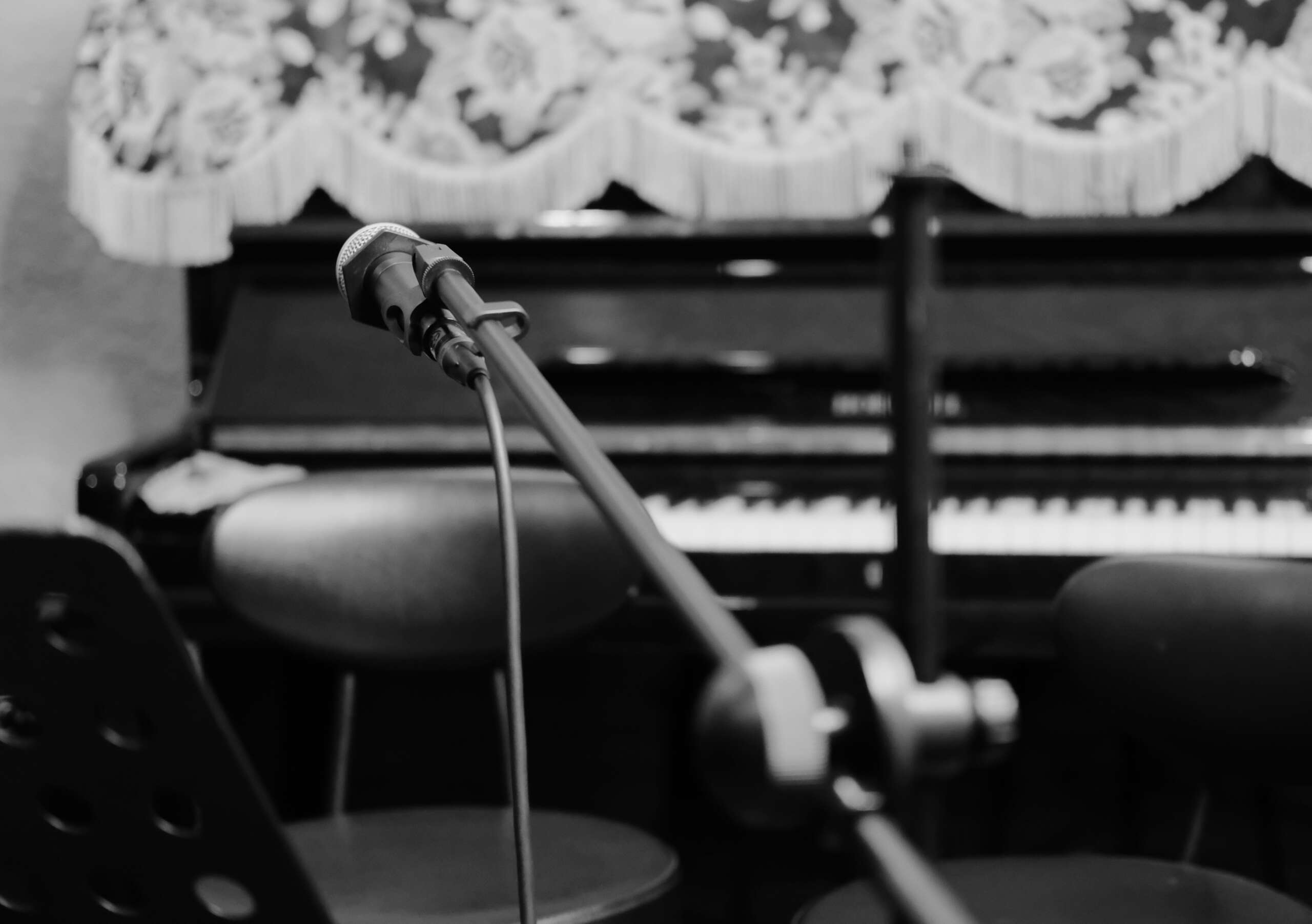
On the small stage at the front of the rowhouse-sized venue, multi-colored lights illuminated mics, amps, a full drum kit, and a keyboard. The room thrummed with anticipation as the bearded emcee quieted the chattering crowd. Then, students ages seven to sixty-seven took to the stage to perform everything from heavy metal to Frank Sinatra. They played drums, guitars, piano, and some sang. The crowd whooped and hollered like it was a real concert, cheering every performer on with genuine enthusiasm.
With a relaxed, tall posture, my friend jammed her way through The 1975’s “Chocolate.” She looked calm, confident; two things I could not relate to feeling on a musical stage. Even more disorienting: she looked like she was having fun.
Yet in that dark, crowded, student concert, while I cheered and whooped and hollered for my friend and marveled at her and all the other students, a longing stirred in me. One I thought I’d rightfully, if reluctantly, put to bed years ago.
I missed music. I missed singing.
Letting someone else—particularly a perfectionistic church music director with underdeveloped communication skills—define what I could and couldn’t do was no longer consistent with my values. He didn’t have to have power over me anymore. None of the old authority figures did. So maybe it was time to stop giving it to them.
I signed up for voice lessons the next week.
Like Vicki, Alice was kind, patient, encouraging, supportive. But this time, I knew what I wanted. I wanted to strengthen my voice, sing pop music, expand my range, and do more than just sing with my head voice. But most importantly, I wanted to learn how to sound like myself. At thirty-five, I figured it was about time.
With Alice’s guidance, I prepared for my own student concert, scheduled for December—less than three months after my first lesson. We worked on proper breath support. On finding resonance without forcing. On trusting myself to find the note, which—after decades of absorbing messages about how I couldn’t trust myself—still didn’t come easy.
I was afraid of sounding bad, afraid of what would happen when I opened my mouth in front of a room of strangers after working so hard to hide among them. Even in the privacy of one-on-one lessons, the little gremlin found a way to rattle me. I still needed someone else to tell me that my voice was enough—that I was enough.
December approached. I did my warm-ups and practiced my song—“Dreams” by Fleetwood Mac—enough to surely draw the ire of my condo building neighbors. My pitch accuracy improved, but at night, the performance-crashing gremlin haunted my dreams.
I mentioned my anxiety-induced sleeplessness in therapy. And with my therapist’s guidance, I invited a version of myself with braces and big hair into my mind’s eye. She was in the middle school cafeteria, alone at a long, dark table. Across the room, a cluster of her peers looked at her, then turned back to themselves, whispering, “She thinks she’s a singer! Why does she think she can do that? She’ll just embarrass herself!” Their laughs shot in a long arc over to the girl with the frizzy hair, who wrote on a piece of paper, trying to ignore them. But she wanted their love, their acceptance. I—the adult version of myself—approached her table and sat next to her. Together, we looked at the whispering, giggling teens on the other side of the room, and a question emerged: Would friends worth having treat people like this? “You don’t have to stay here if you don’t want to,” I said. I told her about a place where people loved, supported, and encouraged her. As we left the cafeteria, I thought I saw a priest in a white robe lurking in the shadows, but we didn’t turn back.
The next day, I reflected on my therapy session and remembered a story I’d once heard from a professional singer about how even Grammy-winning singers experience performance anxiety. So I set new goals for my performance: to recover well when I made mistakes, to see every note as a new opportunity, and—importantly—to have fun. Because wasn’t that the whole point?
Finally, in my mid-thirties, I was beginning to understand that perfection and external validation—whether in school or grocery stores or religious communities—are mirages that will always be just out of reach. Perhaps what mattered more was to be brave enough to share something we love with others. To learn to accept our voices—ourselves—for what they are instead of what we think they should be.
On the day of my first student concert at 7DrumCity, when Alice called me to the stage, my legs shook. Fear dug its nails into my stomach. Cold sweat pooled under my arms. But I found my cheering section of friends in the dark; people who would still love me even if I sounded terrible. And I remembered why—and for whom—I was doing this.
I stepped into the spotlight on the tiny stage, between the drum kit, amps, and keyboard. I grabbed the microphone with trembling hands and thanked the audience for attending my exposure therapy session. I nodded to the sound guy and adjusted my shimmering gold top. The backing track unfurled through the speakers. And for perhaps the first time during a musical performance, I experienced something a bit like joy.
 Stephanie E. Buck is a writer who has called many places home: Chicago, Fort Worth, London, D.C., and now Baltimore. She is an alumna of the Juniper Summer Writing Institute. Learn more at stephaniebuckwrites.com.