
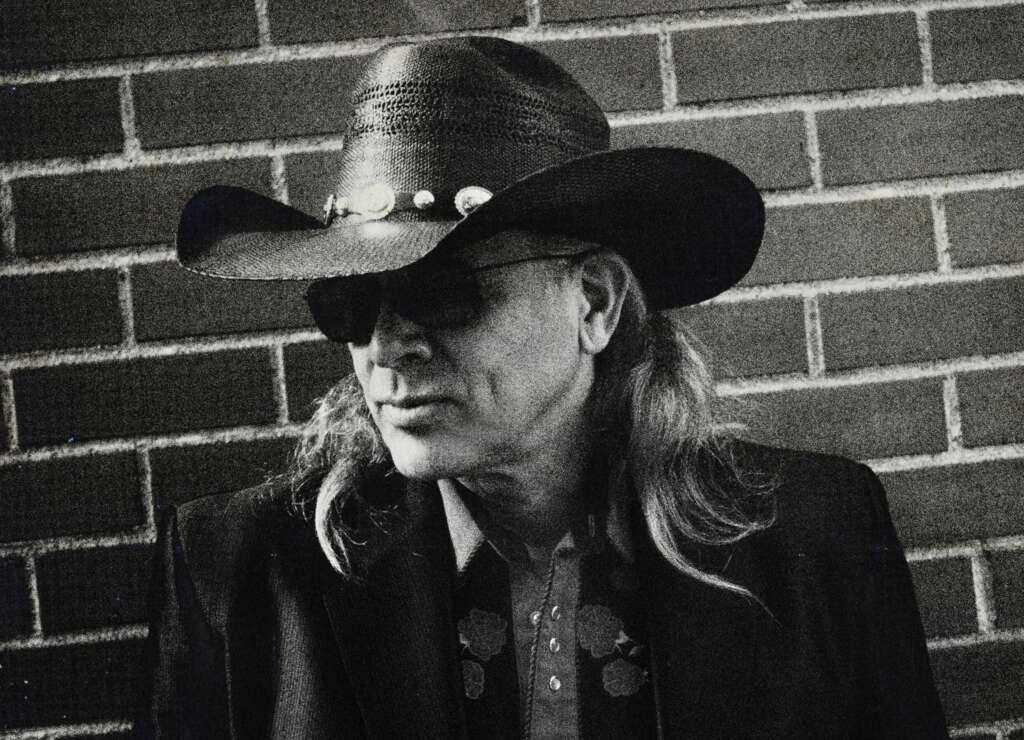
By Sophie Ann Hinkson
In this golden age of horror, Stephen Graham Jones stands out with a distinct voice and a talent for revealing hidden depths in a horror landscape I thought I knew very well. That’s what a great storyteller does: he shakes you, and makes you cry, shiver, and smile.
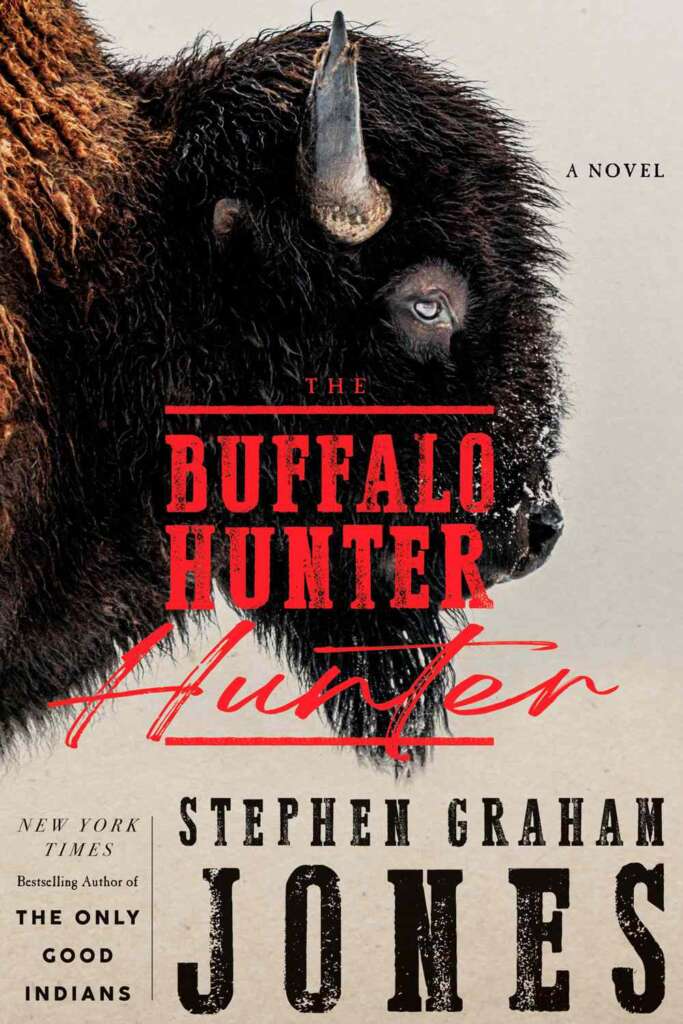
With The Buffalo Hunter Hunter, the Stoker Award-winning author of about thirty-five books tackles the vampire myth with a story inside a story inside a story. The novel opens and closes with Etsy, a communications and journalism professor, who reads the 1912 handwritten diary of her great-grandfather, Arthur Beaucarne, a Lutheran pastor who grows increasingly suspect as he hears a confession by Good Stab, an Indigenous man from the Blackfeet tribe, who wears dark spectacles and never eats or drinks. In this epic western, human beings are more cruel than vampires, and everybody has something to hide. The Buffalo Hunter Hunter contains many stories—human, animal, and monstrous—explored from different angles, set in the present and in the past, full of violence and tragedy.
The Coachella Review: How did it all start? In your afterword, you mentioned being immersed in a writing seminar about vampires, and suddenly opening a new Word document on a plane and starting to write… It seems like you knew it would be a vampire story, but did you have a certain period in mind? Did you know it would be in Montana, for example?
Stephen Graham Jones: I think I did have a sense of it being in Montana. I didn’t know it’d be in 1912. I stabbed that down randomly on the plane, and then I did research, and I decided, Let’s just leave it 1912 and let everything fall into place around that. I don’t really plan things when I write. I just kind of luck into them and make them work. And it makes it feel fun for me anyway.
TCR: How did it connect with your hero, Good Stab? Because everything had to ultimately connect with his story. When he talks to the pastor in 1912, he has been a vampire for a few decades, and he has seen his people being massacred by white settlers. So many things happened to him. How did you decide on this year specifically? Did you have an idea of what would happen before and after?
SGJ: All I really had was an image, or maybe a scene of an old-timey pastor or a preacher or a priest. This person was giving a sermon on a Sunday, and his congregation flies out, and there’s one dude in the back wearing sunglasses, and that’s a vampire. He’s got a robe on too, and I knew he was Indian. I didn’t know he was Blackfeet. I didn’t know his name, and that’s really all I had. I didn’t know anything about the preacher, or the pastor, as it turned out, and I didn’t know the town. I didn’t know anything whatsoever. And I didn’t know Etsy was going to be there either. She totally surprised me.
TCR: She surprised you?
SGJ: When I sat down to write that scene of an old-timey pastor giving a sermon on a Sunday, instead of writing it, Etsy just started talking. So, I let her talk, and it turned out that she was transcribing that pastor’s journal. Then Good Stab showed up. So, I guess the one thing I knew about the novel was that it was going to be a continual back and forth, and that this was going to be on a series of Sundays.
TCR: Right, so, Good Stab shows up. He’s an Indigenous man, and he turns out to be a vampire. Your story is deeply rooted in Blackfeet culture and their history. We’re immersed in it, and everything is clear—well-condensed, if I may say so. What guided you to select what to talk about? Why the Blackfeet perspective? Did you do a lot of research?
SGJ: So, the Blackfeet specifically, because I am Blackfeet. I always default to Blackfeet. When I say I didn’t know the Indian guy at the back of the chapel was, I knew he was Indian, but I should have known he was Blackfeet, because all my characters end up being Blackfeet. As for research, I’ve been reading Westerns since forever, so I’ve got that all in my head, all the dustiness and horses and wagons and mining towns. But, yeah, there was a lot of research that I had to do, but I didn’t want to do it, because I despise research. So, I called up three friends. One of them knows the language really well. One of them had a whole lot of clippings from back in that time period. And another had written a book, Beneath the Backbone of the World, about the Blackfeet history. So, I just called them on and asked them to give me stuff instead of doing research myself, because research is not fun.
TCR: But you talk about so many things! And everything we learn about history and the culture ultimately connects with your characters and what happens to them. Did you have a sort of plan? Like selecting specific episodes that would work out well with your story?
SGJ: I’m aware that I need to get certain things on the page to make the story work. But I’m also very aware of not spoon-feeding the reader. To me, to make the story conform for easier palatability by a largely non-native audience, I think that does violence to the work. So, I guess I’m kind of saying: if you want to engage the story, you got to learn some of these words.
TCR: What about having three very different characters, with three distinct voices? Plus, two of them lived in 1912, so I’m sure you thought about the vocabulary, the tone… How did you manage to do that?
SGJ: It was mostly about mindset. Because once you have the mindset of the three different characters down, then their voices are going to be different. Good Stab was pre-scientific and non-industrial, so he doesn’t need to know that a bowling ball and a feather fall at the same weight and that it doesn’t impact his world. He also doesn’t distinguish between what we, in the Western tradition, call natural and supernatural. That’s all one continuum to him. Once I was able to click my mind over to think like him, then, his voice came naturally. Same with Arthur: He was educated at what would become Yale, probably in the 1860s, and then he was isolated in the West, so his education and vocabulary decayed. He is hesitant or nervous about that, so he tries to cover it up with fanciness, and it ends up with this, like encrusted diction, which was really fun. He was the easiest of all of them to write. Etsy was pretty easy to write. However, she’s a cat owner, and I don’t know anything about cats.
TCR: So, I have something to tell you about Arthur. I truly hated him all along, and his racist remarks were a lot to digest… Problem was, I had to keep listening to his voice, because I wanted to know what happened to the characters! The hard thing to realize was that he was a human being, not the devil, not a monster. It shocks me that he was the easiest to write… I would have thought that you had to resist throwing him in terrible situations just to watch him suffer.
SGJ: I think he is suffering the whole time. He’s dealing with what he’s got inside him. What I love to do in everything I write is to complicate people’s reactions to different characters. Good Stab, putatively, is the good guy in the story, but he does some bad, bad things. We can’t really support or endorse everything he does. Arthur is a bumbling, sweet-toothed old man. Some people might fall for him, but he’s got bad parts to him, for sure. Etsy tries to whitewash herself, but she’s not totally good either. I always resist characters that are all good or all bad.
TCR: Good Stab is indeed the good guy—even if he’s a vampire—but to me, he’s also good trouble. Look at what he says: “What I am is the Indian who can’t die. I’m the worst dream America ever had.” Later on, speaking about the American flag that he qualifies as “a blanket for all Americans to hide under,” he says, “It flies above every camp of dead Indians. I will always pull them down. You put your reminders of pain on the wall and pray to them. We still hurt, so we don’t need that reminder.” So, is Good Stab good trouble? Is his vengeance good trouble?
SGJ: He’s seeking what he considers justice, but he’s inflicting that justice upon descendants. Or he’s not. He’s terrorizing Etsy, even if he’s not doing violence towards her. With Arthur, what is fair for what he did? Is it to be turned into a monster for a century? Who can say? It’s almost like when your rage is spent, that’s justice. I do think Good Stab is good trouble. American history is a horror story. America’s biggest power, their best superpower, is forgetting or pretending something didn’t happen. Good Stab, by dint of being a vampire and having this long, long life is a constant reminder that you did things.
TCR: Do you think horror is a good medium to bring good trouble? I’m struggling to answer this question myself. A number of creative people say art should be political. Some think the opposite. Are you aware, when writing, that you’re passing on a message, or are you first and foremost being you and simply telling your story?
SGJ: I think it’s the second way. What I’m really trying to do with my stories is just entertain. I want people to want to turn the page. So, I come up with things that I think will keep them turning the page and horrify them, make them laugh, make them cry, make them feel things. That’s my main goal. But because I am a single individual writing it, I have a single set of resentments and bitterness and a political stance. If I can hold on to that and not let it get watered down, then hopefully the book or the story can get to the shelf with some sharp edges intact and maybe cut some people’s hands.
TCR: I was struck by the omnipresence of animals in your story. They’re like quiet witnesses. They’re here when the Cat Man, a centuries-old vampire, is released on soldiers, they’re watching when Good Stab feeds on someone for the first time. It seems like they accentuate the tragedy; in fact, they reminded me of the chorus in Hellenic dramas. They follow the characters and see everything! Why are they so present in your story? What’s their role?
SGJ: I wasn’t thinking about observers, but I like that. Good Stab’s world is a world where he’s always aware of all the animals in his surroundings; therefore, he mentions them. Arthur Beaucarne out in the wilderness, is not going to mention them. He’s going to think he’s alone, but he’s not. You’re never really alone. And Good Stab just comes from a way of life where he is keenly tuned into all that. And also with his vampiric senses, he’s really, really tuned into it.
TCR: You use specific terminology to refer to animals. For example, a “real-bear” is a grizzly bear, the “dirty-faces” are the mice, a “swift-runner” is a hare, a “big mouth” is a wolf, etc. Was a glossary a possibility? Did you think of having one, or your publisher, maybe?
SGJ: No, I think putting the glossary on would be a fail. It’d be like, Here’s a key to Indigenous culture. I want to make it unpalatable to all of you out there. That’d be the wrong move to make. People could come up with their own, of course, which is great. I take a lot of notes myself while I read stuff, so hopefully people do that themselves. But it would be really weird for the book to provide it to me.
TCR: Favorite vampire movie, and why?
SGJ: Near Dark.
TCR: Yes, of course! But the end…
SGJ: I mean, they get a little bit easy at the end, but I like getting there a whole lot. I like the setting, and I just like the vampires. I like how the vampire is stripped down. They don’t have to worry about being invited into a place, they don’t have to worry about flying, turning mist, charming people, any of that stuff. They have flat teeth, even. They have to cut people to get the blood. And that’s the vampire I prefer, which is why my vampire is largely stripped down.
TCR: What about your favorite vampire book?
SGJ: The Lesser Dead, by Christopher Buehlman. I mentioned it in the acknowledgements. I think that’s an amazing, amazing novel. It does an escalation in the last, like, ten percent or maybe eight percent that blows me away. I’m not sure how he pulled something that magical off, but it’s really, really well done.
TCR: In The Buffalo Hunter Hunter, you stay close to the canon. You follow the vampiric codes. For example, Good Stab can’t stay in the sun. He can’t eat or drink; he can only have blood. But you also added some variations on the myth! There’s a “you are what you eat” dimension, where vampires become what they feed on, animals, or human beings. Good Stab grows horns after drinking too much deer blood, and when he feeds on white people, he is horrified to find himself developing their physical features! What a nightmare!
SGJ: I like to put my characters in binds that they can’t solve. I think that’s productive. Good Stab’s bind is that he identifies being Blackfeet with his skin, his hair, his eye color, with not having a beard. If he feeds on too many trappers and buffalo hunters, he’ll start to exhibit physical characteristics, which he thinks makes him not Blackfeet. So, in order to remain Blackfeet, he has to feed on his own people, whom he wants to protect. And yeah, that was really fun. Also, he can’t stop once he latches on. He has to drink until it’s gone, and he’ll even drink to the point of bursting his side open. I did that because I think vampires often get off too easily, like they go to a club and they take a drink from six people, and they get a meal that way. That seems like they’re not having to deal with the impact of being a predator and the consequences of being a predator. And I really wanted Good Stab or my vampires to feel that—to feel that they aren’t just parasites. They’re killers.
TCR: We talked about all the good stuff. Let’s finish on books! An image from The Buffalo Hunter Hunter haunts me. When they find Arthur Beaucarne’s diary at the very beginning of the novel, it is physically being devoured by time. The ink became an acid eating the journal, and it has to stay enclosed in a case to be protected from temperature and humidity. I see a metaphor in that. That connects to a certain fear of seeing literature and arts disappearing. So, Stephen, what will be left of literature? Can you help me finish this interview on a positive note?
SGJ: I think stories will always persist, and I don’t know what form they’re going to take. For us to maintain our personal identities, we have to create stories about ourselves, about who we are. And to do that, we need training, and we train ourselves with stories. We use stories as cautionary tales. We use stories to pass down cultural information. We use stories in so many ways in the world that I don’t think we’re in any danger of stories going away. I’m not sure if we’ll call it literature later. I’m not really afraid of the book going away, I guess because the story will find a different home if it needs to. Maybe it’ll be video games. Maybe there’ll be some apparatus we’ll stick to our head. I don’t know, but I think story will persist.
 Sophie Ann Hinkson spent much of her life in France, where she worked as a bookseller and literary journalist for both magazines and radio. Now based in Chicago, she teaches French and ESL at various colleges and is currently pursuing a Low-Residency MFA in Creative Writing at UC Riverside. Her stories will appear in the upcoming fall issues of Midwest Weird and Shadow Dog Press. At home, she shares her life with her husband, a black cat, and six pet rats.