
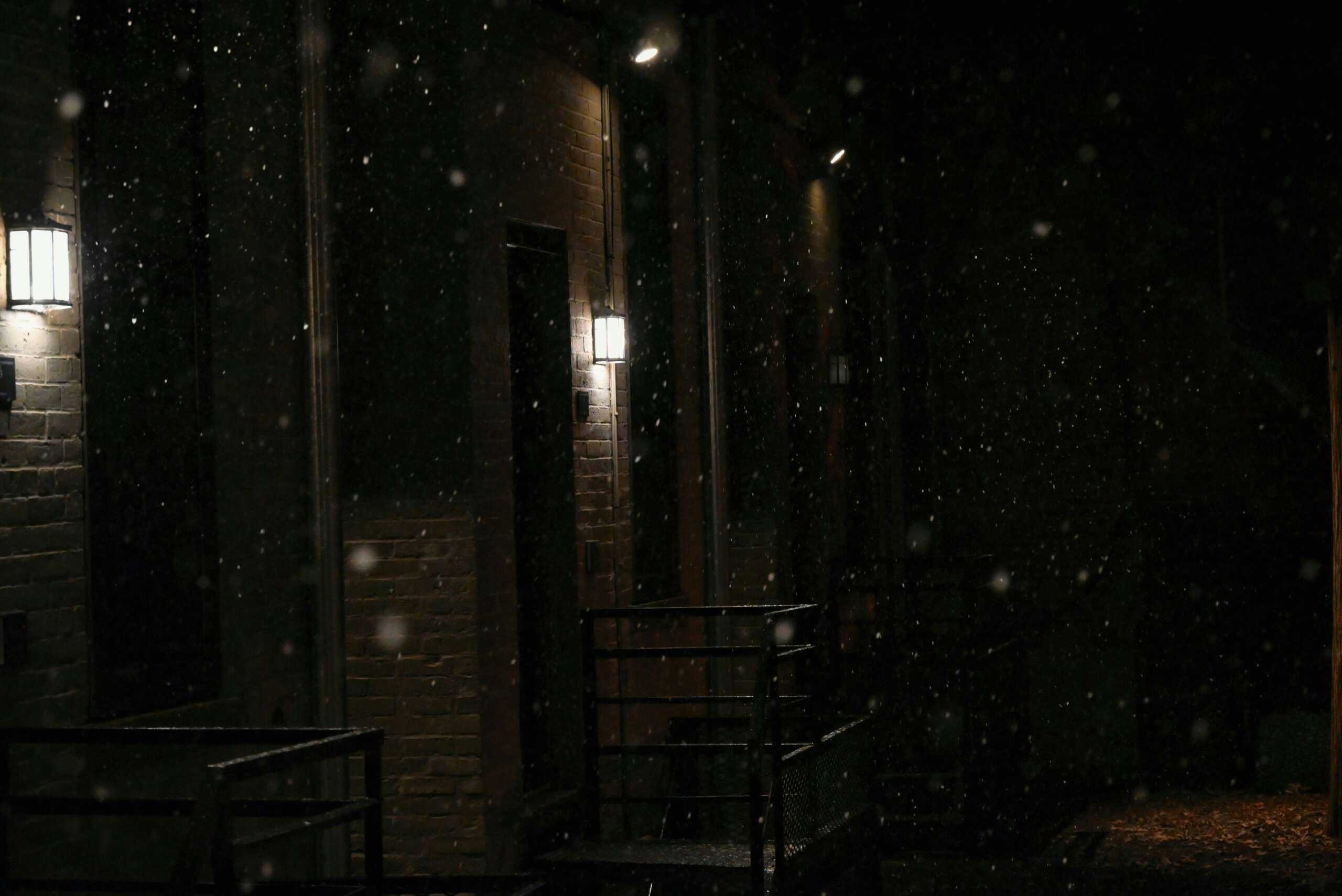
It was Christmas Day at the prison. Several inches of snow had fallen during the night, and the temperature was a biting twenty degrees below zero. I helped McKenzie, our youngest, zip her pink parka and snuggle the fake fur hood around her beautiful face. Katie, fourteen, and Beau, eleven, were all suited up before McKenzie finished wrestling with her mittens. Lou, now inmate #52760-080, would be waiting for us outside the rear door of the visitor center in a few minutes.
Yesterday, after celebrating an early Christmas at home in Dallas, the kids and I flew to Omaha, rented a car, and drove three hours north to South Dakota. Pulling into the small town of Yankton was like driving into a picture postcard.
Merry Christmas and Happy New Year banners hung on every light post on Main Street. Alternating red and green lights outlined the municipal buildings on the town square. A twelve-foot-tall, inflatable Santa Claus stood next to the life-sized nativity scene on the snow-covered lawn in front of City Hall. With three wise men and all manner of barnyard animals, Mary and Joseph stood staring raptly into the wooden manger—a spotlight shining down on the baby Jesus.
I turned into the town’s residential neighborhood onto a wide street lined with large Douglas firs—their branches topped with fresh snow like dollops of icing on cupcakes. Every house, large or small, had a decorated Christmas tree perfectly framed by a living room window—the scene backlit by a warm, yellow glow. I imagined the families gathered in the dining rooms, ogling the impressive Butterball turkey in the center of the table, raising their glasses for a festive toast. Their children happy and tired after a long day of building snowmen, sledding with cousins, and playing with their new toys.
On my left, the houses continued for several blocks. But on my right, the houses stopped at the intersection of Douglas Avenue and East 10th Street, where the landscape opened up to the twenty-five-acre campus that, for over one hundred years, had been Yankton College.
The grounds were immaculate—trees perfectly pruned and sidewalks cleared of snow. The Conservatory, erected in 1882, stood proudly on the highest part of the campus. Built in the Romanesque style, it was three stories tall with two distinct towers—one for the college bell and one for the clock.
Next to the main entrance was a grand stone monument. Two small spotlights illuminated a brass plaque with burnished, raised letters.
FEDERAL PRISON CAMP
YANKTON, SOUTH DAKOTA
When Yankton College closed its doors in 1985, the Federal Bureau of Prisons managed to snag some of Yankton’s best real estate, and they retained the collegial character of the place.
No sentries or tall guard posts. No bars or concertina wire. Warm and welcoming, the campus was lovely. Even now, a cornerstone of the neighborhood.
My husband, Lou, had been here for fifteen months—almost half of his three-year sentence for a white-collar crime. I knew from my calls with him that at this early evening hour inmates were having dinner in the cafeteria, spotting each other lifting weights in the gym, or calling home to family who didn’t make it for the holiday. Others were settling into their dorm rooms for the night—remembering better times, wondering how they ended up here on this wintry Christmas Eve.
Before we checked into the Comfort Inn, we had stopped at The Frying Pan—our favorite restaurant in town. The kids loved the six-foot-tall glass case at the front door with its rotating display of homemade pies and cakes. I loved that in typical Midwestern fashion, the waitresses approached every table with a glass carafe of black coffee. “Coffee, hon?” was the standard greeting no matter what time of day or night. I appreciated the coupons the diner gave to inmate families, allowing children to eat free. With full bellies and tired from the long day, we checked into the motel and called it a night.
On Christmas morning, it took an unusually long time to get to the front of the line and through security, but the routine was familiar—the armed guards, the metal detectors, the inmate counts, the vending machines. As we walked into the crowded visiting room, I held Beau’s hand and Katie held McKenzie’s. Every table was occupied, every seat taken.
The room was filled with love and resentment and anger and yearning and gratitude. Mothers telling their boys that it’ll be all right. Wives in Christmas sweaters, trying to camouflage the fact that they would rather be anywhere but here. Fussy children with snotty noses and raspy winter coughs. Sisters, brothers, a few friends from the old hometown. Some families just happy to be together.
The voices in the room dropped to a whisper as the familiar click and static of the intercom sounded. “Families who have been approved for the Christmas service, please proceed to the rear door.”
The closest guard pointed us in the proper direction. Bundled up and ready, we obediently joined the other families lining up by the double doors on the far side of the room.
The guard supervising our group told us that the inmates we were visiting would meet us as we exited the building. “Once outside, you must stay with the group and walk on the concrete pathway only,” the guard said. His voice robotic, his face listless. He was hardly present. I imagined he was thinking about going home later that night to have a slice of pumpkin pie or maybe an eggnog. “Any infraction of the rules will immediately terminate your visit for today.”
McKenzie was getting fidgety, and probably hot as bundled up as she was. I overheard Katie tell her to be patient as she patted her hood-covered head. Beau’s instinct was to try to inch himself closer to the front of the line, but I kept his hand in mine to hold him back. I was excited and a little nervous as I always was before coming to see Lou.
When the metal doors opened to the outside, a wave of frigid air rushed in—so fast and so cold, I gasped and felt a stab at the back of my throat.
And there was Lou.
At six-foot-four, head and shoulders above the other men, he was easy to spot. The navy blue knit cap I’d packed for him over a year ago was pulled down low—his graying hair, now longer than usual, sticking out around his ears. He made his way to us through the cluster of waiting men—frosty breath rising from their mouths like they were all smoking cigarettes. All inmates wore heavy, hip-length parkas designed for extreme weather. Some had their hoods up, drawstrings pulled tight to protect their ears. Their faces were framed just like McKenzie’s. Below the hem of the coats, there was a mixture of regulation khakis pants and blue jeans. It was inmate’s choice this weekend. All had on durable, waterproof boots. Lou wore his black sweatpants, almost certainly with long johns underneath. His complexion was ruddy from the cold, and his smile was so broad I could see the familiar space between his two front teeth. As he reached us, we enveloped him in the center of our family quintet. I closed my eyes, briefly, and for a moment, it felt like we were back home in Dallas.
“Follow me please,” the guard said. “Stay on the sidewalk.”
Our group of about thirty shuffled along with two additional guards at the rear. All ice had been cleared from the pathways, and a gritty layer of sand safeguarded against a fall. Marshmallow-like snow drifts rose on both sides of the sidewalk leaving the visitors center. I suspected this unpleasant, frigid job of sidewalk maintenance had been assigned to an unlucky inmate work crew.
As we made our way into the interior of the campus—the quad—we had a clear view of the outdoor visiting area where a few brave souls had gathered around the snow-covered benches and tables, enduring the cold. This was the only place on the entire campus that smoking was allowed. So, rain or shine, sleet or snow, even in zero degrees or colder, it was a popular spot.
The first time Lou and I went out there, I had a wonderful feeling of privacy. Even though our conversations never involved anything secret, the outside area seemed immune from the intrusion of the guards. My illusion of intimacy was shattered when Lou told me the guard station was equipped with long-range listening devices. Pointed in our direction, the guards could hear every word we said.
All around us, as we walked farther into the campus, the lawns were snow white and largely undisturbed—with one exception. A trail of large footprints leading to a sight that was unmistakable. An inmate had lain down on his back in the snow and moving arms and legs had made a huge snow angel. I loved imagining that whole thing taking place.
Ahead of us, three solitary figures were braving a walk on the icy, oval track—mouths covered with scarves to keep the frosty air from damaging their lungs. Inside the periphery of the track were two tennis courts. Used constantly in warmer weather, the courts were empty now—nets removed for the punishing winter. There was what looked like a horseshoe pit next to the tennis courts—only the tips of the iron stakes visible above the snow at each end of the pit. A few benches, now covered with snow, were scattered about. Nearby, two raucous male cardinals squabbled over something on the ground, their bright red color spectacular against the winter’s grays and whites.
Our group made its way toward the south end of campus—couples and families talking quietly—but only among themselves. Even the children sensed that best behavior was required. It felt odd to be on the inside rather than on the outside—so different from what I was used to.
A constant stream of inmates, chatting and laughing, strolled from the dorm to the mess hall, from the classroom building to the gym, from the visitors’ center and back to the dorm. Inmates politely scooted to the left to make way for our group as we passed on the right—an occasional wave or hello even. Almost like walking down any ordinary sidewalk in any ordinary town.
“That’s my favorite building over there, guys,” Lou whispered to me and the kids. We had all seen the now defunct Clarke Memorial Observatory from the street, but never from this vantage point. The round, painted brick building had a domed roof and was originally fitted with a seven-inch refractor-type telescope. It made me a little sad knowing how much Lou would have loved to go in and look up at the stars. On our family camping trips, he was our expert, pointing out constellations in the big Montana sky.
On the other side of the observatory, under the deep snow on the sloping hillock, was a dormant planting area. Lou’d been ecstatic last spring when he was assigned to the horticulture department. It meant he could spend his days outside. He’d always loved to grow things. Our garden at home was filled with radishes, lettuces, jalapeno peppers, asparagus, and zucchini. With the same enthusiasm he’d studied Texas Native Plants, he’d learned which flowers were hardiest for South Dakota. The inmate landscape crew was given free rein to design, plant, and tend this 15×30 landscape centerpiece. Lou was so proud of the riotously colorful, ornate lattice pattern he designed. The other team members were willing workers, but Lou was the artist.
When I visited by myself last June, Lou’d made sure I took pictures of his handiwork from outside the prison grounds. The hillside looked like a fluffy quilt—the border and crosspieces of pure white phlox. Like individual pieces of fabric—sections of dime-sized yellow marigolds, triangles of purple aster, and multi-colored moss roses hugged the ground. This display was visible from the grand houses across Douglas Avenue.
Surrounding the campus, the four-foot tall, ornamental wrought iron fence was the only thing between the inmates and the citizens of Yankton. In warmer months, men in exercise clothes jogged the perimeter. Young mothers with babies in strollers or their kids on roller skates were a common sight.
Farther along the path, there were several newer buildings—unfortunately not in keeping with the original architectural style. Two four-story, uninteresting, perfectly rectangular dormitories housed most of the approximately 800 inmates. It was easy to imagine energetic college kids living in these sturdy quarters, pelting each other with snowballs as they walked from the dorm to the library, to their classes, to their study groups. Falling in love, enjoying their independence, heading for their rosy futures. There was another, older, way more charming housing unit on the other end of the property. Lou was pleased to be in the newer, less attractive, surrounds as the heat was better and more reliable.
Our destination was just ahead—Forbes Hall of Science. Three-stories with a red brick exterior, Forbes had a classical beauty and symmetry—rows of large windows along the entire façade. Two white, ornamental cupolas adorned the roof, one at each end.
The main access to the building had been sealed off for repairs—an X of yellow caution tape across the double doors. As we approached the stone staircase at the side entrance, the lead guard motioned for us to stop. We all stood obediently and watched as he leaned over and picked up a red, plastic pail sitting in the snow by the bottom step.
“Be careful,” he said. “These steps can be pretty slippery.” With his gloved hand, he reached into the pail, took a handful of rock salt mixed with sand, and flung the mixture—like throwing feed for the winter birds. “Moms and Dads, please hold on to your little ones.”
We walked gingerly up the steps and entered the cavernous interior. Polished marble floors, high ceilings with elaborate plaster moldings, sturdy wooden doors on both sides of the wide corridor—each with an old-fashioned glass transom window resting horizontally on top.
Male voices came from one of the open rooms. The conversation seemed good natured, peppered with chuckling and the recognizable sound of cards being shuffled.
“That’s where we play bridge,” Lou said, leaning into me and whispering. “Remember I told you about the guy from Omaha who is a Grand Master player? I love playing with him. It’s the only way to really get better at bridge, playing with somebody better than you are.”
Of course I remembered, but I also tried not to think about it too much. It kind of pissed me off hearing about his bridge game while I was juggling so much at home—three kids, carpools, work, laundry, soccer practice, piano lessons. My days were pretty damn full.
Most of the doors on the first floor were closed as there were no classes on holidays.
“This is what we call the library,” Lou said as he pointed at an open door on the left. There were seven or eight guys sitting around in comfortable looking, overstuffed chairs. It looked so fraternal—mostly young men, slouching lazily with their books, legs draped over the chair arms. “It’s not much of a library and sometimes when we have to request a book from Sioux Falls or Omaha, it can take weeks to get here.”
Again, it was a little irritating and hard to be sympathetic. But not as irritating as last spring when Lou kept pestering me about why it was taking so long for me to get him his tennis racket.
Most of the time, there was no question about it. I wouldn’t trade places with Lou for anything. Being separated from my children was one of the worst things I could imagine. But there were certainly moments when I wondered who was being punished? Which was harder—serving a sentence or holding down the fort? Some days, playing cards and hitting a tennis ball sounded pretty good.
The wide staircase to the second floor had a polished wooden banister, and each marble riser was worn down in the center from all the coeds, all the faculty, all the visitors on parents’ weekend, and all the felons. The second floor was a repetition of the first—a wide, long hall with doors on both sides. The first door on the right was slightly ajar. The men inside were discussing which TV channel was going to occupy the next hour—an episode of Matlock, a popular telenovela, or a Christmas variety show. The room next door buzzed with activity—art supplies everywhere. Easels, rolls of butcher paper, trays of colored pencils and acrylic paints. Even a potter’s wheel. Very little talking as the men focused on their projects.
At the end of the long hall, light from an open door washed the floor in a warm, welcoming glow. A small table to the left of the doorway had name tags, a black Sharpie, and a little basket for the back side of the stick-on tags.
“We need name tags for everyone. Padre wants to know who all is attending the service today. Men, put your inmate number to the right of your name,” the guard said. In single file, we all crouched down, wrote our names, and attached our tags before entering the makeshift chapel.
The room was brilliant with light. This corner classroom had windows from the wainscotting almost all the way to the high ceiling, so even though the day was overcast, light flooded the room. Metal folding chairs had been placed in rows to accommodate the crowd—six rows, each with ten chairs. We settled into seats toward the front and listened to the metal chairs scraping the floor as the audience made allowances for longer legs or wider bottoms. An old, scarred upright piano with sheet music on its rack stood up against the back wall. A small artificial Christmas tree, decorated with strings of popcorn and ropes of fresh cranberries, stood in the corner of the room where the windowed walls came together.
At the front of the room, placed in the center, was a rectangular folding table draped with a white tablecloth. A colorful, homemade-looking embroidered runner ran the length of the improvised altar. On one end of the table was a portable cassette player, and on the other, a grouping of three white candles. The focal point was the well-used Bible in the center.
McKenzie and Katie surveyed the room—talking to each other in soft voices. Beau sat next to his dad, Lou’s arm draped over Beau’s shoulder. It hurt to remember how every night, for almost a year after Lou left, Beau cried himself to sleep as I tucked him into bed. His grief was somehow different from the girls’—and even from mine. I wondered what it was like for a son to be without his father, especially as the only male left in the house. I had been so careful not to say anything to make Beau feel that he had to be the man of the house or any of that nonsense. But I think he felt that empty space in the family calling him just the same.
Once the families were settled, inmates with no visitors who wanted to come to the service were ushered in until all the chairs were filled.
“That’s Jerry. The guy with the reddish blond hair,” Lou said. “He’s one of my roommates.” Lou waved him over—which surprisingly was allowed—and introduced him to all of us.
Jerry was average height, really skinny, and neatly dressed in the prison regulation uniform—khaki slacks, khaki shirt, and black leather belt. I vaguely remembered Lou’d told me that Jerry had the misfortune of getting caught growing marijuana in his basement—lots of marijuana. He bowed over to meet the kids at their heights. As Jerry shook my hand, he leaned in a bit. “Lou talks about you all the time, bragging about how well you’re handling all this. My old lady left me after I was sentenced, before I even got here,” Jerry said with a shrug. “That’s usually the way it goes. Me and the other two guys in our room call you Saint Susie, just so you know.”
“Everybody, take your seats please,” Padre Tom said.
I had mixed feelings about being Saint Susie. I knew things they didn’t. Like how many times I’d lost my patience when Lou grilled me about some business decision I made. How sometimes I didn’t want to pick up the phone when it rang at night because I just didn’t have the energy to talk to Lou. How furious I was when someone gave one of the kids a hard time at school. I was no saint. But I was proud that our whole family was on the same team—everyone moving in the same direction toward the same desired outcome.
“Thanks everyone for making the trip to Yankton on this very special day,” Padre said. “I know how much your being here means to these men.” There was no church attire per se—no black alb, no starched white collar, no enormous cross hanging at chest level. Padre wore khaki slacks and a maroon, long-sleeved polo shirt with a modest silver cross barely visible at his neck.
Sitting on Lou’s right, I took a few deep breaths and remembered sitting on the hard pews of the Episcopal churches in my youth. This was a far cry from the pageantry I loved—the smell of the incense, the majestic swells of the pipe organ, the passing of the collection plate. But the feeling of congregation, and what that really means, was poignant.
After a few introductory remarks, Padre reached over, pushed a button on the cassette player, and “All Things Bright and Beautiful” started playing. The voices were tinny sounding and the volume a bit too low, but still the moment was gripping. The room was totally silent—everyone leaning forward, craning to hear the beautiful music. And I felt lost in space—lightheaded, almost floating. How did I end up here on Christmas Day? I wanted to close my eyes and will us back to our own home with our own Christmas tree and our own Christmas dinner.
But as I turned to our children, I saw that McKenzie had gotten up in Katie’s lap, and Beau was holding his dad’s hand. Like a miracle, they were all smiling and rosy cheeked and happy. We were all together—still a family. I glanced behind me at the other people going through the same thing we were. Wives with the same perplexed look. Some children clinging to their dads and others with arms crossed, unable to forgive. Different ethnicities, different ages, and more than likely, different religions. And yet, here we all were. All caught up in the system one way or another, trying to come out the other side. And I knew some families would make it and some wouldn’t.
The service was filled with hopeful messages of salvation, forgiveness, and redemption. The familiar hymns, accompanied by the lackluster tape recorder, brought back more memories of my own childhood Christmases—my mom singing with the worst voice but definitely the most enthusiasm. My dad, playing “Let It Snow” on the piano in the living room. My brother, Peter, sitting next to me in his striped pajamas while we took turns opening our gifts.
“We have a special treat for you before we end our service,” Padre Tom said. Practically beaming, he pointed to the classroom door with a great flourish. “Ladies and gentlemen, may I present The Yankton Ringers!”
All heads turned as eight inmates, dressed in regulation khakis, filed into the chapel. It seemed clear to me that these guys had been in prison for a long time. Their uniforms were a little worn looking—collars frayed and belts less shiny than when they were newly issued. But they walked with confidence, like they were familiar with everything around them and with each other, too. They were mostly large men with straggly, greasy hair of various lengths, pulled back into ponytails or braids. Some had beards that had taken decades to grow. Some moustaches fell like waterfalls on both sides of the chin. The array of tattoos was breathtaking—on arms, necks, earlobes, everywhere. Snakes, skulls, roses, names, vines, animals, marijuana leaves in beautiful, vibrant colors. All the men were top heavy with muscles—working out being the most common pastime for inmates.
Lou nudged me with his elbow and pointed up at the windows. Large, fluffy snowflakes were beginning to fall as the men lined up, like schoolboys, at the front of the room. I hadn’t noticed before that each inmate was carrying two metal rods, one in each hand—each rod about ten inches long and maybe an inch wide. Looking closer, I realized these were hand chimes—each with an external clapping mechanism and a letter written on its side indicating its corresponding musical note. Functionally similar, but a far cry from charming brass, classically shaped handbells.
To a hushed audience, and with perfect aplomb, the inmates played a rendition of “Silent Night.” Each mellow note resonated clearly until its chime was lifted to the chest where the pressure stopped its echo. The audience was stunned by the performance. Everyone was perfectly still. Even the smallest children. The only sound was the chimes. The faces of the ringers were so earnest—so focused and determined to do well. I couldn’t help wondering if their parents or wives were sitting next to me—proud or sad, or both.
Snow falling, our family reunited for Christmas, the sincere devotion of the prison chaplain, and “Silent Night.” It was a lot. Thinking of the time we had left to endure without Lou, the birthdays he’d miss, all the soccer games, Katie learning to drive a car, I started crying. Our sweet son, Beau, reached in front of his dad, took my hand and gave me three distinct squeezes—our family’s secret code for “I love you.”
Lou looked down into my blubbering face and chuckled. I couldn’t believe it. Had I completely lost my mind or had my husband lost his? Humorous was the last adjective I could possibly attach to this scenario.
“What in the world are you laughing about?” I said.
Lou cocked his head, took my other hand and said, “C’mon Suz, I mean, just think about it. It’s Christmas. We’re in a prison in South Dakota, listening to eight of the baddest drug dealers and motorcycle gang enforcers in the United States playing ‘Silent Night’ on aluminum hand chimes. How can you not think this is funny?”
He had a point. The whole thing was bizarre. The contrast with our life in Dallas was so stark. Like a parallel life with an alternate cast of characters. Or a dream with familiar people in it but doing things that were clearly abnormal.
“You’re right, Lou,” I said. And I started laughing. And then, the kids were laughing too. “You’re so right.”
The snow fell faster—huge flakes flying past the windows. The warmth from the noisy radiators blanketed this gathering of humanity from the cold outside. The scent of candles coupled with familiar songs and memories of other places. The devotion of a prison chaplain called to serve these men. There was certainly something humorous about this particular Christmas service. But there was also something divine. The spirit of Christmas—even here in this prison in South Dakota.
 Susan Reese is 75 years old, mother of three, grandmother of nine, a voracious reader, and an avid catch-and-release angler. Her husband, Lou (now deceased) was incarcerated in federal prison from 1992-1995. During that time, Lou wrote poetry and reflections on his experience on the “inside.” At the same time, Susan wrote about her experience as wife and mother on the “outside.” It is her hope to one day compile Lou’s best work and her best work into a book-length manuscript that will marry the two perspectives.