

Interviewed by Jessica Ribera
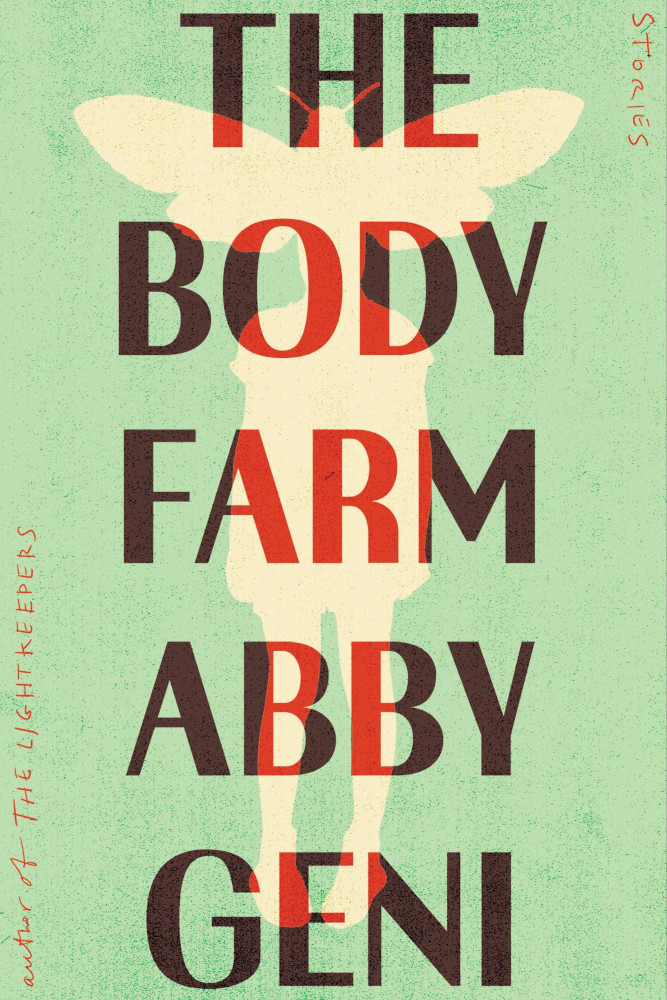
This month marks the paperback release of Abby Geni’s second short story collection, The Body Farm. In the collection, Geni has created a laboratory for studying humanity’s relationship to the risks and weaknesses—but also incredible powers—of our bodies. The characters grapple with common yet serious challenges, from physical and mental illness to abuses and lost love. Each story’s richly described environmental landscape acts as a backdrop against which the characters’ relationships with themselves and others to unfold, like the underwater world of Eloise, a shark tagger, in “Rapture.” Similarly in “Porcupines in Trees,” a woman recovers from a suicide attempt on a forest retreat where she discovers an interest and affinity for porcupines. And in the titular “The Body Farm,” an entomologist studies the decay of corpses to solve crimes and considers how she might use that power to help her own family.
The Coachella Review spoke with Geni to learn more about her interest in writing happy endings, her thoughts on front stories versus backstories, and what it means to be monogamous in writing.
The Coachella Review: The Body Farm came out a year ago, but your paperback has just come out this month. Tell me what it feels like to have the paperback out there.
AG: It’s always exciting when a book comes out in paperback. Hardcovers are beautiful, but people prefer paperback. It’s lighter; it’s smaller. It feels like [the paperback] is for everyone, and it’s always fun to see your book published again.
TCR: Since it has been out, can you tell us about any responses that you’ve been particularly delighted or surprised by?
AG: I actually just had a really wonderful letter from a woman who read “A Spell for Disappearing,” which is the story of a woman who is in a situation where she basically needs to flee everything about her entire life. And this woman wrote to me and told me her story, which was basically that story. It was really wonderful, and she said—to my delight—that I hit all the beats right, but that she never expected to read a story like her own.
TCR: Oh, that’s beautiful.
AG: Those are my favorite kind of letters, when the story has touched someone very personally, very specifically…the title story itself, “The Body Farm”—people have very strong opinions on whether the story is a happy one, whether the ending is a happy one. I personally think the ending is a very happy one, and I like people who agree with that. People write and are like, “Yeah! I support this.”
TCR: I’m glad you said “happy ending,” because in these stories, I appreciate your willingness to write a happy or at least hopeful ending. And yet your books don’t come off Pollyannaish—there’s still a balance. Is it important to you to write a happy or hopeful ending? How do you hit that balance, so that it’s not too cheerful? Or is that a thing? Maybe that’s not a thing.
AG: No, it is! Thank Jesus. That is exactly what I hope for. It’s that particular kind of ending where it’s not so saccharine that it doesn’t feel real, but it’s also not like you’ve had your heart ripped out and you have to go to the hospital. I think, for me, books should have happy endings—if not for the characters, then for the reader, because life is hard enough. I think… we find solace in stories; there’s beauty in stories; we see ourselves in stories. My favorite books tend to be the ones where I walked away feeling… better, even if it wasn’t for the characters what I would call a happy ending.
TCR: You mentioned “A Spell for Disappearing,” and I think my favorite line is from that story, when the character says her grandmother taught her, “Men were afraid of women with knowledge and that women should seek knowledge in all its forms.” I’m curious what knowledge you find yourself seeking right now, and how do you stay curious to build all these deep, niche worlds that you travel in your writing?
AG: Interesting. First of all, I find it difficult to read in the same genre that I’m writing in, so if I’m busy writing a novel, I have a lot of trouble reading literary fiction novels. But of course, I’m absorbed by reading, and so I just love learning about everything: about anthropology, about biology, sociology. I’m constantly absorbing different ways of thinking about the world, different facets of the world that we live in. And I draw so much inspiration from that. The more that I discover worlds through the books—real worlds insomuch as we understand them, not worlds someone has created, but the study of human evolution, or how butterflies metamorphose. I find those are the doorways that lead me into the world of the stories.
TCR: Talking about anthropology, are storytellers like the scientists on the Body Farm? Are we engaging in anthropological research when we write? You have the main character saying that she’s participating in finding a solution for what she sees wrong in the world.
AG: Yes, I think it’s both things. I think it’s diagnostic to a certain extent. We look at the world and try to say, “This is what I see there.” But stories are also the only thing we have that can change the world. Facts don’t change people’s minds—this has been studied and proven—but stories do. And I think we want to show the world as it [is]; we want to represent what we see. And, again, that’s part of the reason I want my endings to be happy or hopeful to a certain extent. Stories do affect the world; they have this ripple effect. They percolate outward, seeing the world and also changing it a little bit.
TCR: That’s the great combo! So, some of your stories—most of your stories—could be considered “issues related.” We’ve got addiction, partner abuse, suicidal depression, on and on. Again, you do this beautiful job: they don’t come off like afterschool specials or a helpful family pamphlet.
AG: Ha!
TCR: Because they are stories! How do you be mindful to write stories in which characters are more than the issue they are confronted by or carry with them?
AG: Every story for me begins with the problem the character is facing and the passion that the character has. So, the woman who has experienced suicidal depression is fascinated by porcupines. And it was the combustion of those two things that made the story. Again, in the title story, it’s this woman who works with the dead and is dealing with this stalker who her wife has been running from for years, and so it was the interaction of those two things: the passion of the character and the problem that she’s dealing with. And that is how I locate who my characters are: by what they care about. And the more I learn about what they care about, the more I understand them. So I hope, at least, that stops them from feeling like the people in an afterschool special, here to represent a particular trait.
TCR: I very much felt that they did not come across that way, and yet I could come away from the story with an increased knowledge and sense of empathy for what that character had going on, which is—like you said—how you make a little change in the world. If you are getting to know your characters this way in your head, what’s it like for you to carry them around? How many stories do you carry in your head at a time?
AG: I’ve always been very monogamous in my writing. I would work on one story and that would be the one story I was working on. But during the pandemic, I sort of splintered in my head the furious angry book I was writing and the dreamy otherworldly book I was writing. And I had the stories. I bounced based on where I was mentally, emotionally, surviving the pandemic. And the stories coalesced first, which is why The Body Farm was the first of those books that are still floating in my head that was published. I will say, I always have the book or the story that I’m working on now, which will be currently a disaster, usually. And then I have the image of the next book or story, which is going to be perfect. I’m going to be able to write it in just one beautiful draft. It’s sort of the shining light at the end of the tunnel of the current disaster of the messy draft that I’m working on. It’s part of what gets me through. First drafts are not my favorite thing, and to get through them I always have the image of the next story.
TCR: What are some of your tricks for getting through that first draft? Do you plow forward, or do you nitpick over things?
AG: I have learned—painfully, and over a great amount of time—that you have to just plow forward and leave wreckage in your wake. I remember when I was writing [the novel] The Lightkeepers that in an early draft, I wrote the most beautiful, perfect, polished, amazing first chapter that I spent so long perfecting; then, I got about a hundred pages into the book and realized that not only does it not start there, that’s not even going to be in the book at all. And I teach writing, and I actually talk to my students about the danger of looping, which is what I call it. You write twenty pages into the book, and you think, “Oh! I just learned something! That means I have to go back to the beginning and change it!” And you write thirty pages into the book, and you go, “Oh, I have to go back to the beginning and change it!” Then you write forty pages and have to change the beginning, and you keep looping through the first fifty pages of the book. You have to just leave the wreckage in your wake and keep going, or the book will never be.
TCR: That’s very helpful!
AG: I learned through a trial by fire!
TCR: In The Body Farm stories, there’s a landscape that’s the body and then the larger context, but then there’s kind of this third layer making sense of it all, or not: the mind. Your work plays a lot with the mind-body connection or disconnection. It made me curious as I read. I wondered what your own experience with mind-body connectedness is, and what do you do, if anything, to foster that?
AG: I have a lot of chronic—both physical and mental—things that I have dealt with for years, and I have spent a lot of time living in my body-mind, which is how I think of it—one word—and the way it interacts with itself, and the way the physical changes the mental and the mental changes the physical. And part of why I’m so interested in the question of the body and the mind, is just that I’ve spent so long in a system which is difficult and requires a lot of monitoring and noticing. You become really attuned to that stuff. But I do think writing is the lens through which I view the world and the lens through which I protect myself. Because when I’m writing about something, I don’t feel it in the way that I would if I were living it. So if I’m going through something difficult physically, and then I write about something difficult that someone is going through physically, I’m shielded from it in a way that I wouldn’t be if I were just looking at it. Writing is a protective layer, an analytical protective layer. You’re analyzing it, writing about it, trying to make it beautiful, and as a result your mind is kind of protecting your emotional self.
TCR: I want to touch on something I read on your blog on your website, about how backstory and front story spark against each other. What’s it like balancing front and back story in a novel versus a short story? Is there a difference in how you manage that?
AG: Yes. With a short story, it’s a matter of choosing exactly the right backstory because you don’t have enough time to put in many different memories. You have to find the one memory that serves as the microcosm for a huge portion of the character’s life or an aspect of their personality. You can’t do, like, fifteen flashbacks because the story will be bogged down. With a novel I think it’s more about maintaining momentum, because you have to bring the reader on such a long journey, and if you do too much flashback the momentum of the novel will slow to the point that it stops. And the reader will be sort of wandering around in the past. And the past is inherently static. No matter how interesting it was at the time, it’s over, so nothing is changing there. So I tend to, when I’m building a novel, have the architecture of the momentum and tension moving, and then I sort of hang… Okay, imagine a rope that is spanning through the air, and I hang backstory on it, and it dips the rope down a bit because it’s heavy. Then the rope comes back up and continues [to] tense, and I hang another thing on there, and it dips a little bit. I’m always watching for how much tension is there—how much backstory can it hold before the reader no longer feels that upward tension, if that makes any sense.
TCR: It does make sense! And it goes into my follow-up which is, What are the ways you know? “Oh, this isn’t backstory. This is a different story.”
AG: I think, first of all, the front story should be more interesting than the backstory. Unless the front story is just there as sort of a bookend or a clothesline on which to mostly hang the story, which is something else. But typically, the front story is the most interesting thing. So if I’m writing, and I discover a flashback which is so interesting and maybe so much more interesting than the front story, then either I’ve started the story at the wrong time and it should be taking place in the past, or that past is worth exploring on its own.
TCR: I love how you give and show characters moments of real triumph that convey a sense of glory. I’m thinking of Eloise in her swirl of blue sharks [in “Rapture”]. Can you share a moment you’ve had of that sense of triumph, or hope, of import, when you think, “This is it” that you can draw from?
AG: You know, on the one hand, there’s the finishing or publication of a book that feels like you’re standing on a mountaintop screaming joyfully. There are also moments I’ve experienced in nature, which are wordless but potent. And I don’t know that I could even write about them because they sort of take you back down to your animal self, being in the natural world. And that feeling is something that sort of lives with me, but I couldn’t necessarily write about the moment because it is inherently animalistic, which is wordless.
I guess, the birth of my child… not even necessarily the birth! But the twenty-week ultrasound when you see an actual baby in there. And I remember thinking, Oh! My body did that all by itself. I was just here thinking about stuff while my body was making a human, which is not something I necessarily know how to do in any way, shape, or form! So there are times, I guess, emotionally when it happens, times analytically when it happens. And that was one of those times when I was like, Oh, my body has its own agenda and its own life, which is kind of separate from me even though I’m here with it. To create a human was something my body knew how to do, and I did not.
TCR: That’s right on theme for the story collection! Are you working on anything right now? What’s on deck?
AG: I finished working on the angry book. It’s currently in its final stages of agent-editing finishedness. And I’m now working on the dreamy, otherworldly book. So, the things that began during the pandemic are finally coming to fruition, and I am once again monogamous. I worked only on the angry book until I reached the end of it, and now I’m working only on the otherworldly, dreamy book. So, I’m back to myself!
 Jessica Ribera writes and lives in Seattle with her four kids, best-friend husband, dog, ants, fish, and one crazy chicken. Her first book, The Almost Dancer, was published by White Blackbird Books. Her stories for The Moth are available wherever you get podcasts. She’s studying fiction and nonfiction in the University of California Riverside Palm Desert Low-Residency MFA program.