
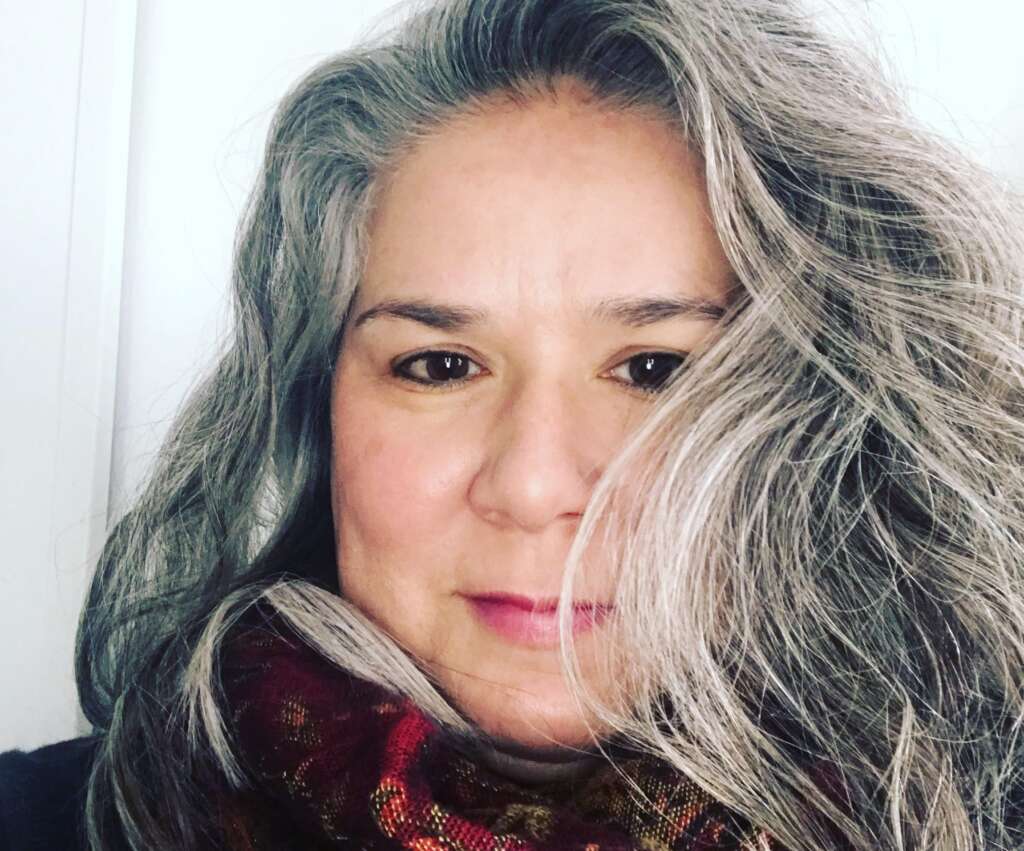
By Shannon Glass
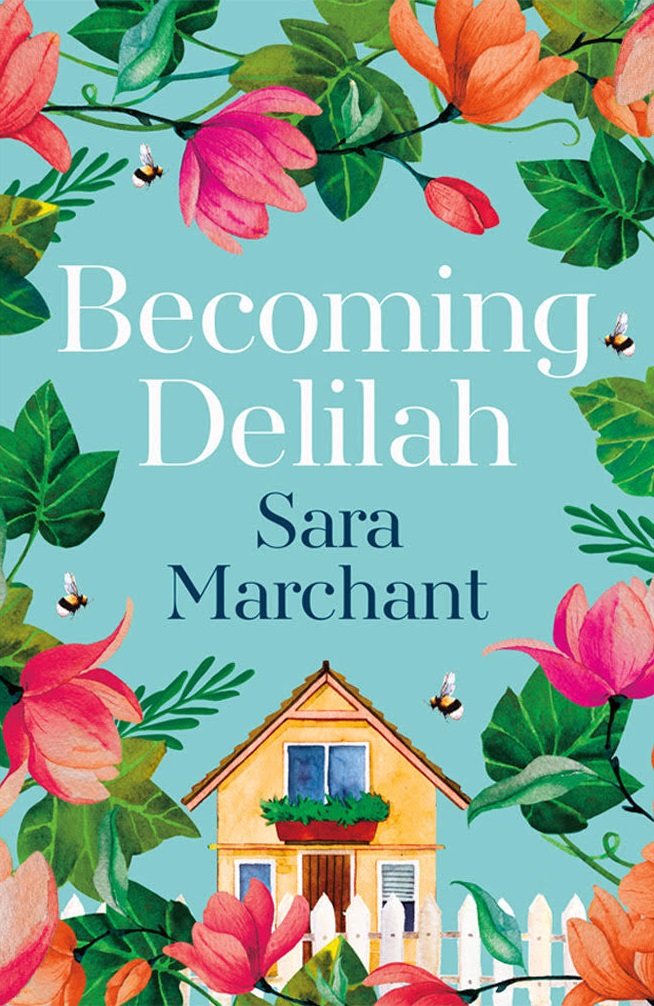
Fans of Sara Marchant’s work will find the setting and characters of her first novel, Becoming Delilah, familiar. The Coachella Review recently spoke with Marchant about how she expanded her previous novella, The Driveway Has Two Sides, to create the new book. The story follows Delilah Ortiz as she moves to a village on an island off Cape Cod, where she must navigate her new neighbors’ reactions to her vibrant garden and her married lover. It’s a delightful journey to selfhood for Delilah, filled with equally moving depictions of plants and people. During our chat, we also discussed her envy-inducing ability to write both fiction and nonfiction, as well as her editorial work with the literary collective Writers Resist.
The Coachella Review: What does your garden look like? It’s clear from reading this book that you love plants, at least from your great descriptions.
Sara Marchant: My garden is a mess. It’s utterly destroyed right now because we have chickens that freely wander the entire property. We have two dogs, two horses, and we have a pig, who is a nightmare.
TCR: For the garden?
SM: Yeah. Well, she’s a nightmare anyway. She’s loud, she’s obnoxious, she wants constant attention. She’s like a really bad boyfriend. Anything I plant pretty much gets destroyed overnight. So right now, it’s not good. Plus, it’s really hot here. We do two hours of watering every day and it’s not enough.
TCR: Was it fun to plot out a fictional garden in a climate that is different from where you live?
SM: It was so nice, actually, because it’s really frustrating where I am trying to garden. I grew up having gardens, and my whole family is really into gardening. Then I moved to the high desert [in Southern California], and it’s just one thing after another destroying everything. This was a weird little fantasy that I could do what I wanted to in Delilah’s garden and not have to worry about a pig digging it all up in the night.
TCR: That’s wonderful! Did you have experience living on an island to draw from for that garden?
SM: No. My husband watches Jaws like every other month. I probably shouldn’t tell anyone this, but my entirety of research for island living was from watching Jaws.
TCR: I love that. I am going to guess that, with the difficulties gardening where you are, that gardening didn’t really influence your writing process.
SM: Not really. I take a walk every morning and that’s when I prepare my mind, think about what I did the day before and what is coming next. That, to me, is really freeing somehow. If your body is in movement, your mind can wander; it’s either take a walk or wash the dishes.
TCR: One of those is definitely more fun. This novel is based is on your novella, The Driveway Has Two Sides. Were you drawn to expand on that story, or is Becoming Delilah something quite different?
SM: No, it’s a whole weird backstory. Before the pandemic, Fairlight Books, who published The Driveway Has Two Sides, came to me and said that Tin House had expressed interest. Fairlight is a UK company, and Tin House wanted to acquire the US rights to The Driveway Has Two Sides, but they said it was too short. Well, it’s a novella, of course; it’s not a novel. And then Fairlight asked if I was interested in turning it into a novel. At the time I said no, because I was teaching and I was deep in another book already. Plus, with family life going on, my mind had moved on from The Driveway Has Two Sides.
And then the pandemic happened. I was suddenly at home, and after the first few months, my job disappeared, and I finished the novel I’d been writing. So, I thought I could probably turn The Driveway into a novel. A novella is just one story, just the A story; there’s no B story. I added her backstory by thinking, “How did Dolores become Delilah?” There are hints in The Driveway Has Two Sides, so I [expanded] upon that. I brought in a villain. Abuela became a major character, and that became the B story, how she became Delilah. And that’s not even my title. Fairlight said they hated my title, but in a very polite way, because they are British. We went back and forth for two months, and they didn’t like anything I was suggesting, so they said, “Here’s your title.” And I said, “Yeah, you’re right, that’s the title.”
TCR: It’s a great title. I don’t know what you suggested, but I like the title.
SM: Apparently what I suggested was crap. But theirs is great.
TCR: Besides the letter correlation between Dolores and Delilah, was there any other reason you chose Delilah for her alter ego?
SM: Aside from that stupid Tom Jones song that runs through my head all the time, I honestly can’t remember. It was so long ago. That’s the thing. Books take so long to come out now that at the launch for this book, people were asking questions, and I had to say, “I can’t remember, I’m so sorry.”
TCR: Was there a scene you enjoyed writing, or that you remember writing?
SM: The one I had the most difficulty with was the scene where she chose to become Delilah. I couldn’t even imagine that. That took me a long time. It was the last scene I wrote for the book; it wasn’t written in chronological order. How on earth does one do that, and what are the mechanics of doing that? But then for some reason, I kept getting the smell of a library, when I was thinking, “How do you give up your identity completely and assume another?” For some reason I kept smelling my childhood library, that really specific, weird, ink and leather and dust and air conditioning smell. So that’s how it came to me that she was going to have to do it in a library.
TCR: There was a strong theme around isolation and loneliness in this book. The setting is literally an island. What drew you to explore that theme?
SM: I don’t know, but it just made sense that if someone is running from something in their past and choosing to give up everything that made them who they are, that they are going to be very lonely. Because if you can’t share your past with someone—anyone—you are possibly the loneliest person in the world, I should think. And what’s lonelier that being on an island?
TCR: You graduated from the MFA program at UC Riverside Palm Desert. Was this something you worked on in the program?
SM: My thesis was a novel that is still in a drawer somewhere, and for my cross genre I wrote a memoir. The Driveway was the first book I published and then [the second was] my memoir, Proof of Loss, which [professor] Emily Rapp actually named. Apparently, I’m terrible with titles because other people are always naming my work for me. But I did write that in the program.
I don’t even know where the idea for The Driveway came from. It was a short story that just kept getting longer. I think I was just messing around with point of view, because, at first, I was interested in showing one event through multiple people’s eyes. And then, of course, it just evolved, and you can’t really even tell that anymore.
TCR: It takes on its own life.
SM: Exactly.
TCR: Between your memoir and the novella and novels you’ve written, do you find you have a preference for fiction or nonfiction? Do you have a hard time switching between the two?
SM: I don’t really have a hard time switching between the two. I think it’s different sides of my brain or something. Because I know my fiction doesn’t have much of me in it, which sounds weird. I know that I’ve also been told, by [MFA director] Tod Goldberg, that if I could do what I do with my memoir or my essays and do it in the fiction that I would be better off. And I don’t know how to do that, sorry.
TCR: Has working with other writers for the journal Writers Resist changed your view of the writing community? Have the submissions influenced your work in any way?
SM: I don’t know if it’s changed my views on the literary community. I know it’s really good for us to edit other people’s work and see what other people are writing. Fiction, and all writing, is about compassion and empathy. The more you read of other people’s lives, the more you realize your place in the world. And how you don’t really have one, unless you are compassionate towards others and their point of view, as well. Writers Resist was started at a really difficult time in everyone’s lives, and it was a real privilege to be able to see what was happening to everyone in all different walks of life at the time. It’s also kind of fraught, because everyone was so stressed out.
TCR: Did you find that it was helpful to get everyone through that time, not that we are through it really. But as a support system, almost?
SM: I don’t know about that. I do know a lot of people thanked us for providing an outlet. And I remember every time some horrible event would happen, the next day our inbox would be full of poems. Poets especially would freak out and regurgitate these poems that were like someone had ripped their heart out and put it on a page, and sent it to us.
We’d actually shut down when January 6 happened. And as we were watching everything unfold on that day, I got a text from K-B Gressitt, who really runs Writers Resist. She texted me and said we needed to open submissions again because the poets weren’t going to be able to handle it. And the next day, our inbox was full. She was right.
TCR: Will we see any more of Delilah in the future?
SM: I hope not. I’m bad. Once I’ve written something and sent it off, I feel like you’re raised, I’ve educated you, go live your life. I want to concentrate on the new one. There was a final chapter for Becoming Delilah that tied everything up and said what happened to everybody. They all got their happy or not-so-happy endings, depending on what I thought they deserved. Again, I got an email from the women at Fairlight, whom I love—I love all these women. They said, “We hate that final chapter. It’s not open enough, and we want some more ambivalence. That’s not the ending.” So we worked around that. It is a mysterious ending, or at least mysterious to me, because the ending that is published is different from my ending for the book. People can reach out to me if they want to know what happens to everybody.
TCR: That’s so interesting. In that process, was it difficult for you to change your ending completely?
SM: No. Maybe it’s being an editor myself, but when people say they don’t like this and we should do something different, I don’t take it personally. When someone is kind enough to read your work and want your work to be better, I think arguing with them or refusing is not even polite.
TCR: Do you have any new projects in the works?
SM: I am writing a novel that is similar to my essay “Haunted,” which is all about growing up in a haunted house. Maybe [because of the similarity] I will finally rise to the level that Tod Goldberg expects of his students. I am also writing a novel about a woman who becomes a sex worker because she can’t pay her student debt. Which is a lot more fun to write, actually. We’ll have to see which one has more of me in it.
TCR: You’re working on two new novels at once. Does that ever confuse you?
SM: No, I finish a section and put it aside to come back to later. It helps to have two different projects for that. I also think I have ADHD, because I am not happy unless I have multiple projects going at once. Just for those moments when you have to put something away and let it rest for a while. Then I can switch to the other one, and it works for me.
Another project I am working on is an essay about how, when I became too old to play with Barbies, that was when I started writing. The birth of me as a writer was because society said I was too old to play with Barbies. And everyone keeps rejecting this essay because of the Barbie movie.
TCR: Really? It seems like good timing.
SM: Maybe because it’s a little bit creepy.
Shannon Glass is an MFA candidate at the University of California Riverside Low Residency Program in fiction. She lives and writes in North Carolina.