
Edited by Cambria Matlow and Dave Oei
Though for many of us these times feel unprecedented, the need to make “good trouble” is timeless. The term, coined by civil rights icon and United States Representative John Lewis, points to taking necessary actions of resistance against systems of oppression in service to our shared humanity and collective liberation.
These works, ranging in genre from fantasy to YA fiction to historical nonfiction, show that good trouble can take countless shapes, often falling outside the norm of our surface-level perceptions. Here, we see tiny, intimate moments of individual decision-making but also the power of larger movements fighting against empires and ruling governments. Humor, fun and cultural celebration are contrasted with hard work and its attendant emotional costs. Themes of community, relationships and collaboration abound. Heroes look all kinds of ways. We meet, among many others, Native Lipan Apache modern-day high-schooler Grace, Charlie and Sidney, a biracial father-daughter duo questing in a post-white society, visionary 17th century mystic Sor María de Ágreda, and Arthur, a father-phoenix protecting his brood of magical children. The threads of good trouble are sewn between lessons and traditions from the past, implications for the present and possibilities for the future. Perhaps more than any other defining feature, the need for bold imagination and the space to dream infuse all of these works.
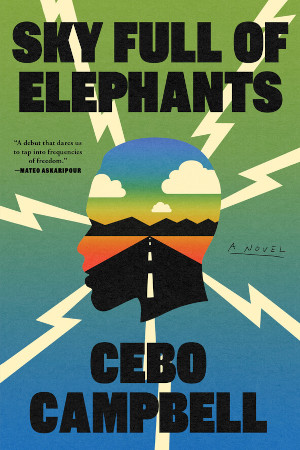
Sky Full of Elephants
By Cebo Campbell
Reviewed by Lisa Billington
In this deeply provocative novel, Campbell imagines a life for Black Americans without the overbearing influence of white society. A year after every white person walks into the nearest body of water and drowns, Charlie Brunton struggles with life after “the event.” A call from Sidney, the daughter he has never met, sends them on a journey south to find an aunt Sidney believes is her only surviving white relative. Raised in a white household as a biracial child, Sidney struggles both to define herself and to identify with the father she believes abandoned her. But the truth of his absence is more sinister.
Interwoven with this complex and nuanced father-daughter dynamic is an exploration of Black America under white oppression, the characters’ struggles with identity and generational trauma, and a thoughtful examination of potential challenges after the disappearance of a white-focused societal construct. Though many institutions collapse “as a result of [people of color] having too little say in the running of the world before,” Campbell depicts a desirable new world: an open, collaborative society in which mutual agreement rather than money and power gets things done. Airports are not run by airlines but by the willingness of individual pilots to fly where people want to go. Charlie teaches at Howard University, qualified not by a diploma but by the wealth of knowledge he has to share: “As long as you have something worth learning, you teach.” It’s so far removed from the America of today that it seems unattainable, but Campbell creates a hunger for the slower, gentler way of life Charlie and Sidney encounter along their journey.
This powerful story is a celebration of Black culture, excellence, and history, and the dream of a future in which Black people can determine their own destinies and embrace their authenticity. Campbell boldly creates a new paradigm in which Black people can have true freedom once they shed the definitions previously imposed upon them and heal their collective psyche.
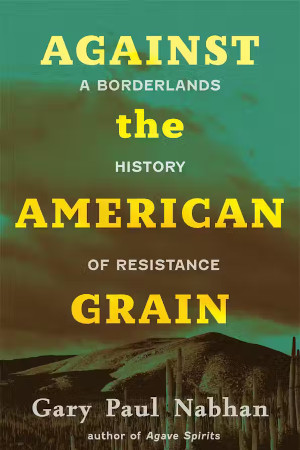
Against the American Grain: A Borderlands History of Resistance
By Gary Paul Nabhan
Reviewed by Pallas Gutierrez
This essay collection presents a history of the American borderlands through fourteen moments of resistance against colonizing forces and governments, bringing to life a generational tradition of struggle. Spanning from Yaqui elders in the 1500s to modern refugees, this history’s poetic tone enriches Nabhan’s narrative threads, deepening the understanding of what it means to live along the United States-Mexico border physically, spiritually, emotionally, and socially between cultures and realities.
The book’s structure rebels against literary traditions and expectations. Nabhan acknowledges and rejects the white heteropatriarchal conventions of William Carlos Williams’s In the American Grain, which inspired Nabhan’s title. Williams’s book contained only two Indigenous characters, while Nabhan consistently centers the indigenous experience of cultural conflict and exchange. He aligns himself with other historians’ unsettling popular views of American history, putting his work in conversation with Carrie Gibson’s El Norte and Kelly Lytle Hernandez’s Bad Mexicans. Nabhan explores the impact of several religious leaders—including Sor María de Ágreda’s visions and reports of bilocation—reinstating religion as a motivator for conquest, conflict, and community. Nabhan takes seriously the methods and languages used to pass these stories down, and centers the lived experience of the people populating his narrative.
Nabhan strengthens the ideas of community, culture, and tradition by interweaving people or events from earlier chapters, such as friar Francisco Garcés attending a seminary that studied María de Ágreda about 150 years after her first vision, demonstrating characters’ awareness of and interactions with one another. Rejecting historical objectivity, Nabhan asserts his place in each chapter of the narrative, concluding “Sanctuary” with his experience housing people seeking sanctuary in the U.S. This self-inclusion is a reminder that history is happening now. By braiding disparate ideas together, Nabhan weaves not just a story of fourteen moments, but a legacy of resistance in which each piece progresses toward the next. In rejecting historical conventions to pay these overlooked figures and events their due, Nabhan asserts that every part of America has been defined by resistance to oppression, and the good, necessary trouble that allows it to continue growing.
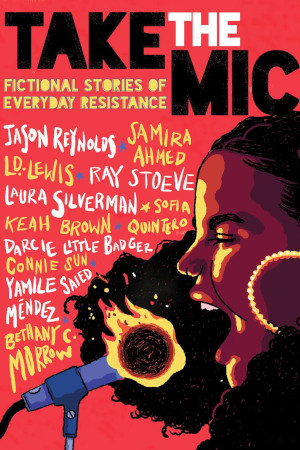
Take the Mic: Fictional Stories of Everyday Resistance
Edited by Bethany C. Morrow
Reviewed by Jessica Ribera
This YA story and poetry collection featuring queer and racially marginalized characters seeks to encourage youth in their “smaller, less visible acts of resistance that aren’t getting news coverage.” The pages are rich with vivid descriptions of foods, languages, values, challenges, and even hashtags that build specific worlds.
Using first- and close-third-person perspectives, the authors depict characters who together say: I deserve better. Listen. In Morrow’s “As You Were,” a cop pulls over Black teen Ebony, causing intense panic that she hides under the calm words and demeanor she knows could help her survive: “‘Everything is okay’… but I’m biting my lip.” Morrow’s page-turning tension conveys a world full of risks no one should have to experience. But because many do, the story excels as a piece of fiction and a call for cultural change.
These authors deftly show how high the stakes can be in everyday situations, revealing the nonstop mental work required of marginalized teens and validating resistance fatigue. Fitting in at a sleepover is already difficult, but Yamile Saied Méndez’s Latina character in “Aurora Rising” is torn between her cultural identity and fitting in when a rich white woman guilt-trips her into wearing a shirt with a MAGA-like slogan. Samira Ahmed uses anaphora with great effect in her poem “Are You the Good Kind of Muslim?” to build the question’s threatening tone but also the speaker’s exhausted resolve to resist profiling.
Willing allies in resisting oppression get models—instructive and cautionary—in the stories’ supporting characters. Ray Stoeve’s cisgender side character robs the trans main character of leadership by using their story without their permission, providing an example of what not to do. Meanwhile in Darcie Little Badger’s “Homecoming,” an ally passes the mic to Grace, the Lipan Apache main character, to speak for herself in a conflict over an “Indian brave” mascot. Grace says, “My humanity is not up for debate.” So long as anyone has to defend their existence in such a way, we need to keep making good trouble, drawing motivation from stories like these.
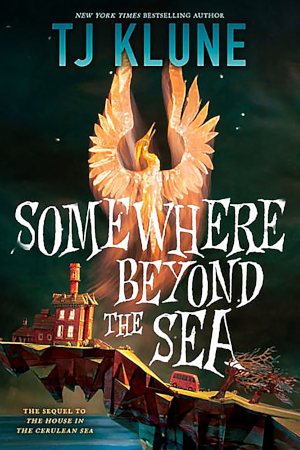
Somewhere Beyond the Sea
By T.J. Klune
Reviewed by Kasey Carlton
In this fantasy novel, T.J. Klune’s cocktail of mischief, resistance, and joy showcases his ability to interrogate heavy topics while centering hope through comedy. Protagonist Arthur Parnassus’s perspective activates pathos on multiple levels; Arthur isn’t just the charming head of a foster family, he’s also a phoenix, the rarest and most maligned of magical beings. Living in exile on the island of Marsyas, he’s an adult responsible for the safety of similarly magical children, and thus motivated to shield them from the childhood abuse he endured. His horrifying past drives him to improve the present, especially when a bigoted government tries to rewrite his story to serve its narrative. When that government threatens the children in the name of non-magical beings’ safety, Klune interrogates it, exploring the parts of society willing to make concessions for oppression that masquerades as protection for “the greater good.”
The book is a poignant investigation into those who uphold societal norms and those with the courage to challenge them, but it doesn’t take itself too seriously. Arthur’s chaotic family of eight includes a bearded garden gnome named Talia, an amorphous green blob named Chauncey gifted in the art of hospitality, and Lucy, the six-year-old antichrist. Klune’s signature sense of age-agnostic humor keeps the material accessible and grounded without being heavy handed, highlighted during a tense point when Arthur is interrogated by government officials, and asked about the “danger” they claim Lucy poses:
“Can you promise he’s not going to split the planet open like an egg?
“Oh,” Arthur said. “I highly doubt it. You see, he’s still learning how to crack chicken eggs properly, so I expect it’ll be quite some time before he’s ready for planetary destruction.”
Somewhere Beyond the Sea is as entertaining a fantasy as it is a practical manual for resistance through joy, individuality, and acceptance. In a time where hate is loud and division is encouraged, Klune’s Marsyas offers a reprieve through humor and triumph, showing that community and connection aren’t just a happy ending; they’re our ticket to a better world.
Voice to Books is a periodical short list of reviews focusing on writers from marginalized or underrepresented groups. It is edited by Cambria Matlow and Dave Oei.