Bill of Fare

By: Susan Olding

Appetizers

Pimento-stuffed olives
Celery with cream cheese
Julienned carrots
Angels on horseback
Pigs in blankets

Your career begins early, before your head even clears the kitchen counter. The crystal dish that your mother places in your hands feels much heavier than you expect. Pressing it to your chest, you look down at your red patent party shoes, nervous you might skid on the kitchen’s vinyl tile or trip on the lip of the living room carpet. Music greets you, music and smoke; clinking ice cubes and the smells of mingled perfumes. The women’s faces glow. Their dresses rustle like the plumage of exotic birds. Like birds, they coo and sing at your offerings, pecking and cooing while watching you with bright eyes. Someday you would like to join their dazzling flock. But for now, you observe them observing you.

Read more

Assholes and Stanky Glitter

By: Arch Jamjun

I have been a server for almost twenty years. When I say that out loud, I feel like a big failure, and when I think about my parents, how they went from being children Sally Struthers might hug to USA professionals, I feel like an even bigger failure. This feeling especially haunted my twenties when, after trying pharmacology, education, nutrition, paralegal studies, nursing, and even accounting, I always found myself inept. Server money has been a big comfort. It’s hard to feel sorry for yourself when you can earn a middle-class income while garbage-mouthing leftover food and guzzling wine you could never afford in half of the above-mentioned careers. But my mom has an interesting perspective: “Oh you are like a food prostitute.” In a sense, that’s true. When you’re a server, you’re constantly thinking, “Am I too old for this?” and I think only sex workers and athletes ponder that as much. Also, when you’re a server, people often ask you, “But what do you really want to do?” And I’m like, “Ummm, be the next Whitney Houston.”

Read more

A Dozen for Delbert

BY: JAMES KELLY

“Delbert was a straight one percent man,” Mister Spiffy told me. “But, he got caught with his hand in the cookie jar. And don’t forget to call that order in to Dezzy’s the night before. Dezzy’s Doughnut Kastle. Number’s on the visor. Tell her you want a dozen for Delbert. That you’ll be there right at seven when she opens to pick them up. And remember, just hand him the box of jelly doughnuts and shut up. Don’t say a word. Delbert speaks when he’s good and ready, not before.” Mister Spiffy ran a one-van, two-man carpet-cleaning business. I worked for him one summer and part of that fall. He paid a guy to paint the number 18 real big on both sides. But, like I say, he only had the one van. “Client sees that,” he explained, “it makes a good impression. They think we got eighteen vans instead of just the one. Gives them confidence. Means they can count on Mister Spiffy to handle any volume of business they throw his way. Guaranteed.”

Read more

The Red Shoebox Guitar

By: Roy Dufrain

On hot Saturdays the neighborhood men took refuge in their garages. They opened their garage doors and ran portable fans, and they turned up the Giants game on the transistor radios that sat on their workbenches. The men fixed things and made things and drank bottled beer out of old round-shouldered refrigerators. Wives and children were generally not invited.

That summer of 1966, Bobby Highfill and I were both eight years old. Our mothers were forever shooing us out from under their feet and into the great outdoors, which in our corner of suburbia consisted of a few square blocks of housing tract and one dead-end street of undeveloped lots known to local kids as the Trashlands, where Bobby and I both served honorably in the Great Dirt Clod Wars of Concord, California.

Read more

Buddhist’s Kiss

By: Tobie Helene Shapiro

The Buddhist would not kiss me. He courted me; that is true. And during our courtship he regaled me with Buddhist stories, Buddhist parables, Buddhist lessons and teachings. And I know that he felt very wise. I decided not to test his hypothesis. It didn’t seem right, or fair, or even kind.

He expounded about the awful and soul-disfiguring injuries of his childhood. His father, the son of a famous and revered early twentieth-century artist, was evil incarnate. His mother watched soundlessly, sweetly failing to protect him. His older sisters—crazy, jealous, deranged, angry—all hated him, plotted against him, wanted him silenced in all matters of inheritance from the trust established by the famous-artist grandparent. His younger brother was the only salvageable human being in the lot of them, because his younger brother understood him. His brother, alone, was not a member of the family cabal, the terrorist cell pitted against him.

Read more

TCR Talks with Ben Blatt

By: A.M. Larks

In his latest book, Nabokov’s Favorite Word Is Mauve, Ben Blatt uses his data journalism skills to tackle writing’s lingering questions and examine adverb usage, gender pronoun tendencies, reading levels, and writers’ favorite and fallback words.

Although Blatt uses statistical analyses to show that writers generally follow their own writing advice, word counts grow in size after the first publication, and co-authors rarely get equal title space on book covers, his work isn’t a math book disguised as a creative writing book. Blatt uncovers interesting insights into style and writing tendencies by looking at rule breakers and followers, including best sellers, critically acclaimed works, and fan fiction, to give the reading public and would-be authors a comprehensive view of what writing looks like by the numbers.

Read more

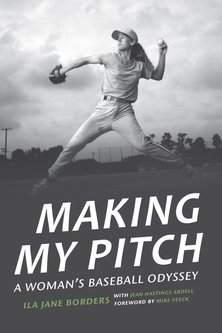
TCR Talks with Jean Hastings Ardell

BY: Nathania Seales Oh

In Making My Pitch: A Woman’s Baseball Odyssey, Jean Hastings Ardell co-authors the deeply moving memoir of Ila Jane Borders, a woman shattering gender stereotypes in a male-dominated profession while navigating her secrecy, shame, and eventual acceptance of her sexual orientation.


Throughout the book, Ardell points to transformative moments of struggle in Borders’ life: as a child at home and in the church, as a young woman on the baseball field and in male locker rooms, and at a Christian university where she played before being signed to play professionally. There are moments of levity alongside anecdotes of profound loss and rejection that show the reader Borders’ path to authenticity and success.

Read more

TCR Talks with Gayle Brandeis

By: Angela M. giles

I am not sure when I first became aware of Gayle Brandeis and her work. It was a few years ago, and truthfully, it was the story of her mother’s suicide that drew me to her. There is a strange bond between survivors of suicide, a shared understanding of that particular kind of loss and the way in which our kind of grief is often messy. I read a few of her essays online and was hooked. I poured through whatever I could get my hands on by her, and her poetry is amazing, by the way. I knew she was writing a book about her mother’s suicide, and whereas saying I was looking forward to it sounds a bit morose, I was. So, when the opportunity to speak with her about writing the book was presented, I was thrilled. It turns out, Gayle is as brilliant and kind in person as you hope she is, and she has an amazing ability to distill grace from even the most painful moments.

Read more

Bright Orange Candy

By: Anne McGouran

Kate is a Burmese-Indian octogenarian with scornful dark eyes in a heavily lined face. The top of her head just about reaches the height of my armpit.

“My husband dropped dead in his surgery at age thirty-two. To support my five little ones, I taught at a private girls’ school in Dharamsala. I adored the teaching but not the housework. Housework is just a bourgeois fetish.”

“Dharamsala…was that in the sixties?” I ask.

“Yes, during the first wave of Tibetan emigrations. Did you know I tutored the Dalai Lama’s niece? Not the brightest bulb, that one”—Kate stares off into the distance…  into the Outer Himalayas—“I was always the first person up in the morning. I’d pour warm milk and curd into a chati, cover it overnight with a blanket, then churn it for our breakfast. The nuns all adored my lassi. I still get letters from Sister Veronica. That slyboots used to slip Santra Goli candies into my mailbox when I was having a hard time with the spoiled rich students. Sister V. and I are the last ones standing. Soon enough we’ll leave our bodies so nature can work her magic. Our energies are continually recycled, you know. We pass from death to life over and over again. It’s nothing personal, really.”

Read more

Book Review: Yuval Noah Harai’s “Homo Deus: A Brief History of Tomorrow”

By: A.E. Santana

Who would like to know the future? To know and understand the coming changes to our environment, society, and the individual? Whereas Yuval Noah Harai doesn’t claim to be omniscient or a fortune teller, his book Homo Deus: A Brief History of Tomorrow paints a picture of what may be in store for humanity in the next fifty or a hundred years. Harai does this not by making psychic predictions but, instead, by carefully examining history, biology, psychology, and technology. With a copious amount of research to back up his claims, Harai gives a detailed hypothesis on the next steps of human evolution—taking people from Homo sapiens to Homo deus. Whereas Harai gives intelligent, thorough explanations, it is through his clear, clever, and often humorous writing that he connects with readers.

Homo Deus: A Brief History of Tomorrow is broken up into an introduction and three parts: “Homo Sapiens Conquers the World,” “Homo Sapiens Gives Meaning to the World,” and “Homo Sapiens Loses Control.” Each part delves into the rise and fall of societies, provides an intimate look at biology and psychology, and discusses the growth of technology as it pertains to Harai’s claims. It is by understanding these topics, Harai suggests, that people will be able to understand how society may progress into the next stage of human evolution.

Read more