BY: Kaia GALLAGHER For a small country of 1.3 million people, Estonia has a rich and long-standing literary tradition based on centuries of folklore and lyric poems. The country is located on the Baltic Sea to the south of Finland and shares its eastern border with Russia. At the end of World War II, Estonia was occupied by the Soviet…
TCR Daily
BY: A.M. Larks

Dark Chains by LaTasha “Tacha B.” Braxton is a self-published spiritual autobiography of a girl’s journey through abuse to religious conversion. At its high point, Braxton’s story connects the reader to the experience of growing up in an abusive environment.
We children were suffering the most, having to constantly hear that yelling and bad language influenced by drugs and alcohol through our locked bedroom door. We dealt with the trauma our mother felt from having a gun put to her face by my father. We dealt with the fear after my father threw a big concrete block through their bedroom window, shattering glass everywhere, with the brick barely missing my tiny head as I innocently slept in my mother’s arms. We were succumbing to this dysfunctional curse that would negatively impact too many generations to come.
BY: KAYLA HAMBEK
CHARACTERS:
REBECCA HELLER (30 years old. Middle daughter, has anxiety.)
CATHERINE HELLER (50s/60s. Mother.)
JACK HELLER (32 years old. Oldest son, deadbeat “entrepreneur” living in Catherine’s basement.)
AUDREY HELLER (27 years old. Youngest daughter, incredibly reliant on her boyfriend.)
KEITH BECKER (Late 20s-30s. Audrey’s boyfriend.)
SETTING: Sioux Falls, South Dakota
By David M. Olsen
We Can Save Us All is an ambitious debut by a very talented Adam Nemett. The book begins with a chance meeting of our rather nerdy protagonist, David Fuffman,  in an odd, drug-enhanced damn-building exercise where he meets the charismatic and wealthy Mathias Blue—in a frigid river, at Princeton. This clever scene is a fun springboard into the witty, satirical, and nihilistic novel that is to follow. The story is set in the near future where all-too-realistic issues of war and climate change combine with a phenomenon called “Chronostrictesis,” where time itself seems to be coming to an end as though through a funnel: human existence as we know it is no longer, as the characters have to stockpile food and supplies for the severe weather and the impending superstorm.
By Grace Jasmine

Min Kahng is an inspiring and inclusive force in the San Francisco Bay area theater scene. The world premiere of his most recent play, The Four Immigrants (based on the historical, groundbreaking manga panel-drawn comic strip by Henry Kiyama), premiered at the innovative TheatreWorks, Silicon Valley, and won the Theatre Bay Area Award for Outstanding Original Musical, the Edgerton New Play Award, and an NAMT Production Grant. The Four Immigrants chronicles the lives of four Japanese students as they immigrate to the California bay area. Kahng has also been the recipient of the Titan Award for Playwrights.
BY: Mir-Yashar Seyedbagheri
“I didn’t say bomb,” Mustafa Bey said to his son David, his words inflected with his harsh Turkish accent. “I said bum. Tell them, my boy. Tell them your father isn’t a fucking terrorist.”
“You said bomb on an airplane,” said the TSA agent, whose name was Lawrence. They were both in his office, having been ejected from their flight prior to takeoff.
BY: Sarah Broussard Weaver
The college professor is calm as he describes genocide. He’s just giving his planned lecture, the one scheduled on the syllabus and outlined in his notes. The students continue doodling or staring into space, only looking up when the professor mentions a detail that’s unexpectedly gruesome.
That is not how I react.
BY: A.M. Larks
Everyone I know is looking for a way to escape, hit pause on reality, and just take a breath; get immersed in something else, someone else, anything else because the real world seems too much to bear. And I am no exception. I do it too. Because at its heart, that’s what reading is: a way to escape the world around you, which makes it ironic that my escape would be reading about characters who are trying to escape their own complicated fictional lives in True Love And Other Dreams of Miraculous Escape by Micah Perks.
By Karina Cochran
CHARACTERS:
HAROLD (any age, any gender)
FRANK (any age, any gender)
(the names Harold & Frank are placeholders; they never say each other’s names)
SETTING: A small space (chairs, pillows, blocks) all pink, representing a womb.
(HAROLD and FRANK sit in two chairs next to each other. Harold is sitting on top of a chair, his feet resting on the seat. Frank is sitting in the chair with his feet solidly on the ground. Harold is slightly hunched, reaching toward Frank’s body. Frank is leaning over the chair against Harold’s legs. They are each entangled in pink ropes, surrounded and holding pink cushions.)
BY: A.M. Larks
It is our origin stories that shape us. How we came to be in this world matters  almost as much as what we do in it. There is a natural and innate curiosity to know the facts that happened before our consciousness, that ties us to our personal histories, to our culture, and to a larger family history. “Family lore given to us as children has such a hold over us, such staying power. It can form the bedrock of another kind of faith, one to rival any religion, informing our beliefs about ourselves, and our families, and our place in the world,” Nicole Chung writes in All You Can Ever Know. These stories are often simplified down to almost anecdotal summation, like my spouse who blames his perpetual tardiness on being late for his own due date. He came out a month late but only by inducement. He was late in the beginning and therefore will always be late.
BY: Nathania Seales Oh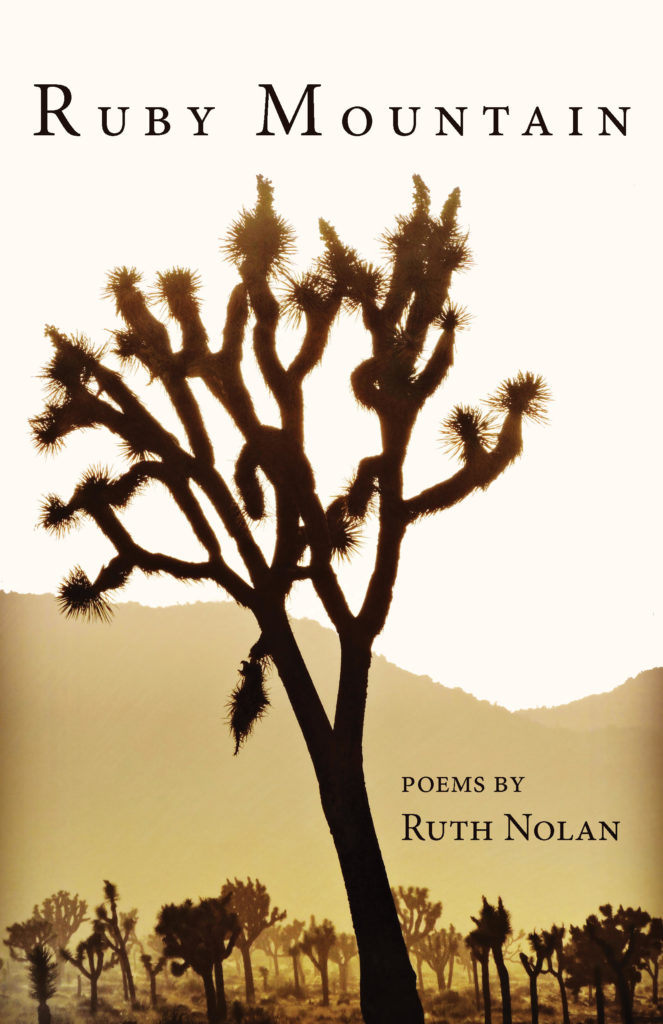
In a time when the power of a woman’s voice rings louder and clearer than ever, Ruth Nolan is putting her money where her mouth is. From the beautiful ecopoetry in her latest project, Fire and Rain: Ecopoetry of California, where she acted as coeditor and contributor, to her deeply personal poetry collection Ruby Mountain, Nolan is, in a word, an activist. She is a profound advocate for the respect and conservation of the California desert, a landscape she has always called home. She speaks not only to its beauty but also to its transformative power. Nolan tells of our relationship, history, and encroachment upon lands where wildfires have burned for centuries. Yes, it’s true. Wildfires are not a new thing. Our living in the places where they unfold, is. She also reminds her readers, students, and fan base of the importance of speaking your truth. As we witness this watershed moment in time, The Coachella Review is honored to spend time in conversation with the passionate and incomparable Ruth Nolan.
BY: Jennifer Harvey
She heard them, before she saw them. Felt the tremor in the soles of her feet, as the energy shuddered through her. And when she turned around, there they were. Horses. Too many to count.
She watched them ford the river at a shallow point where the rocky bed was visible, their snorts as wild and free as the rush of the water, and the sight of them frightened her. Something about the movement—the ripple and flow of their manes, the sound of hooves on rock, the way the tension in the muscles was so visible, and the whites of their eyes so emphatic—seemed to slow time and silence everything. All she could do was stand there, in that improbable hush, unable to move.