
By David Holloway
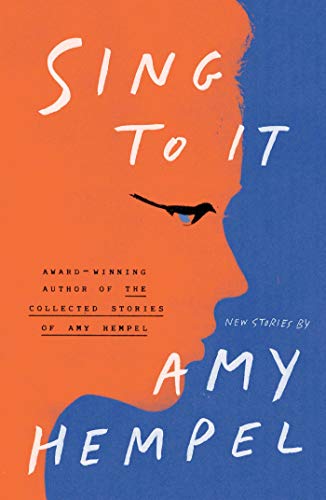 Sing to It: New Stories is the first new work from Amy Hempel in a decade.
The first thing to notice in this collection is the variety of story lengths and tempos. Of the fifteen stories in Sing to It, ten are less than two pages long. Modest of plot, names and setting, the title story is only one page long. But “Cloudland,” the last in the collection—more a novella than a story—runs for sixty-two pages. The reader might imagine the briefer stories to be a sign of the times, a nod to flash fiction. But it’s more likely to be a choice of substance, not form, from a genius of succinct narrative. Throughout this collection, and especially in these shortest pieces, the haiku-like prose is condensed and concentrated. Intense and sparse, there is a bleached and stripped quality to Hempel’s writing. Her narrators, reluctant to yield up their secrets, force us to read between the lines. The reader is left, generally, with a lot of work to do.
 “
“ It is almost 11:45 a.m. on a rare sunny day in Berkeley and instead of being outside, I am sitting in the basement lecture hall of Berkeley City College that smells vaguely of feet. My cell phone doesn’t get reception, so I cannot distract myself from my impatience and anxiety. I am anxious because I want to like this panel of authors, because I deeply respect the moderator, and because I need something to write about, to tie into, my review of Jamel Brinkley’s collection A Lucky Man.
  Things You Won’t Tell Your Therapist might appear at first glance as a simple collection of flash fiction, but the breadth of emotion that Colleen Kearney Rich has achieved in her stories is something to be admired. Writers often shy from flash as one of the more difficult formats to capture depth, but Rich runs full force into the form. Rich’s language is cut to the bones, but her details are visceral and real. She steers the reader through her characters’ anxieties, while reminding us of our own. The stories in Rich’s collection are fierce in their simplicity, stolen moments of seemingly quiet lives
 Claudia Rankine is the author of five collections of poetry, two plays, numerous video collaborations, and is the editor of several anthologies. Rankine has won the PEN Open Book Award and the PEN Literary Award, the NAACP Award, and the National Book Critics Circle Award for Poetry, and was a finalist for the National Book Award for her book Citizen. Rankine is the recipient of the Poets & Writers’ Jackson Poetry Prize and fellowships from the Lannan Foundation and the National Endowment of the Arts, in addition to other honors and awards.
 Sunshine changes the world under your nose. There’s one kind of smell from pavement right after it rains, and a slightly different one when the sun heats it to a muggy steam afterward. Freshly mowed grass becomes muskier under the sun’s blanket, pine forests sharper in its embrace. On a motorcycle, immersion in the land’s constantly changing hues, from roadside to horizon, is inevitably chased by these shifting aromas, the speed of light being a bit faster than the speed of smell. And so, as we dove and crested blue-line highways through the pillowy hills of Iowa farmland between Council Bluffs and Des Moines, clouds burned away from the face of the sun, encouraging freshly tilled fields, wildflowers, and sheep farms to vie for dominance in color and scent.