by Briana Weeger
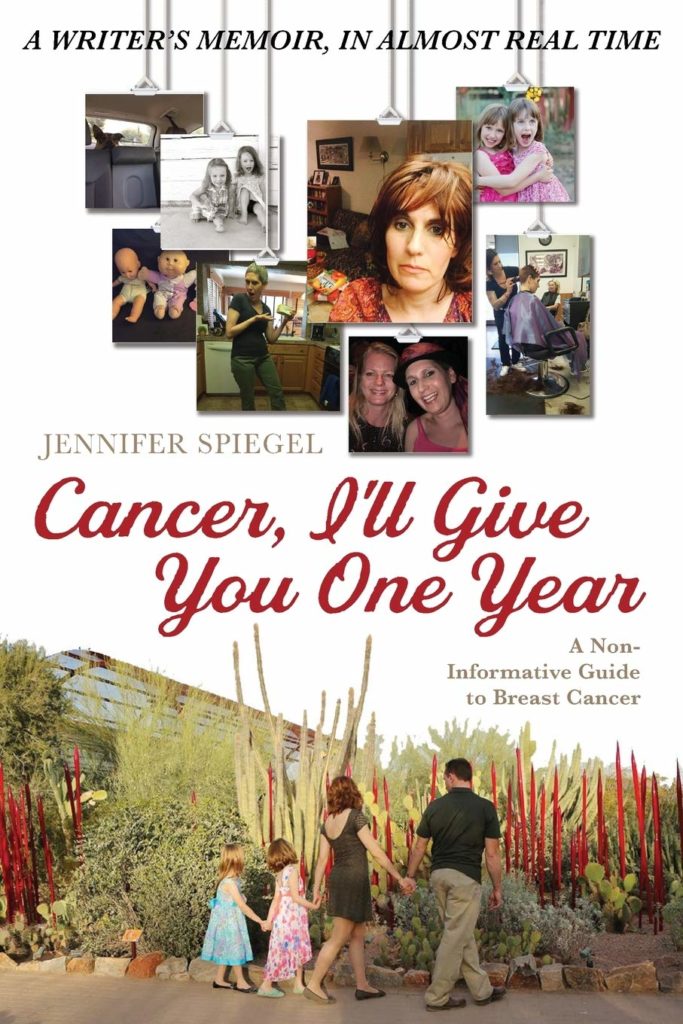
Only a few hours after Jennifer Spiegel is diagnosed with breast cancer, she is immediately on the page, sorting her thoughts and emotions through writing. “At this point, I have no clue what stage it is, if I’m going to die, if I’ll have one or both breasts cut off, or if nothing will be removed at all. I will tell you this: I instantly feel that my body is the enemy.” The result is a candid and compelling debut memoir by novelist Jennifer Spiegel, Cancer, I’ll Give You One Year: A Non-Informative Guide To Breast Cancer, A Writer’s Memoir In Almost Real Time.
 Spiegel’s memoir in “almost real time” reminds me of a story I once heard about a man suffering from Alzheimer’s. The man was due to give a presentation to a large gathering of people and had only recently been diagnosed. Right as he walked on stage, he forgot why he was there and what he was presenting. Looking out to a silent crowd, and not knowing what to do, he started to name out loud the emotions he was feeling. Frustrated, confused, frightened, alone. It was a method his psychiatrist had recommended that could help him to calm down when he had a memory lapse and began to feel anxious. Standing on that stage, it helped. He started to relax and remembered why he was there. After the event, many of the audience members approached him and told him that was the most powerful part of his presentation. Spiegel’s memoir has a similarly powerful effect.