TCR Daily

Book Review: Kendra Tanacea’s “A Filament Burns in Blue Degrees”


BY: Catherine M. Darby

A Filament Burns in Blue Degrees by Kendra Tanacea is a haunting first collection of poems released this year by Lost Horse Press. Tanacea is a master of the moment—not straight-on moments, but rather, ones full of visuals and emotions that transport the reader into Tanacea’s world. In this world, the reader becomes a lover, beloved, betrayed, friend, child, and want-to-be-mother, all while ruminating about life and the fullness it can offer.

Her poems intelligently meander on corners of braided rugs and peep through keyholes to see what life is beyond that usual existence of life, her words intoning the mysteries and science of the universe.

In “Keyhole,” the narrator looks through the keyhole of a locked door, straining to see “what is out of sight.” The words deliver full sensory experiences of an ever-widening life:

There is the scent of man, of woman, of cedar.
The eye shifts, straining in its socket.
French doors open onto a veranda
overlooking an ivy-walled garden.
The round moon is rising, giant and yellow.
Star jasmine, star jasmine!
An eye can see far beyond
its scope: solar systems, galaxies,
the Milky Way’s skid of stars.
All atoms, revolving around one another.
Read more

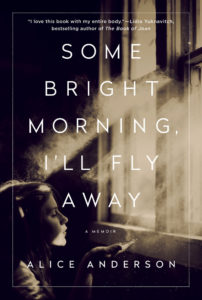
Book Review: Alice Anderson’s “Some Bright Morning I’ll Fly Away”

By: Kaia Gallagher

In Some Bright Morning I’ll Fly Away, Alice Anderson proves she is a survivor no matter what life throws at her. Her memoir recounts a decade-long battle to protect her three children from a vengeful, violence-prone ex-husband. The courts provide little help, encouraging family reunification rather than assuring the safety of an abused spouse.

Anderson is no stranger to hardship. Early in her writing career, she recounted her determination to overcome her father’s sexual abuse in an award-winning book of poetry. Human Nature is a harrowing description of a young girl’s fight for a future despite a childhood filled with incest and violence. It won the 1994 Elmer Holmes Bobst Award for Emerging Writers.

Despite her early success as a poet and international fashion model, Anderson is haunted by her past: “Something about [being a model] made me feel used up, consumed, like I was the little girl my father gobbled up all over again, his sexual abuse consuming in a drunken, hungry rage all the best parts of me until I was nothing, but a pretty, performing doll.” She becomes ripe for a relationship with Liam, her ex-husband whom she sees as someone trying equally hard to escape his family demons. Her spiral down into acquiescence is gradual, with an ever-tightening noose that threatens to erase not only Anderson’s very identity but also her life.

Read more

Rubber On Wheels


by jim kelly

Side by side at a stoplight, engines revving, roaring. “Teach them a lesson?” Fat Leonard shouts. My big brother, riding shotgun, nods. Turning, he hollers for me to “hold on.” Fourteen, drunk, I have nothing to hold on to. Below me, cement, the floor having long since rusted out, fallen away. For safety’s sake my feet rest on a single, hopping-around piece of jammed-in two-by-four. Junker with a crap paint job, a scrounged joke of a thing with a monster engine dropped in. Engine with more power than this stripped down, rattly ass car was ever meant to handle. Beside us a shiny new, daddy-bought, big engine Buick. Front seat and back, it’s full up with shouting guys. Pointing at us, laughing, calling names.

It’s summer 1964 and the muscle car is king, faster the better. Late nights in a shut down Shell station. The one Fat Leonard runs. His call when to quit pumping gas, close down, then open up for his friends to work on cars. Allowed, if I keep shut, I watch, all eyes, all ears, as my brother and his buddies turn junkyard finds into hotrods. Dross into dreams. A tiny, greasy front radio with a single, broke-tip antennae plays and quits, plays and quits. Somebody shakes it. Somebody punches it. Off and on rock and roll, at no set intervals, all night long. Ragged bits and howling, truncated pieces. Blue air thick, molten at the top of the tire racks from all those cigarettes, one after another. Drained, stomped flat beer cans kicked out of the way, piling up.

Read more

Algonquin

by jane katims

I find myself on 44th Street and 6th Avenue in Manhattan, in front of a gallery displaying award-winning photographs by students.   I shade my eyes with my hand and peer through the window of the gallery — inside, a reception party is in progress, glasses of wine poured and passed around, animated conversation, laughter.  A tempting sight, but I prefer to look in on it from the outside, prefer to be free to move away, to feel the spring air, and to let my own thoughts encircle me.  For a moment, I stand on the corner, observing life on the street.

I wander down 44th.  At the entrance of the Algonquin Hotel, a doorman nods, opens the glass doors for me.  In the hotel’s large lobby-lounge, a woman with a beaded black jacket with sequins around the collar sits on a couch.  Her legs are crossed, she holds a yellow iced drink.  A man with a martini sits close to the woman, his arm around her.

Read more

TCR Talks with Ragnar Jónasson

By D.M. Olsen

On a recent visit to Reykjavik, Iceland, I found a great little bookstore in the downtown area. Eymundsson was a three-story establishment with a coffee shop on the third floor. I sought out the section by Icelandic authors and came across an impressive display for Ragnar Jónasson and his Dark Iceland Series. I knew that Nordic noir was very popular throughout the European zone, so I purchased a copy of Jónasson’s bestseller Snowblind. I read the first chapter that night, and tore through the rest of the book in a few days. Needless to say, it’s a gripping read. It tells the story of Ari Thor, a rookie police officer in an isolated Icelandic village investigating the mysterious death of a writer. After I finished it, I emailed Ragnar to see if he would be interested in doing an interview, expecting never to hear back. To my surprise, he responded, so I asked him a few questions about his books and his writing process over email.

Read more

TCR Talks with Jenny Forrester

by dein sofley

In her debut memoir, Narrow River, Wide Sky, a heart rendering portrayal of small-town life, Jenny Forrester vividly evokes the landscape and culture of the conservative Colorado town where she grew up surrounded by narrow-minded churchgoers, ranchers, Native Americans, and strident
patriots. The book explores the complex forces of family, politics, and religion that served as catalysts for the author’s feminist awakenings. Throughout the memoir, Forrester navigates feelings of isolation, loss and grief with sensitivity and resilience. It’s a breathtaking, story about one woman’s search for identity within the mythology of family and America itself.

Forrester is the force behind Portland’s Unchaste Readers—a quarterly reading series for women, now in its fifth year—and an award-winning flash fiction writer. Her stories have been published in Seattle’s City Arts Magazine, Gobshite Quarterly, PomPom Lit, Nailed Magazine, Hip Mama, The Literary Kitchen, Indiana Review, Columbia Journal and in the Listen to Your Mother anthology, published by Putnam. Her latest writings and photos can be found at www.jennyforrester.com.

The Coachella Review: The title Narrow River, Wide Sky reflects the Western pioneer mythology that, as a child, you struggled to navigate. In its injustices and contradictions is your genesis story.  You forged your identity through the uncharted terrain of your upbringing. As a result, the word navigate emerges throughout your memoir. In your stories, you navigate the vast landscape of your western Coloradan heritage, along with your mother’s contradictions and feelings of isolation. As a child, you weren’t given the tools to navigate. Was writing a way for you to map your feelings?

Jenny Forrester: Writing became the way to deal with my feelings, with my moral core, with my desire to come to terms with loss, but also with many other things in life. I’d kept a diary and actually quoted from it in the book—it was a coming together of different sorts of writing I’d always done, but writing a book to be published was a dream. An ambition. Something I wanted, but wasn’t sure I could do for many reasons, ranging from the impact it could have on my family members to the artfulness and the how-to to the actual finding a publisher and then what.

Read more

Two Poems by Alexander Radison

I Cannot Dwell in Possibility There is a theory that states there are an infinite number of parallel universes, each a mirror of our own, but slightly different. Each choice made creates another universe: In this one, I went back to college, in another, I stayed in the army. Here, my mother picked up her first cigarette at 14 in…

Read more

Escape From Delhi

by scott morris

I am at the exact furthest point from home possible—zenith or nadir, depending on perspective—standing at the immigration counter at the Indira Gandhi International Airport, body wracked with some stewing South Asian pestilence stirring up the worst kind of hallucinations, trying to get the fuck out of India.

Earlier that night the proprietress of the hostel had given me some expired medication. She assured me it would fix me right up, quiet the internal motion of unwell, that she had seen all this before, but the only difference it made was that I had started passing out periodically, the first time while walking into the train station. I had to lie on a bench for a while to regain enough strength to get through security, all while a circle of Indian men crowded around, shouting offers of every type of service imaginable at this prone and seemingly dead American man. The modern train was built for western tourists, and I was the only passenger, thankfully alone to save myself the embarrassment of having others watch me vomit into a plastic bag.

Read more

Two Poems by Breeann Kyte

Translation in the close dark causes tongues to catch on knobbed spines. Unzippering mouthfuls along the length of secret sentences. One language to another opens in a grin, a stutter to a tentative translation of this alphabet of four. Now see, her jaw lit. Why sew ivy cut for the sun? Let barrel-folded fingers wring the kinks straight: Staircased helices,…

Read more

TCR talks with Zoe Zolbrod

BY tracy granzyk

Zoe Zolbrod’s memoir, The Telling, was published in May of 2016, and it will undoubtedly remain a “go to” book for both survivors and family members of those who have experienced childhood sexual abuse. In The Telling, Zolbrod comes to understand and accept the grey her own experiences have equated to within, while at the same time gives readers an example of how trauma and tragedy might be assimilated and used to empower one’s self. Especially poignant and game-changing in the memoir are her experiences as “Mama Bear”; a new parent with an immediate need to protect not only her children, but all kids from suffering the same experience she did. While Zolbrod never takes refuge in the title of victim, her honest pain exposes the depth to which she is still able to feel, never seeming to shut off and others out as a result of what was done to her.

As a writer, Zolbrod’s voice is both authoritative and accessible, and the narrative flows smoothly through different time periods of her life. She serves as both teacher of topic and craft by threading four Research Shows chapters within the story’s framework, allowing her to break off from the narrative, which she described during our conversation as a respite from the emotion inherent in diving back into such a painful experience. As a person, Zolbrod’s warmth and kind soul are what I was first drawn to during the interview that follows.

Read more

Sonic Horror Geographies: “Hush,” Gender, and Disability

By Geneveive Newman
A Note from the Editors

This week, The Coachella Review presents a stand-alone episode of the podcast Open Ivory Tower, written and produced by Geneveive Newman. In this episode, Newman looks at Mike Flanagan’s 2016 film Hush, a horror film about Maddie, a young writer who is deaf and mute and who has recently moved to a secluded cabin in the woods. The film details one harrowing night when a serial killer arrives at her home. The episode is a critical examination instead of a review, looking at the ways the film conforms to and subverts common horror tropes. We are excited to present it here.

Content Notice: This podcast contains discussions of rape, gendered violence, graphic depictions of injury and physical/mental harm, ableism, and imprisonment, as well as audio clips from the film. Some listeners may find it disturbing.

Read more