TCR Daily

TCR Talks with Ben Blatt

By: A.M. Larks

In his latest book, Nabokov’s Favorite Word Is Mauve, Ben Blatt uses his data journalism skills to tackle writing’s lingering questions and examine adverb usage, gender pronoun tendencies, reading levels, and writers’ favorite and fallback words.

Although Blatt uses statistical analyses to show that writers generally follow their own writing advice, word counts grow in size after the first publication, and co-authors rarely get equal title space on book covers, his work isn’t a math book disguised as a creative writing book. Blatt uncovers interesting insights into style and writing tendencies by looking at rule breakers and followers, including best sellers, critically acclaimed works, and fan fiction, to give the reading public and would-be authors a comprehensive view of what writing looks like by the numbers.

Read more

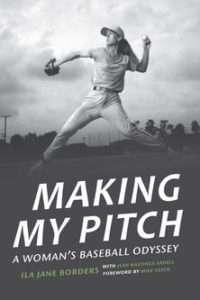
TCR Talks with Jean Hastings Ardell

BY: Nathania Seales Oh

In Making My Pitch: A Woman’s Baseball Odyssey, Jean Hastings Ardell co-authors the deeply moving memoir of Ila Jane Borders, a woman shattering gender stereotypes in a male-dominated profession while navigating her secrecy, shame, and eventual acceptance of her sexual orientation.

Throughout the book, Ardell points to transformative moments of struggle in Borders’ life: as a child at home and in the church, as a young woman on the baseball field and in male locker rooms, and at a Christian university where she played before being signed to play professionally. There are moments of levity alongside anecdotes of profound loss and rejection that show the reader Borders’ path to authenticity and success.

Read more

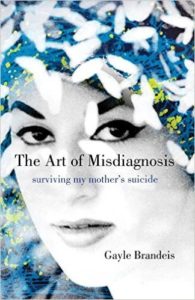
TCR Talks with Gayle Brandeis

By: Angela M. giles

I am not sure when I first became aware of Gayle Brandeis and her work. It was a few years ago, and truthfully, it was the story of her mother’s suicide that drew me to her. There is a strange bond between survivors of suicide, a shared understanding of that particular kind of loss and the way in which our kind of grief is often messy. I read a few of her essays online and was hooked. I poured through whatever I could get my hands on by her, and her poetry is amazing, by the way. I knew she was writing a book about her mother’s suicide, and whereas saying I was looking forward to it sounds a bit morose, I was. So, when the opportunity to speak with her about writing the book was presented, I was thrilled. It turns out, Gayle is as brilliant and kind in person as you hope she is, and she has an amazing ability to distill grace from even the most painful moments.

Read more

Book Review: Joe Hill’s “Strange Weather”

By: Xach Fromson

Joe Hill is no stranger to short fiction. His short story credits go back twenty years and includes the 2005 collection 20th Century Ghosts. After last year’s incendiary success with The Fireman, Hill returns to the form with Strange Weather, a collection of four short novels offering a panoramic view of humanity in scenarios that range from the fantastical to the all too real. Across all four stories, Hill excels at immersing readers in a full sensory experience that takes readers on unique journeys. The tightly written prose wastes no time in ratcheting up the tension, foregoing any trappings of the slow-build, existential horror in favor of rapid-fire pacing that never lets up.

Read more

Bright Orange Candy

By: Anne McGouran

Kate is a Burmese-Indian octogenarian with scornful dark eyes in a heavily lined face. The top of her head just about reaches the height of my armpit.

“My husband dropped dead in his surgery at age thirty-two. To support my five little ones, I taught at a private girls’ school in Dharamsala. I adored the teaching but not the housework. Housework is just a bourgeois fetish.”

“Dharamsala…was that in the sixties?” I ask.

“Yes, during the first wave of Tibetan emigrations. Did you know I tutored the Dalai Lama’s niece? Not the brightest bulb, that one”—Kate stares off into the distance…  into the Outer Himalayas—“I was always the first person up in the morning. I’d pour warm milk and curd into a chati, cover it overnight with a blanket, then churn it for our breakfast. The nuns all adored my lassi. I still get letters from Sister Veronica. That slyboots used to slip Santra Goli candies into my mailbox when I was having a hard time with the spoiled rich students. Sister V. and I are the last ones standing. Soon enough we’ll leave our bodies so nature can work her magic. Our energies are continually recycled, you know. We pass from death to life over and over again. It’s nothing personal, really.”

Read more

TCR Talks with Helena Echlin and Malena Watrous

By: D.M. Olsen

When I found out that Helena Echlin and Malena Watrous, two instructors I’ve taken classes from at the Stanford Online Writer’s Studio, were collaborating on a YA novel, I was curious about their work. When I heard what their book was about, I was even more intrigued. A book about “mean girls with superpowers,” sounded entertaining and original. The protagonist, fifteen-year-old Laurel Goodwin, wakes up to find her older sister, Ivy, missing from their shared bedroom and is forced to team up with mean girls from Laurel’s high school to find her.

After reading the book and seeing all the amazing reviews online, I caught up with the authors, who graciously agreed to do a brief interview for The Coachella Review.

Read more

Book Review: Yuval Noah Harai’s “Homo Deus: A Brief History of Tomorrow”

By: A.E. Santana

Who would like to know the future? To know and understand the coming changes to our environment, society, and the individual? Whereas Yuval Noah Harai doesn’t claim to be omniscient or a fortune teller, his book Homo Deus: A Brief History of Tomorrow paints a picture of what may be in store for humanity in the next fifty or a hundred years. Harai does this not by making psychic predictions but, instead, by carefully examining history, biology, psychology, and technology. With a copious amount of research to back up his claims, Harai gives a detailed hypothesis on the next steps of human evolution—taking people from Homo sapiens to Homo deus. Whereas Harai gives intelligent, thorough explanations, it is through his clear, clever, and often humorous writing that he connects with readers.

Homo Deus: A Brief History of Tomorrow is broken up into an introduction and three parts: “Homo Sapiens Conquers the World,” “Homo Sapiens Gives Meaning to the World,” and “Homo Sapiens Loses Control.” Each part delves into the rise and fall of societies, provides an intimate look at biology and psychology, and discusses the growth of technology as it pertains to Harai’s claims. It is by understanding these topics, Harai suggests, that people will be able to understand how society may progress into the next stage of human evolution.

Read more

Book Review: Megan Stielstra’s “The Wrong Way to Save Your Life

By: A.M. Larks

Nothing other than fate can attribute to my review on Megan Stielstra’s book, The Wrong Way to Save Your Life, which took place a week after the events in Charlottesville (which occurred on August 12, 2017), when I was supposed to have received it a month prior. During the last week, the fear for our country has increased, it is undeniably pervasive and palpable. This fear is in every conversation, every communication, and every action or reaction. Fear is exactly what Stielstra tackles in her book. Stielstra ties the broad and the specific by examining fear at its roots, fear in her own life, and fear in everybody’s lives. Written before the November 2016 election, she comments on the fear rhetoric building at that time (which seems to have reached a violent pinnacle with Charlottesville), claiming that we must work through fear by confronting that which lies on the other side. Her words are startlingly prophetic:

Read more

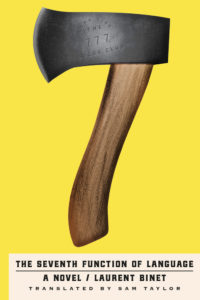
Book Review: Laurent Binet’s “The Seventh Function of Language”

By: John Flynn-York

Laurent Binet’s first novel, HHhH (short for “Himmlers Hirn heisst Heydrich,” which, translated, means “Himmler’s brain is called Heydrich”), was a fictional reconstruction of the assassination of the Nazi Reinhard Heydrich. The novel’s narrative fluctuated between past and present, history and story. In the past, Heydrich rises to power in the Third Reich, committing unspeakable atrocities along the way, while two operatives—the Czech Jan Kubiš and the Slovak Jozef Gabčík—plan to kill him. In the present, the narrator grapples with this story and how best to write it, drawing on books, museums, and other references to recreate it in detail. The brilliance of the book came from the tension between these perspectives. What does it mean to recreate history? Can we understand the way historical figures understood things—that is, can we get inside their heads? Can we ever know the truth? In other words, HHhH was as concerned with what it means to tell a story about history as it was with the historical events themselves.

Binet’s new book, The Seventh Function of Language, similarly takes its inspiration from a real event: the accident that claimed the life of the semiologist Roland Barthes. Out of this incident, Binet spins a madcap tale of intellectuals run amok that is by turns wildly entertaining, mildly frustrating, and intellectually captivating—and only sometimes faithful to the historical record.

Read more

Bienvenidos a Pilsen

By: todd Gastelum

One

I was used to rebooting my life: CTL+ALT+DEL and voilà, tabula rasa.

About to turn thirty, it was time for me to move. Once again, I was leaving a boyfriend I’d taken up with in a previous life. Once again, it was me who fucked things up. Now I needed my own place. I was hoping for the top floor of a brick three-flat, preferably with hardwood floors, a bay window, and crown molding. Somewhere near the 18th Street stop on the Blue Line with a view of buckled chimneys, waltzing antennas and the Baroque twin towers of St. Adalbert’s.

That’s not the apartment I found.

My new place was the rear unit on the top floor of an architecturally featureless building, whose ground floor taquería would eventually add another ten pounds to my frame. The apartment had been recently remodeled with a coat of white matte and cheap beige linoleum that still reeked of glue. There were just three rooms: a bedroom, a bathroom, and a kitchen/dining/living room too cramped to qualify as open concept. All the doors were standard-issue Home Depot as were the kitchen cabinets and bathroom fixtures. The tiny window over the kitchen sink gazed into a narrow air shaft, and the double-paned windows behind my futon framed an alley with a backbone of splintered utility poles and drooping cables. If I lived a dozen floors higher, I’d have been able to see the lake, but I didn’t and I couldn’t. I had no link to the natural world—only the constant rumbling of big rigs speeding toward the Stevenson Expressway.

Read more