By Pallavi Yetur
When we first meet Maggie Downs in her debut memoir Braver Than You Think: Around the World on the Trip of My (Mother’s) Lifetime, her mental state is immediately established from the image of her shuffling through the Cairo airport in flip flops, her sweatshirt hood pulled over her head, and her body hovering between sleeping and waking because, “Sorrow does that.” Incidentally, travel can do that too, and Downs’s memoir tells a story of both.

Ten years ago, Maggie Downs quit her newspaper job and set off on a yearlong trip around the world. As she traveled from Peru to Bolivia to Uganda to Thailand, her mother’s mind and body were succumbing to Alzheimer’s disease back in the US. The trip is initiated when Downs, underwhelmed and disengaged with her job and life, decides that she must live because her mother can’t; because her mother gave up dreams of seeing the world to tend to her parental and familial duties. Downs asks herself: “By confining myself to this cubicle, wasn’t I making the same mistake my mother made?” In this state of suspension between doubt about her future and certainty of her mother’s, she found the reasons to travel: “to see what I was made of, to discover how strong I could really be, to live out the dreams of my mother.”







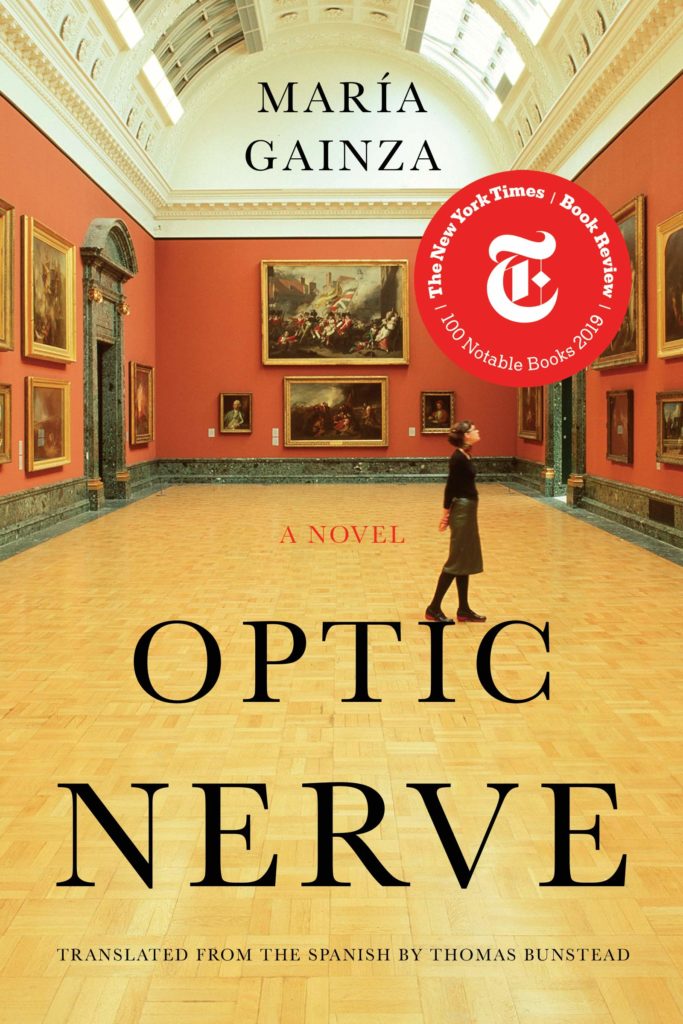 Several years ago I visited the Picasso Museum in Malaga, Spain. At the time, each gallery was arranged by theme rather than chronology, so that as you made your way through, you weren’t seeing Picasso’s works in the order they were —created—you would see a ceramic he created in the 1930s next to a drawing created at the end of his life next to a painting he made in the 1920s, all seemingly random until you realized that they focused on the same theme or subject. María Gainza’s debut novel Optic Nerve reminded me of this museum from the very first page. The story doesn’t proceed chronologically through the narrator’s life, but rather thematically. Beginning each chapter feels like stepping into a new gallery, perhaps especially because the book deals directly with the history of visual art.

 The brain often holds onto distinct and unexpected images and memories at the time of traumatic events. These memories may not make sense on their own, and they may seem disconnected from what actually happened.