
By Kevin T. Morales
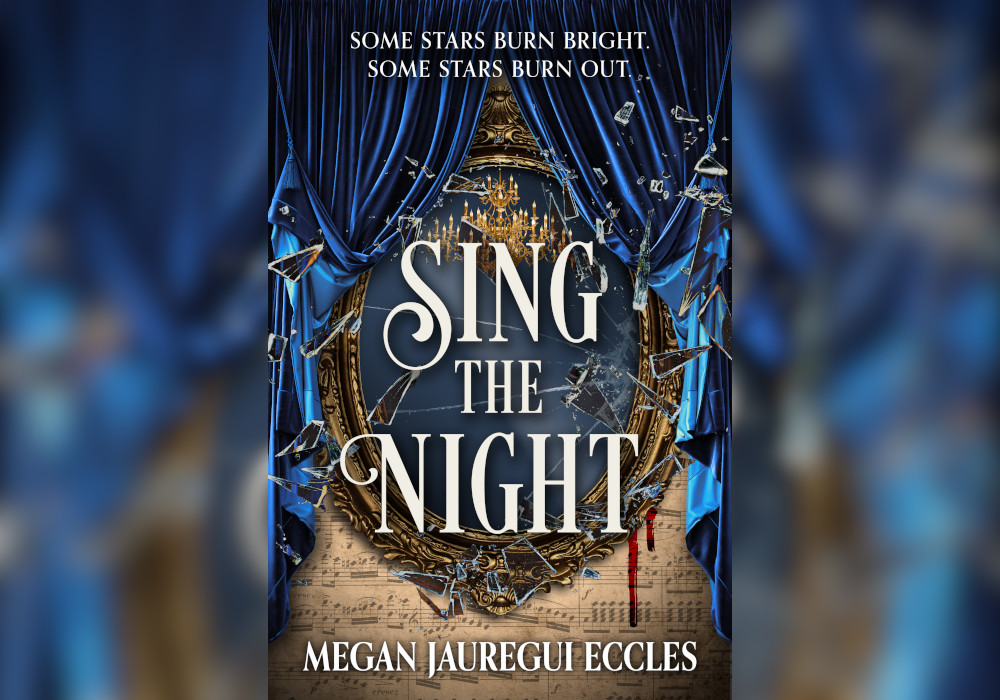
Fantasy is a cooperative challenge. It requires of both author and reader equally strong imagination. In Megan Jauregui Eccles’s debut novel, Sing the Night, magic is invoked by singing, and an intense competition to be the King’s mage takes place in L’Opera du Magician. There’s an inherent challenge in describing music in prose. As The Lovin’ Spoonful lyric laments in their 1965 song, Do You Believe in Magic, “It’s like trying to tell a stranger about rock ‘n’ roll.” And yet Eccles— an established editor, the chair of creative writing at John Paul the Great Catholic University, and a musician herself—does an outstanding job telling the story of Selene, a competitor in an enchanted, operatic audition process with dangerous consequences in which the reader can hear the spells cast in every note and motif.
The Coachella Review spoke with Eccles about her process and inspirations for creating her fantasy world, the unique challenges of writing about magic invoked by singing and music, and the struggles of writing the sequel to her duology.
The Coachella Review: Which came first, the inspiration for you to write Sing the Night or the rules of magic in it?
Megan Jauregui Eccles: The initial idea was a Phantom of the Opera retelling. That superseded everything, and I’ve wanted to do that my whole life, because I love Phantom of the Opera. I have a music degree, and one of the things talked about a lot while I was studying is music as a language, thinking of orchestration almost as conversation, and, as you break down musical motifs, [how] all of those stand as specific phrases. The idea for the magic system stemmed from a traditional idea that a spoken phrase can do magic. And so, I was looking at an individual motif being a spoken phrase for magic.
In music, oftentimes, you’ll take a motif, and you’ll do a lot of variations of that. I was interested in this idea of having a motif for fire, for example, and then you can sing your way around that in an interesting way, but keep the shape of the motif, and layer those things. So it came from having to study Bach and Beethoven, looking at musical counterpoint, and thinking about, Well, what if this was magic? What if this could be a magical language? And then taking it down the rabbit hole of like, If this were this way, you sing magic. How does that work? I did two years of vocal performance, and then switched to music composition, simply because doing juries [final exam performances for music students] is the worst thing I’ve ever done in my life. There’s never been anything as hard in my life or as devastating, except for getting my book deal canceled. But [juries were] such an awful, soul-splitting experience that I had to switch to just writing music instead.
TCR: You mention juries being grueling. One of the things I love in the story is that these characters are not only auditioning and undergoing this intense competition to be the king’s mage, they’re also composing the music. Talk to me about how you got to this idea.
MJE: From the get-go, I wanted [magic] to be something that they compose. As a singer, as you get further along, you make your own arrangements — you just do. I wanted it to be intentional from them.
Also, [those were] my singing and writing experiences. I moved from singing to composition and I think they go hand in hand. If you have seven years of music theory, which all these students would, that’s a natural progression to when you know something well and want to be a part of the creation.
But also, music is a language. So, in order to portray what they want to perform, they have to speak and have ownership of what they’re writing. That was always the idea.
TCR: Back to Phantom of the Opera: Were you inspired by the book, or the Andrew Lloyd Webber musical?
MJE: My greatest shame is that my first [experience with] Phantom of the Opera was the 2003 movie. I knew nothing of Phantom before that. And then I saw that, and it was like, Okay, now this is my whole personality.
From there, I got my hands on the original cast recording. I got a copy of the libretto. I read the book. Any information that was available on the internet in 2003 about The Phantom of the Opera, I went all in. Then I realized, Oh, Michael Crawford [who played the Phantom in the original Broadway cast] has been singing to me my whole life because of the weird children’s cartoons he did. And I went deep into Sarah Brightman [the Broadway cast’s original Christine Daaé] and that relationship. And so, [my initial exposure] does stem from the Gerard Butler version, which, again, shame.
TCR: No shame. We often have no control over our first encounters with art.
MJE: The aesthetics of that movie are so fantastic. And taking those aesthetics and then applying them to really talented singers, I think that’s where it started.
Because of the play, I read the book. And the one thing that kept coming out to me — [though] Christine does have more agency in the book — it’s the story of this girl through the point of view of these men who are seeking to control her. And having been in musical theater, having been in the music scene, I’ve never met a soprano who wouldn’t slit your throat for a role. Her ingenue character never rang true for me in any version. You can see that she’s hungrier in the book version, but in the play she’s kind of like this innocent little naive, confused creature.
No lead in a show has ever been like that. The idea for the book stemmed from wanting Christine to be representative of what I knew of any artist who is hungrily, desperately, viciously seeking their art.
TCR: Was there anything else besides Christine that you knew you wanted to deliberately deviate from?
MJE: Yes, and this is not a spoiler, because I’ve talked about it a lot on the Internet: I was so mad that Christine left with Raoul at the end. He is such a dweeb, and he only cares about himself. And so initially I was like, This is the story where the Phantom gets the girl.
The issue, though, is that I am a “pantser” and I let my characters take a lot of agency as I write. I don’t know if that is the ending anymore, simply because I think the characters have different things in mind, unfortunately. I’m going to see what that looks like. But initially, this was a “the Phantom gets the girl” version, so there’s intentional deviation on that.
I also did my [creative writing] master’s thesis on love triangles, and a love triangle is an externalization of an internal problem. In Sing the Night, both Victor [the son of the King] and the Phantom character are an externalization of Selene’s wants. I feel like I wrote a better love triangle than what’s in the book and in the show [of Phantom], because I love love triangles. They’re such a fun way to create external problems from the internal want.
And yeah, I wanted Phantom of the Opera to have real magic.
TCR: Were there any other specific books that were inspirations for what you were attempting to do?
MJE: The Night Circus by Erin Morgenstern. That made such an impression on me in terms of what is possible with language and atmosphere. If you haven’t read it, [it’s about] a magician’s duel set in the circus. It’s such a beautifully written book. And I wanted people to feel the way I felt while reading The Night Circus. I tried to infuse some of that in there.
TCR: I thought you did a great job incorporating the magic and music into your prose. It’s obviously difficult to convey how music sounds in words alone. Were there early challenges in writing about how the music sounds?
MJE: Yeah, in early drafts, I had the issue of portraying that because I know exactly how it feels to sing [that way]. I know exactly how the music would sound. Writing something you can’t hear, but you’re relying on [a reader] to imagine, there’s always going to be a degree of people hearing things differently than I do, and people imagining it differently than I do. And that’s totally okay.
I went through to try and get things so at least you have an idea of how it feels to sing the music versus trying to be able to portray sound on the page. If you imagine it sounds like Ariana Grande, excellent, good for you. If you imagine it more [like] Anna Netrebko, that’s totally fine, too. But that was a huge challenge and something my agent pushed me to include more of. I really love the study of writing. I realized that when we’re in a character’s POV, we have to lock into how they would see and hear things. I think integrating that was easier than you would expect, because I thought, Okay, as a musician, she would be seeing and hearing and experiencing these things in this specific way. And I was a musician—I guess technically, I still am. I remember being so deep into the music scene that I would be in this grocery store and as the music was playing, I’d be listening to the chord progressions. Locking that tightly into our POV really helped me make it feel very integrated.
TCR: I’m going to ask you a Goldilocks question. When you finished your first draft, was it too long, too short, or just right?
MJE: I always draft short. The original draft was about 40,000 words. I started in the wrong place. I ended in the wrong place. But I had the essence. I did a full-scale rewrite and had multiple POVs. It was about 70,000 words with Victor’s POV and the Ghost’s POV. I sent that version into a competition, Pitch Wars, back in the day. One of the people wrote back to me. Rebecca Shaver—great writer, read her books—was like, I love the idea of this. There’s no plot. What do you want this to be? I explained to her what my vision was and what my idea was, and she was like, Cut the other POVs; write that. So, I rewrote it again and queried that version. I got three R&Rs [revise and resubmit responses] the same week that all said the exact same thing. Great for the ego. I did another rewrite and then sent that out in the following summer. Within three days, I had an offer from Lauren Galit and then got offers from other agents as well.
From that original draft, only two things have stayed: the finding of the mirror beneath the opera house and the midpoint for Benson’s [one of Selene’s competitors] audition. Benson’s audition was originally the opening scene of the book. The ending was always the way I had written it… I am such a bad drafter. It’s always too short. It’s in the wrong order. I have to rewrite at least three times. I’m on my fourth rewrite of the sequel. I think I finally have it. But it’s a mess.
TCR: Is there a character you added that didn’t exist in the 40,000-word version?
MJE: All of the characters existed in the original version. They were just pancakes. No one had clear arcs. There was a redemption arc for Priya [Selene’s main rival in the competition]. Priya doesn’t get her redemption arc anymore. There was a secret romance that comes out at the end that feels like a betrayal, and I cut that. It was between Gigi [Selene’s best friend] and Benson. I wanted their romance to be a secret and for Selene to be mad about it. Then I was like, No, that’s stupid. I’m going to take that out. My first draft is a kitchen sink with a lot of things I don’t [end up utilizing]. I pick what I want to use and spend a lot of time strengthening and developing those things.
TCR: Conversely, were there any characters who got cut? In your reshaping, was there someone who just couldn’t exist anymore?
MJE: Selene’s mom. I had two different options that I had written originally for her. One in which she was a distant part of the gentry and had abandoned her daughter. Then I had a version in which she had died in childbirth, which [was] never addressed. Ultimately, I realized I only needed to deal with one parent trauma at a time. So, I left her off the page.
TCR: Of all the characters you started with, who got the biggest glow-up? Who went from two-dimensional to the character they are now?
MJE: Probably Gigi. I spent a lot of time developing her because originally there was some antagonistic stuff. Particularly in the music world and in the writing world, oftentimes it can feel like you’re competing against your friends. There are only so many literary agencies in the world; there are only so many roles. Initially Gigi felt a bit more combative with Selene. I realized I didn’t want that. It didn’t make sense for Gigi—who she is as a character, or her arc. Also, I think the best part of being a creative person is having your girl group who will ride or die with you. I love how her character turned out. Then, you know what? Priya got a lot more space, too. And though she is the more of an antagonistic character, I have a soft spot for her.
TCR: Writing a sequel is a unique kind of challenge. What in the sequel did you decide to deliberately expand on? And is there anything that you didn’t think you were going to be expanding on, but you find yourself exploring?
MJE: The world and the magic system [were deliberately expanded]. Going from being only in an opera house to being part of the wider world, that was always the intent: for this to be a closed door and then open world. As much as I thought out the magic system for book one, looking at it for book two, I was like, Oh, I didn’t think about this. I didn’t think about that. I didn’t think about how other countries function with magic. I didn’t think about, if they use something different, how that would work.
The second book has a lot more political stuff in it because it’s taking place with the monarchy and in the palace. I unintentionally fell into that… The first book is driven by Selene’s want to win the magical singing competition. So, what is her want for book two? I know what I need it to be, but it’s been a struggle to get her motivated to do that thing. [I need to solve] all the problems that I created for myself and can only blame myself for from the end of book one.
TCR: Your fantasy kingdom we meet in book one is similar to 1800s France. Is it just the kingdom or is the rest of the world in a similar era?
MJE: All the world is in a similar [time]. But the thing that I love about that era is it’s on the cusp, right? We’re approaching the Industrial Revolution; things are being invented. It’s such an innovative period. We’re moving to this point where people can invent a lighter, and none of this will probably ever make it into a book but [I think] about the implication of having a society built on doing these things [like lighting a fire] magically, just as they’re [rounding] the corner to do them practically. We get into that a little bit in book two, especially because I have this split between artists and practical mages, who light your fire and cook your bread. You know, the intersection of where innovation takes over interests me, but I don’t think I’m going to explore that as fully as I’d like to.
TCR: What happens if the world demands a third book?
MJE: I will throw myself off a bridge. I have no idea. I have no idea how to write a third book. Doing a duology, you look at that structurally, like two halves of a whole. So, the end of book one is going to feel like a midpoint twist… after the midpoint, of course, the character is more of an actionable character, and they’re driving the story forward, towards the end to uncover all these things.
That’s not how it has worked, as much as I thought it was going to. And it has been hard. It’s so hard. I’ll never do a sequel again. But, for a trilogy, oftentimes you’ll notice that the first book has a clear and concise arc and then books two and three feel more like a duology with established characters. If [my editor and publisher] say, We’d like to turn this into a third book, I will simply die.
I mean, of course, because I’m a gothic girly, I could stretch things out and add some subplots and do all that, but it depends on how much money they offer me.
If they offer me a lot of money, I’ll do whatever they ask.
 Kevin T. Morales is a writer and filmmaker from California, working and living in New York. He is the former artistic director of two professional theater companies, has directed over thirty productions regionally and off-Broadway, and had several of his original plays and musicals produced. His first feature film, Generation Wrecks, played several festivals, winning the Audience Award for Best Narrative Feature at the Florida Film Festival. A graduate of NYU, Kevin is currently pursuing his MFA at UCR, and his next feature, Ghost Stories for Close Friends in Dark Times, comes out in 2026.