
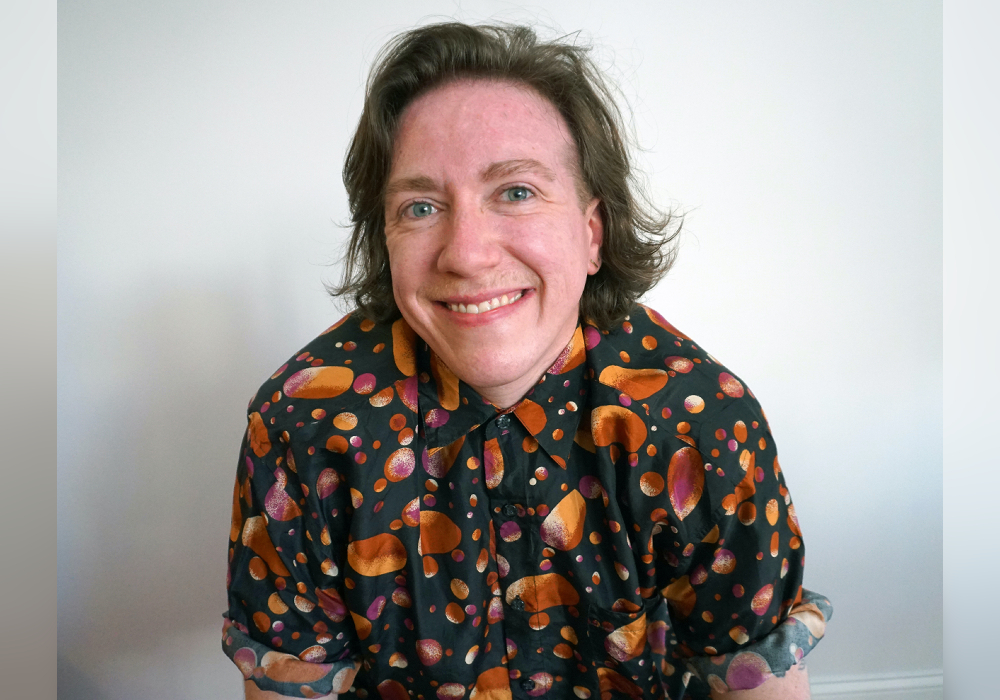
By Sophie Ann Hinkson
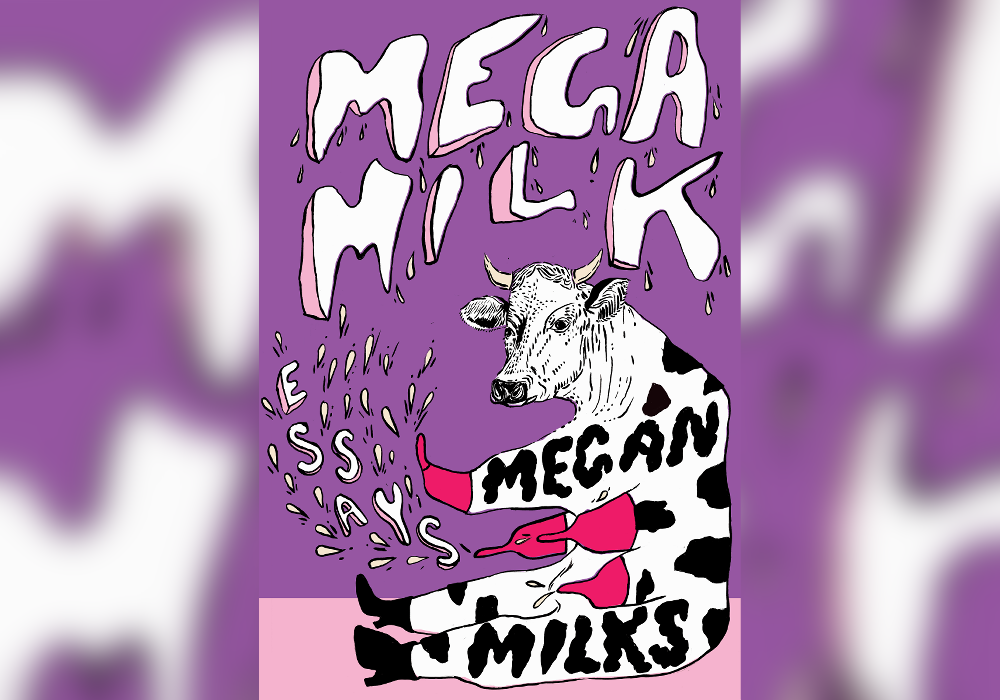
Some authors have a magnetic pull—you keep returning to them, as if by fate. Megan Milks is one such writer, first gaining attention with the body-horror short story “Slug,” from their eponymous collection. Milks is also the author of the novel Margaret and the Mystery of the Missing Body and the recently released Mega Milk, all published by Feminist Press. Their books explore the search for selfhood without confinement—freedom lies at the heart of their writing. Their style is wildly original, playfully bending literary codes. These qualities continue in Milks’s newest work, which weaves together insights about their past, the milk industry, queerness, and the cultural symbolism of milk in the MAGA era.
With such a rich and evolving body of work, The Coachella Review had to ask: what came before writing Mega Milk, and how has Milks’s work evolved since?
The Coachella Review: In Mega Milk, milk is the conduit through which you talk about the treatment of animals on a dairy farm, but it also makes you think about family estrangement, and being queer, and transitioning, and how milk, so trivial that most of us don’t think about it, can be used as a racist symbol. Did you always know you would cover all these themes?
Megan Milks: This book was always going to be about names, and about milk, and about family, because my name contains milk, and my name comes from my family, and milk is so strongly associated with family … so it’s all kind of bound together. One origin point was an essay I wrote in 2010-11 for a Chicago magazine column on names and naming. That piece, which was a series of anecdotes related to my name, was a lot of fun to write. Then in 2017, two things happened in quick succession—there was the release of Get Out, which has an amazing milk moment; and then there were images in the news of neo-Nazis chugging milk in front of the live feed at the HEWILLNOTDIVIDE.US show at the Museum of the Moving Image. Those events made me newly aware of milk’s entanglements with white supremacy. I felt a bit guilty and dumb for not having brought that into the aforementioned essay, and I felt the urge to return to the subject of names, and of my name, perhaps for a book – though it would be a few more years before I turned to the project seriously.
TCR: Since everything connects in the end and each theme feeds into the next stance, I wonder if you had a writing roadmap of some sort. How much research did you do? When did you have the first idea for Mega Milk, and when did you start to write?
MM: This book was sold on proposal, so in the ideation stages I drafted preliminary synopses for each essay. For many years, I thought about whether or not to change my name (and I still do now), and initially this book was going to be my [way to] goad myself: I would use the book to make myself find a new name… but then I started researching milk, and it kind of took over. I got milk fever, I became a milk magnet—I started seeing everything through the lens of milk.
And I did a ton of research. I read many books and journal chapters and news articles; I interviewed my parents and other family members, as well as dairy farmers and people who have lactated and/or nursed; I visited farms and attended a manure expo; and did other experiential research that made its way into the essays.
TCR: While writing, were you surprised by what appeared on the page? Did you find yourself connecting your research on milk to you in an unexpected way?
MM: I’m always surprised by what appears on the page! That’s what keeps writing interesting for me: all the surprises and discoveries, how ideas show up, how connections announce themselves. Getting into that mystical (milky?) flow – it’s a kind of letdown, I guess.
Because milk touches on so many areas and cultural histories, and has so many meanings, there is so much more research I could have done. I decided to use the personal as a kind of constraint. Each essay in the book needed to touch on some area of personal vulnerability.
TCR: How did you pitch your project to your publisher? Did you just say, “It’s about milk,” or did you have to find a more compelling way to present it?
MM: I submitted a proposal that explained how all these ideas were entangled and included essay summaries and a writing sample. The first essay I wrote for the book was “Skim Milks,” which uses the concept of skimming to draw parallels between skimming as a food production process, as a reading practice, and as a way in which we come to know each other and to control how we are known—and that’s all tied to a revisitation of an erotic romance novel that my paternal grandmother gave me when I was eleven.
My publisher, Feminist Press, had published my previous two books, so we already knew each other well. But I think this essay, which I used as my writing sample, gave them a sense of how expansively I would be thinking about milk. One of the great things about working with FP was the sense of mutual trust. The book changed a lot from proposal to final version: a number of essays I had envisioned writing just didn’t happen, and essays like “Cat-Cow,” “The Letdown,” and “The Squeeze” weren’t pitched, but emerged during the research and drafting process. My phenomenal editor, Jeanne Thornton (who is also a brilliant writer), was down for these pivots and generally open to seeing the book become whatever it needed to become.
TCR: There’s a relaxed and even playful tone all throughout that I appreciated. I felt closer to your stance, and it made everything funnier to read. Any source of inspiration from other books you’ve read, ones capable of talking about important matters in an entertaining way?
MM: I’m happy to hear you found the tone inviting. Writing and reading for me are spaces of intimacy, and humor and playfulness are two ways to create intimacy. Humor also keeps me engaged when writing, because essentially what I’m doing is reading my own work again and again—the worst thing I can be is dull.
Dodie Bellamy is probably my favorite essayist—her work delights in bodily abjection and the absurdity of contemporary life. I’ve picked up some of her sense of humor, I think.
I also really love wordplay, and milk gave me lots of opportunities to splash around in puns and other milky wordplay. Myriam Gurba is a writer who has modeled for me a particular kind of shameless glee for puns.
TCR: Did you consciously think about making your book more political? You say you wrote it at the end of 2024, and you do mention MAGA several times…
MM: Milk is inherently political and I hope my book reflects that. Things changed so rapidly during the three years I was working on these essays [2022-2024] that it was hard to know what the present of the book was—it was different for each essay, and at different stages of revision—and how it would be read in the [time period] in which it would be read. When I mention “the end of 2024” I’m referring to my last pass through the book before we sent it to the copyeditor. At that point, I updated the opening essay slightly to reflect the shift in milk consumption from a steady decrease to (suddenly) the first uptick in decades, which has everything to do with the MAGA and MAHA movements.
When I was revisiting the essay “MAGA Milk” in late 2024, I wondered how it would read when the book was released in early 2026. For a few weeks, I agonized over how to speak to a future that would almost certainly be defined by major upheaval. Ultimately, I decided all I could do was mark the time of writing/revising within the essay, as opposed to attempting to predict the future.
TCR: About family estrangement: I found your way of talking about such a complex and painful subject to be very graceful. You don’t say much, but it’s always insightful. You state that family is not necessarily the best fit for everyone. You also recommend books to read on the subject. Could you describe the path that led you to talk about this subject when you started to write about milk?
MM: With this book, I was grappling with a few things: feeling like I was on the edge of “the milk”—that is, on the perimeter of my family of origin. At the same time, I haven’t built a family of my own: I’m not partnered, I’m not a parent. And while I have no lack of intimacy—my life is very full and rich with intimacy of all kinds—I’m not sure I’d say I have what so many queers (and others) call their chosen families. Now that I’m in my forties, I’m thinking a lot about aging as a single person without children, and about the kinds of intimacies I’ve sought out—as well as those I haven’t. I’ve never been pregnant. I’ve never lactated or nursed. And it seems probably that I never will. I think I’m just confronting [the fact] that this is the life I’ve chosen and asking myself what family means to me. I might say I’m as estranged from milk and family as I am from my given name: which is to say there is distance, but I am still tethered to all three.
And then, because milk is so tied to family—in that milk is essential for human growth and typically comes from familial caregivers—it became an apt medium through which I could grapple with these questions.
TCR: Because of the part dedicated to your brother, can we say that Mega Milk is a memoir? How do you feel about memoirs in general?
MM: I do have some anxieties about the memoir as a form, mostly because within trans literature, the trans memoir has tended to be fairly conservative and written for a cis gaze. But I love life writing and the essay as a form. I would say that first and foremost, Mega Milk is a collection of essays. It can also be described as a memoir in essays. Then again, because memoirs typically focus on one life period or area of experience, the word “memoir” doesn’t seem quite accurate for the more diffuse approach I’ve taken to writing about myself here.
TCR: You seem to be ambivalent about the idea of autobiography and memoir. You question the genre in the essay “Milking the Bull”: “Writing about oneself is considered by some to be a masturbatory exercise: self-indulgent, unproductive, bad. I don’t agree, obviously: my fiction is all Self, Self, Self, in messy wrapping.” Later on, you wish you could “escape [yourself] and the obligation of the personal essay.” Can you explain to us why you feel that way?
MM: I fully respect memoir and autobiography as genres! And I absolutely believe in the project of personal writing. Michelle Tea’s essay “Explain” is a big one for me. And Melissa Febos’s “In Praise of Navel Gazing.”
I’ve written about myself for many years, just usually in fiction. I love the tensions and frictions, the ironies that we can create as fiction writers writing from the gap between character and self. But we can do that in personal nonfiction, too. If at times I wanted to escape myself while writing Mega Milk, that’s because, like most people, I sometimes found myself humiliating or boring. But when that kind of claustrophobic feeling crept up, I could turn my focus elsewhere: I could escape into research, I could escape into fantasy, I could escape into language.
TCR: Mega Milk has so many literary references! Was there a goal behind bringing other books into your work? How does reading impact your daily life, creative or not?
MM: Oh no, does it really have that many? I’ had actually hoped I was writing a book that was more out in the world than it was stuck in books. But books are in the world, and they make up a lot of my world. Reading is my milk, I guess? I almost never drink fluid milk, but I do consume a lot of books.
TCR: I’m a huge fan of your collection Slug, especially the eponymous short story, and to me, identity is at the center of your work. You show your reader how identity fluctuates, changes, and evolves. Would you consider this an obsession, or did it naturally come out of your writing, without you pushing it?
MM: Thanks for this reading of Slug! Identity, yes. And also, queer intimacies and bodies. I guess there is something about how identity shapes and is shaped by intimacy and embodiment. In terms of craft, I’m endlessly obsessed with narrative forms and structures, and this kind of content related to identity and intimacy and embodiment, which is everyday life, inevitably finds its way in.
 Sophie Ann Hinkson spent much of her life in France, where she worked as a bookseller and literary journalist for both magazines and radio. Now based in Chicago, she teaches French and ESL at various colleges and is currently pursuing a Low-Residency MFA in Creative Writing at UC Riverside. Her stories will appear in the upcoming fall issues of Midwest Weird and Shadow Dog Press. At home, she shares her life with her husband, a black cat, and six pet rats.