
By Dave Oei
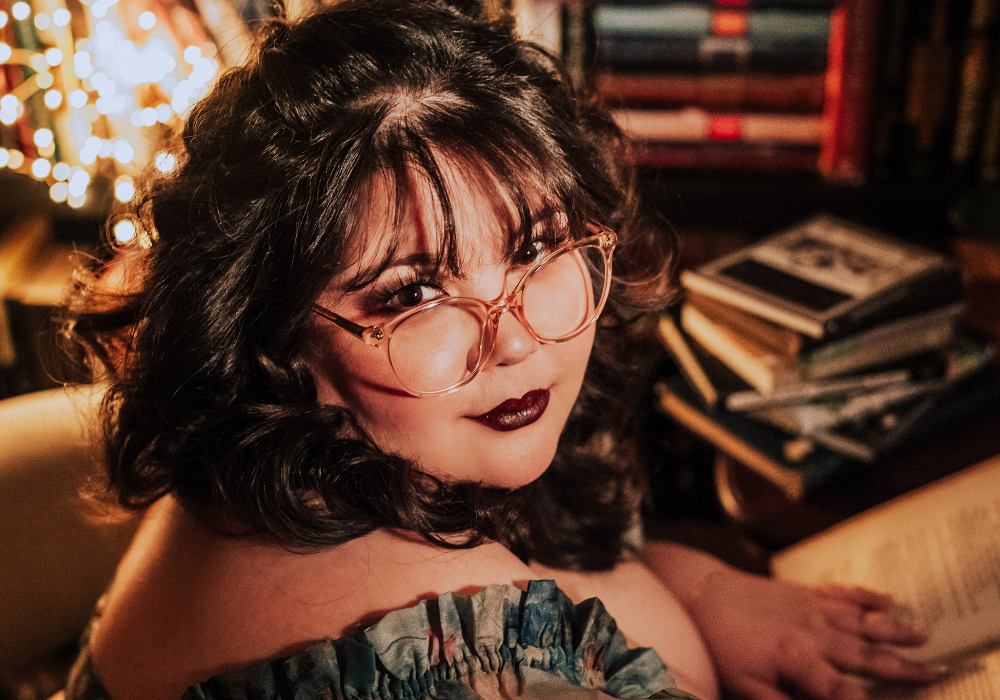
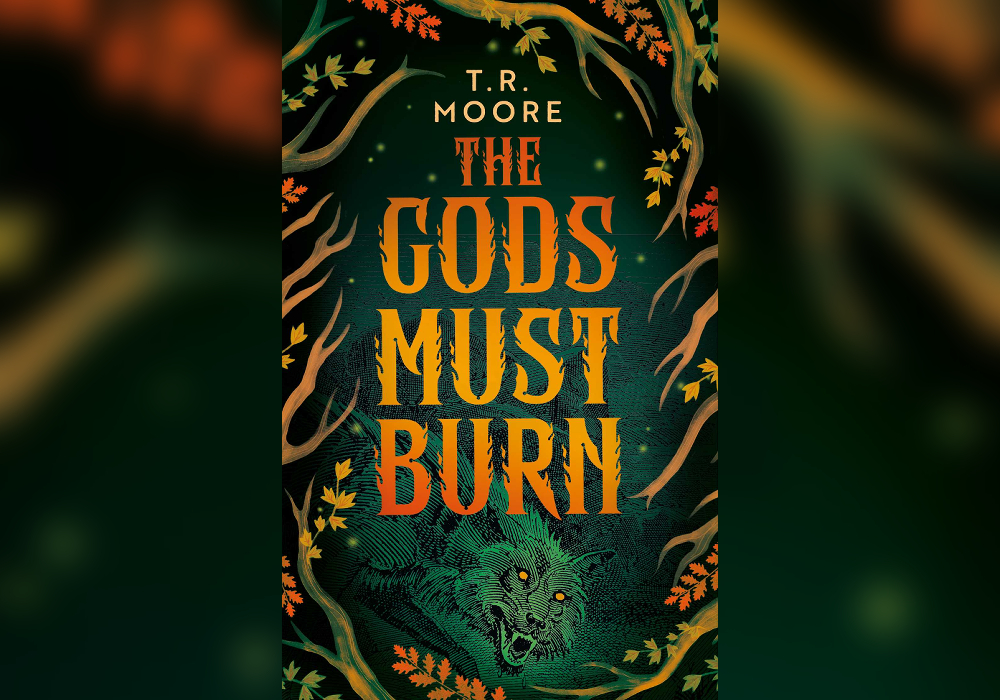
T.R. Moore is the debut author of The Gods Must Burn, a dark fantasy novel inspired by Korean myth. The story centers on Basuin, a disgraced war hero-turned-reluctant conqueror plagued with panic attacks and survivor’s guilt. Basuin wishes to follow his dead comrades to the heavenly Winter River instead of hell, known as the Blacksalt Sea, where he’s sure his sins will take him. His righteousness thrusts him into godhood and a duty to protect the forest he was sent to destroy instead. It is, however, a forest managed by a pacifist god who does not want his help. To heal, he must fight two battles—one against the colonist’s army, and the other against the burden of remorse for past sins.
The Coachella Review spoke with Moore about her challenges growing up as a queer, mixed-race Korean and the craft of writing not a romantasy, but a magical, romantic fantasy.
The Coachella Review: Have you been interviewed before?
T.R. Moore: I have interviews planned, but this is my first.
TCR: Let’s start with your pen name—what should I call you?
TRM: My name is Taylor and I want my readers to be able to call me Taylor, but I also wanted “T. R. Moore” as a pen name and on the cover of my books.
TCR: But where did T.R. come from? And why a pen name?
TRM: I learned when I really young and interested in writing: People will read a book more often if it’s by a man, especially in the adult fantasy space. So, I started thinking of pen names. I wanted to do “T. R.” because my name’s Taylor Renee. I tried a lot of different ‘M’ last names, except none of them felt authentic, and I always try for authenticity even when it’s not pretty.
So I just went with my whole name—T. R. Moore.
TCR: Do you still feel having a non-female presenting name is important?
TRM: With all the women fantasy writers around, definitely not. But, while I’m now divorced from the idea that I need a masculine pen name, after I created “T. R. Moore,” I just fell in love with it. I’m still excited to see it on the cover of my book.
TCR: Tell me about the birth of The Gods Must Burn. What was your process for making it real? What was the initial kernel? Did you start with the characters or the plot?
TRM: It began with a 4 a.m. idea in my Notes app. I thought about a wolf and a deer. I wanted a deer-girl and really scary wolf-man; where everyone thought this big wolf had all the power, when truly, all the power was in this smaller deer-girl. He would become her protector, but everyone would initially think it was the opposite, where he was the one who ruled the forest and she was just by his side. That was the first kernel.
TCR: Okay, wolf-man, deer-girl—and going back to your name and your pen name for a moment: You mentioned the importance of a name, the sound of it, and the authenticity of it. It feels like there’s a parallel between your choice of pen name and the wrestling the main characters—Basuin and Ren—have regarding their use of names and the importance they place on them. Are their struggles meant to mirror yours?
TRM: I’ve always been fascinated with names. I know this sounds really weird, but I believe giving something a name is really powerful. In Gods, everything has a name. From every spirit to every tree. That means it’s alive, it’s living. Opposite that, there’s dehumanization, when people—how do I say this in a nice way…
TCR: You don’t have to be nice. This work is about trauma, right?
TRM: It’s big about trauma. And how not using one’s name is dehumanizing and feeds into one’s trauma. I’m fascinated with this idea. I even have multiple fantasy ideas about true names and the like.
TCR: The male main character, Basuin, wants to be called by that name and not his god-name, but the female main character, Ren, is very reluctant to share hers. A name’s importance feels central to your story. Name is identity. It makes me curious about your struggle with “Taylor” and standing out from the crowd, and how that may have affected this story.
TRM: Yes, how much you tell a person can determine what you can control—you can manipulate how much people know about you. And that’s Ren’s thing—she’s very secretive with it, right? As the forest god, she needs to be proper, strong. She’s running this forest but it’s in danger, but she’s also a god, and that’s a struggle because she knows she was also human once.
It’s the opposite with Basuin, who has a new name imposed on him when he becomes a god. And he hates that name because he wants people to see the person underneath the armor. So, these characters can manipulate others by feeding how much and what kind of information they give. They can create this distance—imagined or real, if that makes sense.
TCR: For sure. I also want to talk about the blur between life and death. It feels like a gradient, especially for some characters. Are you exploring the idea of how one might exist across multiple planes? Is this something you conceived of, or is it rooted in some sort of mythology?
TRM: I draw a lot on Korean shamanism—the idea where every living thing, from every animal and tree, every being, has a spirit. And I’m not religious but I believe in reincarnation. We close our eyes—we die—and then we wake up as a new person. So, the idea these afterlives, where the Winter River is heaven and the Blacksalt Sea is hell—
TCR: Great names, by the way.
TRM: Thank you. I like them, too! Those concepts incorporate this idea where, as a spirit, you could continue life and chillax in this beautiful water-based spirit world, a.k.a., the Winter River. So yes, this story incorporates a combination of both Korean shamanism and a bit of my “What if reincarnation doesn’t exist and you could just hang out in a pool?”
TCR: Have you always identified with your half Korean side?
TRM: Growing up, I did not identify super well with it. I grew up in a town where during my school years, there were two Asian kids. One was me and the other was Dennis Chen, who ran the only Chinese buffet in our very small town. My mom wanted me to be super Americanized. As I got older, I realized I was at this intersection between that ideal and being too Asian in my very small, very white town; I looked too different. But then, there was nothing strongly Asian about me on the other side; I was completely American white from an Asian point of view. And when I moved out of my small town, I was heavily fetishized. I experienced a ton of racism, a ton of sexualization.
The only way for me to reclaim power over being fetishized and being called names and slurs for being Asian, I realized, [was to think,] I might as well just be Asian and embrace that part of me that got away. So, at around twenty, I started reconnecting with that part of my culture.
TCR: What did that reconnection look like?
TRM: Studying the language, reading the history. I met and made a lot of friends who were also Korean.
TCR: I’m sure that all helped. As an aside, how do you feel about the explosion of K-dramas, Korean culture, and subsequent exposure of Korean culture all over the world?
TRM: Yeah, it’s super, super boomed. Which is crazy, because I listened to K-pop growing up, and was I bullied for it in high school!
When I was in high school, “Gangnam Style” came out, and my classmates would do the dance and they would say, “Taylor can do it better because she’s Korean.” They’d make me do the “Gangnam Style” dance. So, I stopped listening to K-pop. I thought it was uncool with all the bullying. And then it blew up. And I was like, “Guys, you bullied me for this shit. Like, you love K-pop now. I was mercilessly bullied over it.”
But oh my god, K-Pop Demon Hunters has made my entire year. The fact kids are loving this Korean movie and there’s so much Korean culture in the movie and it’s done so well—I love it. Because, of course, I think about kids like me who could have had this back then.
TCR: It sounds like a lot of your growing up involved having to navigate being the outsider and insider at the same time. It reminds me a lot of Basuin’s journey. How much of you is channeled into this main character?
TRM: A lot, to be honest, in different ways.
He’s torn between religion and the army, and he’s also torn between what it means to be a soldier and what it means to be a regular person who’s living with trauma. But Basuin is rooted in trauma that I didn’t know how to process. For example, I was not in the military. I don’t have survivors’ guilt in the same way he does. But I wanted to write a book for survivors and Bass is a survivor in a very different way than I am.
There’s also this idea I wanted to explore that trauma changes you completely. That you are forced to become a different person so you can heal and move on. That’s his whole thing—how does [Basuin] shed his armor and learn to let go and forgive himself? If he doesn’t, he’ll never heal. His transformation into the wolf-god is very indicative of this forced change. He is forced to become someone completely different, and he struggles with it at every given moment until he realizes that the only way that he’s going to get through this war and save this forest and the woman that he has come to love is if he truly embraces the monster that he has been forced to become.
And it’s very similar in trauma. You’re either forced to become a different person or you choose to become a different person. However it happens, change is required to heal.
One of my favorite things about this book that I got a lot of criticism for is that, even by the end, [Basuin] doesn’t really forgive himself and he still has a lot of healing to do. It is a healing book, and it proves that you can heal, but he is not a healed person by the end, not even in the epilogue. Some people don’t like it, but I feel that it’s realistic.
TCR: One of the things I picked up on early is how this is a journey Basuin has to take both internally and externally. And they’re almost like two different plot points that have to reconcile. So whatever those critics say, I feel like you did a great job managing both.
TRM: Thank you. I feel people want happy things and I think for people to root for this character, they want him to be satisfied and healed by the end. But imagine saying such a thing to your favorite person—that’s incredibly hard to impose onto anybody.
TCR: Along the lines of expectations, I wasn’t sure if I’d call this a romantasy or something else. With any definition, there will be built-in expectations. What would you call this?
TRM: I actually asked my agent not to pitch it as romantasy. It’s way too dark and it’s definitely not romantic.
TCR: Well, it’s not not-romantic either.
TRM: [laughs] Yes. But, to me, romantasy is where you can’t separate their romance from the plot. The plot, the ending, it all happens because of the romance. Even if Ren didn’t exist as a potential romantic partner, this book would still work. And that’s where it’s not a romantasy.
TCR: Yes, there’s that nuanced definition. But there are going to be some readers who have different expectations. It sounds like you didn’t want to veer toward placating readers’ expectations. What did your agent or editor think?
TRM: It goes back to my authenticity thing. I’m never going to just write to [be marketable]. I don’t care enough about publishing to make my books into [what readers want them to be over] what they should be. Every story wants to be something. For me, my characters show up and they tell me, “This is who I am. I can’t change it.” I tell them, “That’s cool, do what you got to do. I will write you into whatever you want to be.” I’ve had multiple books turn into this, like, genre smoothie of sorts of different tropes that should not, by industry standards, fit together. It’s all just one smoothie. But I don’t change it from there.
I want to write authentic stories. And this story is exactly the way that I wanted it to be.
TCR: In that regard, Basuin is not the typical smart, clever hero who outthinks the enemy. Is that how you constructed him initially?
TRM: Absolutely. He came to me as a himbo, and that’s how he stayed. I don’t really know why he became this character. But my characters walk into my life, and they tell me who they are. When I designed this story, he started as big scary wolf-man who does not control anything. He exists to protect this one woman, this forest god. He just showed up that way, as a hero who didn’t want to be a hero.
TCR: I noticed he doesn’t say he’s bisexual, but he clearly is. It’s like an average romance where the male and female leads don’t come out and say, “Hi, I’m heterosexual.” Instead, they just are, just like Basuin. It’s his unsaid normal. So, I’m wondering, in our heteronormative world, what considerations did you weigh before choosing the route of just laying it out with no explanation?
TRM: I studied sociology in college, worked in gender and sexuality, and did a lot of research on queer issues, like how our media frames queer relationships and specifically the female gender—how they portray femmes and butches, for example, but also homonormativity. I push for that, and I believe that it’s important to talk about queer relationships in a very non-important way. Some people would argue against that—where if it’s in a book, it needs to stand out and really be driven home, and I appreciate those views, but they’re not mine. And that’s partially because of my research but also because of my experience as a queer woman. If I had had a little bit more of queer normativity, I would have not turned out this way.
Let me tell you—kind of off topic, but also on topic: I fell in love with a girl at first sight. I was obsessed with her for two days, and then I never saw her again. And I used to cry in high school because I was not gay. I had so many gay friends. I was like, “That’s so great, and I hate that I only love men.” And then I fall in love with a woman and I’m like, “Oh my god, maybe I’m bisexual.” It was crazy. I have a whole book dedicated to her because she was how I realized that I was bisexual.
TCR: I love how his sexuality was presented as his normal. And how his world also sees this as nothing unusual. And it felt seamless to be in his point of view and to understand not only his loves, but his traumas. Along those lines, Gods features characters who belong to different but intersecting planes of existence. There are dead people, living people, gods, humans, spirits, and sometimes they’re disembodied, sometimes they’re inside one another. It’s very fluid. Does this come from the imagination of Taylor playing around at 4 a.m.?
THM: I have this bad attachment to objects—I attach emotions and empathy to anything, living or not. In high school, I’d walk around Walmart because when you live in a town of five thousand people, that’s what you did, and I’d feel terrible for things that people would just toss on the shelves that didn’t belong there. I had so much empathy for this random fucking object on a shelf that somebody forgot about. When I’m driving down the highway and I see a shoe [on the side of the road], I’m like, Oh my god, is someone gonna get that shoe?
I don’t think I’m alone; we humans have this horrible—or great—ability to talk to all things, and I have this idea that everything is fluid. I don’t know if there’s a difference between life and death. Call me a woo-woo crazy person, but I really think when we die we’re going to close our eyes and open them to something new. Because matter can’t be destroyed, right? So, I followed this idea where everything is living and nothing really matters. And I know it sounds bad. But I’ve been to a lot of funerals, more than I should have [been to] by eighteen. I’ve experienced a lot of death—animal death, people death. I grew used to this idea that people are going to die. I’m going to die. Everyone’s going to die. And then magically, we’re in a new body, which is the reincarnation. A lot of what I write deals with the afterlife and underworld and if we go to heaven. Who is good and who is evil, and how do we pick that and how do we challenge that?
TCR: Fluidity of existence feels like it should make things easier, but it doesn’t for Bass. He’s stuck with this god inside of him, it’s taking over his body. He resists, but he changes forms, and he’s got powers, and he doesn’t want the powers—
TRM: This poor guy, yeah. His only goal in the beginning is that he wishes he were dead. But his idea of death is turned upside down, so [the] poor guy just wants to go to hell where he thinks he belongs and then, turns out, he’s off to something very different.
TCR: Right. So, can we talk about the antagonist, Kensy? Kensy’s primary role is to destroy what Bass has to eventually come to accept as his valid way of seeing himself, right? What was your process of creating him?
TRM: I plan my books out to a T before I start them. So, it was always planned, but Kensy—while I think a lot of people can read him as evil for evil’s sake, Kensy is the embodiment of the idea of colonialism and how power can change a person when they have too much of it. He’s the embodiment of colonialism that seeks to absorb or destroy any part of someone’s culture that is good. If there’s a power that could be used to overthrow them, the colonialists will destroy it. But if it’s positive and not threatening, colonialists will absorb it.
I grew up in Louisiana, and all of our history is completely intertwined with slavery, with the French Revolution. And then I’m Korean and I know so much of Korean history and colonialism, so the mix of these histories has colored my writing. But colonizers will always be the destroyer, so that is what Kensy becomes by the end. He is the embodiment of: If I can’t have what you have, I will destroy it. It’s what colonialism does.
TCR: Before we end, I want to talk about your magic system. This is something fantasy writers toil over. In Gods Must Burn, there’s color magic and threads woven from them with rules that are intricate, but they work seamlessly. It feels like they’re threaded through not only the characters, but the entire setting, including how the afterlife and the gods’ work. Do you have a bible that explains everything? How did you come up with this?
TRM: You’re giving me more credit than I deserve.
TCR: Spill your secrets, Taylor.
TRM: My secret is I hate world building, which is crazy because I write fantasy. But because I hate world building and I hate magic rules, I made the magic system as simple as possible. I will not even lie. Why do I have to tell you how it works? From the start, my goal was to not focus on magic, but on the gods. It is a book about gods, after all, not magic.
Magic comes from gods, and on the main continent, Xalkhir, where the military and Queen are, there is no more magic because they destroyed their gods. The only real question was, how do magic and my spirits work in terms of the gods?
Well, everything starts from the idea that spirits are in everything, and then it trickles down. As for the gods, they’re hanging out, chilling. Obviously, they do big world things. We learn gods need some sort of body or shrine to be able to affect the natural world. And if they’re dead, you can’t do anything unless they have a host that they can work through. And that’s it.
I truly believe in digestible fantasy. Outside of hating world building, I hate inaccessible books. Accessible fantasy is the way to keep people reading. I don’t like to read old white man fantasy, so I definitely don’t write it. I want to write books that people will enjoy without knowing every Dungeons and Dragons system or needing to know all the rules of magic. I wanted to keep it sweet. As someone who grew up in the Bible Belt, what matters to me [were] always the gods and their religion.
TCR: So, what’s next?
TRM: Oh my god, good question. I have no idea. But as someone who doesn’t really care about crafting marketable books, it means not everything I write is going to sell. Right now, I’m writing things that make me happy.
 Dave Oei is a writer, husband, father, graduate of UC Riverside’s Low-Residency MFA for Creative Writing, and advisor at his family’s veterinary hospital. He has served as co-editor of The Coachella Review’s Voice to Books column and continues to write book reviews and conduct author interviews. When he’s not crafting romances, fantasies, or science-fiction thrillers, he can be found on the soccer pitch or on sunset beach walks with his wife of over twenty-five years.