
By Geordie Stock
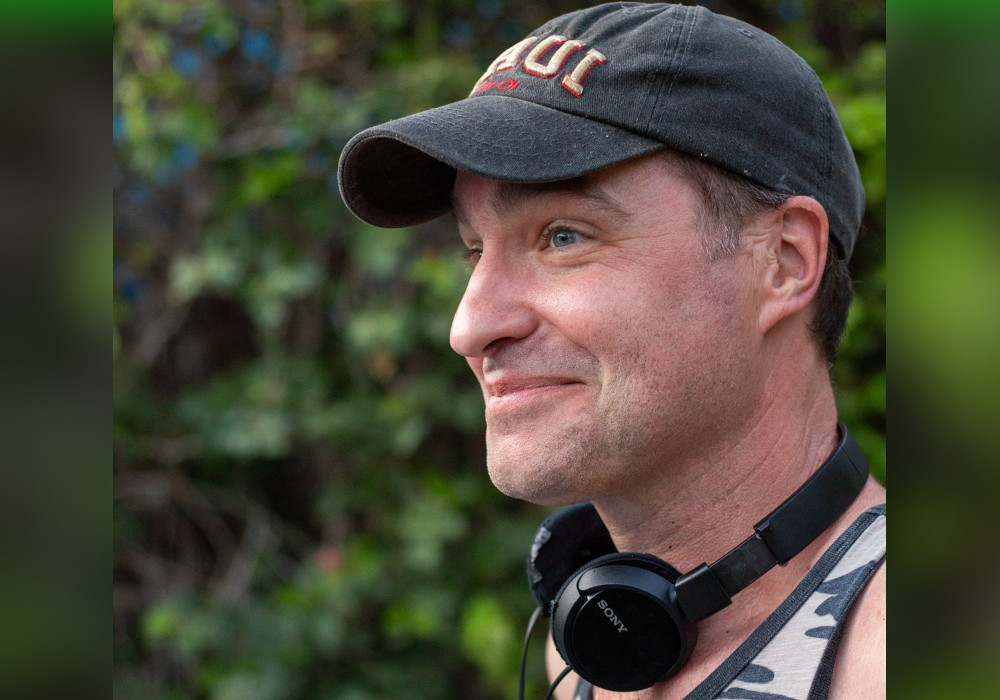
Tim O’Leary’s work is a family affair: he and his husband, Robert Rice, have worked together to put their unique, modern stamp on episodic stories. The duo’s production company, Murder and Gay Stuff, has created streaming shows such as Demonhuntr (now on Amazon Prime and YouTube channel Here TV) and their latest effort, Laid Bare, which is currently releasing new episodes every Wednesday on OUTtv.
The production company is aptly named because, while the duo’s partnership is in a sense family-friendly, their content is not: Laid Bare takes place at a nude gay resort and features a murder at the end of every ten-minute episode. But what the show lacks in accessibility, it makes up for in charm and originality. Laid Bare is a genre mashup, a farcical murder-mystery where the chiseled abs and bare bodies don’t get in the way of laughs, catty conflict, intrigue, and genuine romance.
The Coachella Review talked to O’Leary about Laid Bare’s large cast (most of whom bare it all), the show’s unmistakable influences, and delivering this kind of show in the streaming format.
The Coachella Review: Where did the inspiration for Laid Bare come from? It struck me as very unique.
Tim O’Leary: I would say I had the good fortune of staying at a few nude resorts in Palm Springs, but the Desert Paradise in particular was the one that I liked to stay at the most. One of the things that I thought was really unique and fun and interesting about it was that it creates a real sense of safety when you’re around other people who are not wearing any clothes. Everybody seems very friendly and kind and nurturing and supportive… and I just thought what would be really fun in an environment like that is if somebody found a dead body that was clearly bludgeoned to death and then had to figure out what’s going on.
TCR: Laid Bare has a unique bent to it, but thinking about the murder-mystery genre recently, we’ve seen stuff like Knives Out, we’ve seen Only Murders in the Building, and this feels a little bit like it could come from a love of that specific subgenre: the murder-mystery-comedy. Did that come into your thinking at all? Do you have any favorites in that subgenre, or are you inspired by anything recent?
TO: Oh, one hundred percent. You know, it’s funny. I wrote this before the first Knives Out came out, but after I saw it, I was just like, Oh, God, this is exactly the kind of thing that I want to work on! It’s entirely the kind of creative world that I want to live in, and I’ve just been enjoying the hell out of that series. And then also, we had the [Kenneth Branagh] Hercule Poirot/Agatha Christie movies starting to come out at the same time. And I just thought, God, we’re having a real fun renaissance of old-school style murder mysteries.
And listen, of course, my favorite movie of all time is Clue. It’s so fun. It’s just one of those movies that’s insanely quotable. It’s forty years old, and you can still watch it over and over again and find a new quote to glom onto. So that was absolutely my inspiration.
TCR: In Laid Bare, you have a big cast; you’re introducing multiple characters quickly, but they really each only have a few moments of screentime to establish who they are and what their conflict is. And yet the dynamics are established efficiently, and all these characters feel distinct. What was your approach to establishing these characters with this size of cast and only having ten-minute episodes to work?
TO: Obviously, everything starts on the page, but we learned so much about the characters from the casting itself. Once we had our roster of actors solidified, then it became a matter of making sure that everybody felt like they were an ambassador for their own character. But yeah, you’re right, it’s a large cast; it’s ten people to start off… and it does not stay ten people for very long! I wanted to make sure that each of the characters felt like a different person, like a fully cohesive individual, before we went into the actual mystery. We have eight episodes, and we give our big thesis statement—our “this is what the show is” moment—at the end of episode two. So that way, you get to experience all ten characters and get to know them before throwing them into this sort of powder keg of a situation.
TCR: In that way, it kind of operates like a traditional series pilot with twenty minutes of really getting to know people and then bam! You hit them with, “Here’s what we’re all about; here’s the major conflict.” You spoke about casting all these characters. The idea of casting actors, not just to play these roles but with this degree of nudity and sexuality—that must layer in a whole extra level of challenge.
TO: Sure, yeah.
TCR: In terms of working with the actors, what was it like to navigate that unique element?
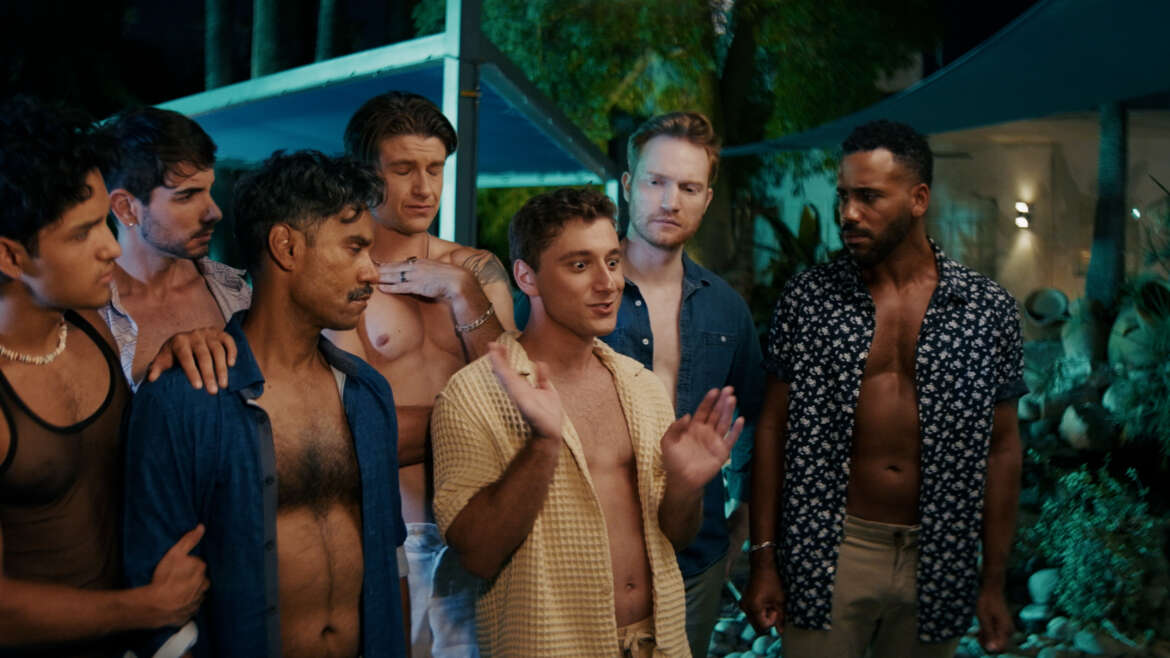
TO: I will say that three of the actors—three of the ten going in—were already cast. One of them, no surprise, was my husband, Robert Rice; I wrote the part of Aaron for him. My friend Jason Caceres, who was in Demonhuntr, I knew he would be amazing in this; he plays Cassidy. And then my friend Ephraim Lopez, who was also in Demonhuntr, I wrote this role for him, as well.
So then, we basically had seven roles to cast. And fortunately, we live in the era of intimacy coordinators. So I think from an actor’s perspective, it’s a lot less scary going into a project that has a lot of nudity in sexual situations because they know that they’re going to be taken care of. And we had really fantastic intimacy coordinators on our show. So I will say, I leaned on them quite a bit to make sure the actors felt as comfortable as possible and as safe and protected as possible.
TCR: You had mentioned the inspiration was to take this kind of wonderful comfort and safety of a nude resort and throw real danger into it. And I feel like that energy kind of infuses this show in multiple ways, because this has these accessible elements—farcical comedy, the whodunnit mystery—but there’s this whole other inextricable layer of sexuality. It’s reminiscent, in my opinion, of some early ‘90s Cinemax-type movies, but the difference here is the comedy is funny, and the characters are diverse and interesting.
When you were developing this, whether working on it with the actors or on the page, how did you approach that balance between the accessible elements—the fun murder-mystery comedy part of the show that’s reminiscent of Clue or Knives Out—and the really sexual element that is inextricable from the setting?
TO: That’s a really good question. And I have to be honest, I feel like it was not as divergent as one might think. It did all feel like one cohesive beast, for lack of a better term. We knew that we wanted to do something racy but paying proper homage to films like Clue, but also even older films like the earlier versions of the Agatha Christie stories.
It’s funny, somebody was talking to me about how all gay people are naturally clued into a murder mystery, which I didn’t realize. I kind of thought I was the only one! And it turns out that the camp element of it is something that is very attractive to the gay community. I don’t know. It didn’t really feel like I was creating something that was a hybrid. It felt like that hybrid already existed, and I just sort of gave it my own spin.
TCR: OUTtv seems like a pretty unique place to be, especially with the ten-minute episode format. What was the process like, developing Laid Bare for that medium and audience, and what was the history of this coming to OUTtv?
TO: Well, I’ve been wanting to work with OUTtv forever, and my husband and I [who have a production company, Murder and Gay Stuff] have a show out called Demonhuntr, and I think that’s sort of how we got on OUTtv’s radar. That was what facilitated conversations early on. We said, “We want to work with you,” and they said, “We want to work with you.”
I came to them with what was, at the time, a script for a feature film version of Laid Bare. It was basically a 90-100 minute film—a movie that’s essentially the series that you’re seeing now. And Lauren Whitelaw, who is their head of development, said, “What do you think about this being a series? Specifically a fifteen-minute episode series, or twelve minutes with commercials?” and I thought that actually sounded really interesting. The first season is based on Agatha Christie’s Ten Little Indians, so somebody dies about every twelve to thirteen minutes. And I was like, “Yeah, we can make that into a series quite easily.” I realized twelve-minute episodes would actually be perfect. So she said, “Okay, take a little time and write that.” It didn’t take me very long, because it was already sort of set up; I came up with the eight-episode structure, which seemed to work and made them happy, and it was actually really fun for us to make.
I also really want to highlight Rob’s role in this, because Rob is obviously the lead; he plays Aaron. And he was really the impetus for us starting to make our own stuff. It was as far back as 2016, I think; he was the one who’s like, “Okay, we should really start making things.” He’s the reason we made Demonhuntr. He’s the reason we brought Demonhuntr to the film festivals, and that’s why people saw it. And that’s why OUTtv saw it and asked if we wanted to work with them. Because I’m the writer and the director, I get a lot of credit for what we do in our company, but he is the executive producer, and he does a shit ton of work. I just always want to make sure that he gets his flowers.
TCR: Were there any standout changes that arose from adapting your feature script to a season of episodes of this length?
TO: I will say, one of the wonderful things about turning it from a feature into a show is we got to expand a little bit of the character interaction. The actors got a little bit more meat to chew on, and they got a little bit more room to play in the playground, which I think everybody appreciates… certainly the actors appreciate, because that lets them dive deeper into their characters. And for me as a writer, I got to explore relationships that we maybe didn’t have a huge amount of development for.
The relationship that really grew out of that was Ephraim Lopez, who plays Eric, and his relationship with his boyfriend Jesse Steele, played by Nico [Nicolas Zuluaga]. That got a little bit more room to breathe, and we got to show that these two guys really love each other. And they’re probably, ironically, the most stable relationship in the entire show! We also got to develop the relationship between the two brothers, Aaron and Alistair. I got to really play with that brother dynamic. In a show full of horny gay men, it was kind of fun to do something that was not romantic or sexual—that was familial and fraternal.
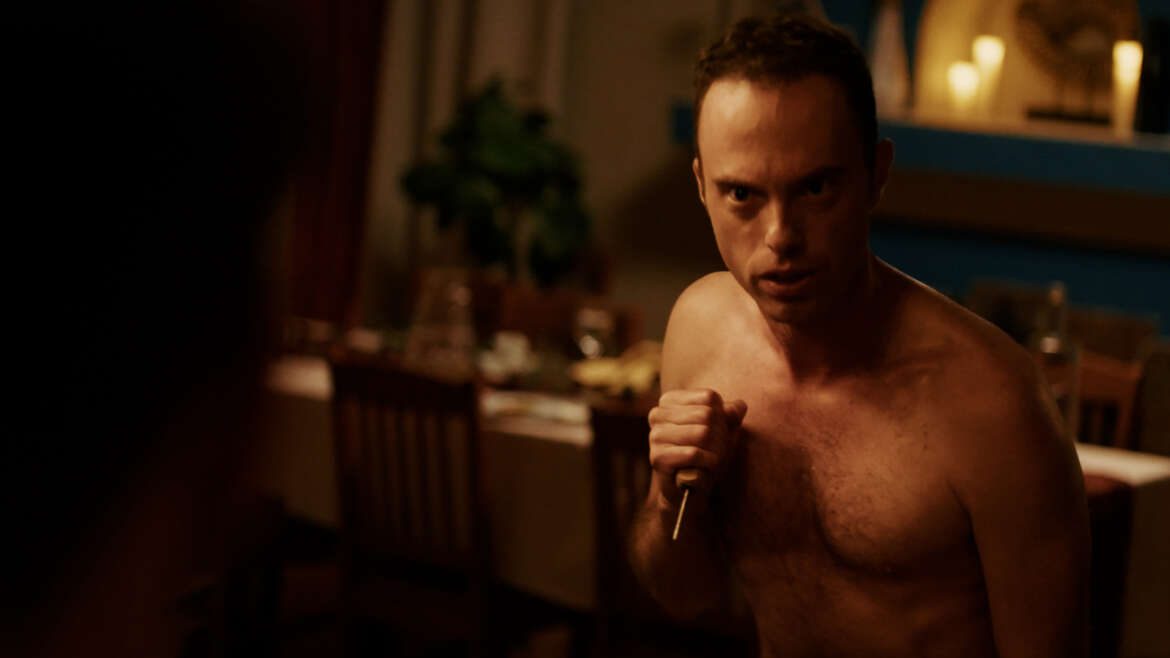
TCR: One of the first things that struck me was, if you’ll forgive the pun, the importance of the “straight” man in this. What was the process like cultivating that character [Aaron] with your husband? Because for a character that is supposedly the “boring” one, his conflict and character are immediately apparent, and he’s really good.
TO: Well, you know, it’s fun because Rob in his daily life is very funny and very goofy. He has a huge, goofy sense of humor. He loves dad jokes. He’s never met a pun he didn’t enjoy. But he was thinking about his instrument as an actor, and he was saying “Okay, I have kind of a neutral look. I’m not the buffest guy, I’m not the hottest guy, but I’m also not this weird gremlin living under a bridge. Where does that put me? I think I’m usually probably going to play the straight man.”
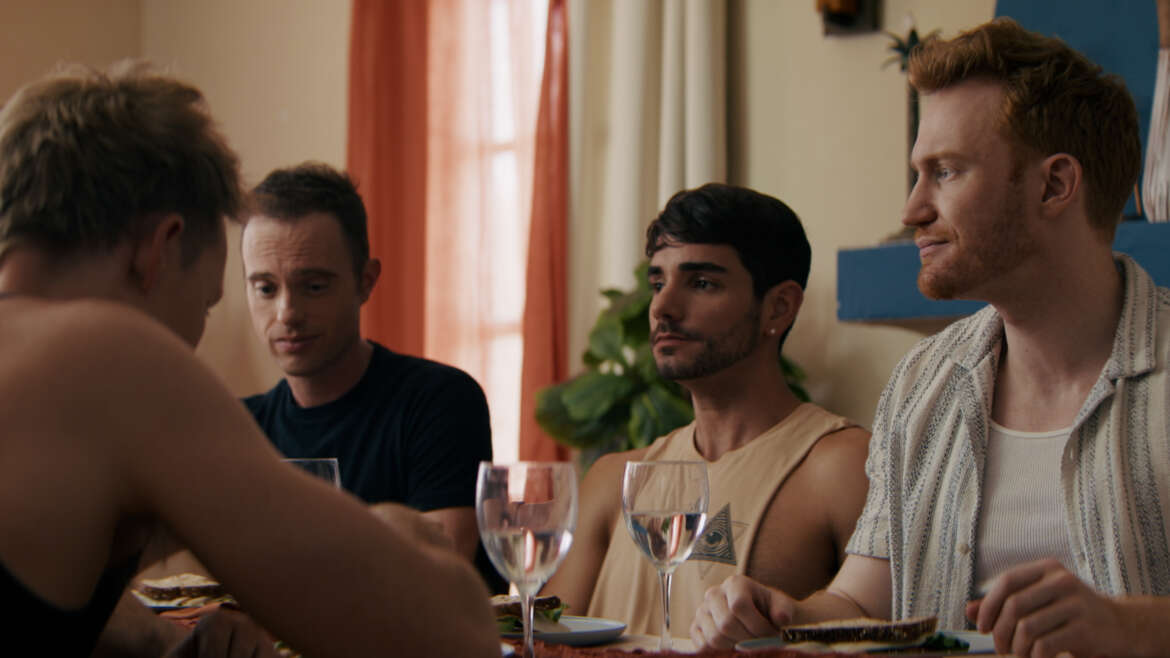
And then the best thing that could have happened to our show was Ethan Corbett auditioned for us, and he is the guy that ended up playing Alistair. He’s so tall and muscular and handsome, but in addition to that, he’s extraordinarily goofy. What we found during the audition process and the chemistry reads is that Ethan is very good at throwing out funny stuff and letting Rob kind of swat it back, but from a very deadpan way. And it was funny, because they seemed like brothers by the end of, like, ten minutes. That’s really one of the reasons why Ethan was cast immediately: because he was so great in that role and his relationship with Rob was so crystal clear.
And then one of the wonderful things about Rob as an actor is that he’s not selfish. He will allow other actors to have the spotlight as long as it serves the story that we’re telling and it serves the scene. It’s really fun to see the two of them play together on set, because they really do seem like brothers.
TCR: I think it’s impossible to not dive more into the sexuality of the show… but at the same time there’s a lot more to it than that, as you were just mentioning: the familial element, the depth of some of the relationships—all that is about more than just sex. In terms of the interplay between something accessible and something less accessible—something like Bros, which is a very conventional rom-com but from an unconventional angle—and also something like Shortbus—
TO: Oh! That’s a deep cut, I haven’t seen that in about twenty years.
TCR: That’s a movie that is a really frank depiction of sexuality but is also kind of a comedy, but perhaps one that’s less accessible maybe, not only because of sexuality, but because of its specific indie aesthetic. And I think Laid Bare kind of does all of these things; it’s explicitly sexual, but also quite conventional and fun, and obviously has a unique representation. I mean, unabashed depictions of gay male sexuality is not something often seen in media or stories.
TO: And certainly not in the murder mystery genre. Actually, I think we’re the first filmed project that is a gay murder mystery. Don’t quote me on that! But I think I don’t know any other ones. I’ve been looking and I haven’t found any.
TCR: Well, I believe you. In fact, one of my follow-ups was, is this the first murder mystery to begin with an orgy? Let alone a gay orgy?
TO: [Laughs] That is a very good question. I can’t say I know the answer to it, but I hope we’re the first.
TCR: But regarding those other stories—Bros and Shortbus—I think of them as somewhat trail-blazing, in terms of their representation. Are you thinking about that at all when you’re making this kind of story?
TO: I mean, that’s something that my husband and I have talked about a lot. And you know, if you try to think too hard about the audience of what you’re making, you’re going to drive yourself crazy and you’re never going to make anything. I always say I make the kind of films that I wish I could see. So by that definition, I kind of have an audience of one, and then I just hope that other people enjoy it.
And it seems, for whatever reason, Laid Bare has kind of struck a chord with people. And I mean, you can see it in Heated Rivalry, right? Like, that’s this phenomenon which, I don’t think anybody thought a gay hockey show would take over the world… but it did! And it was written by Rachel Reid, who wanted to write this because it was something that really appealed to her. And then Jacob Tierney was the filmmaker who brought it to film. And both of them had said they’re really just making it for themselves. So I think that’s all we can do, and then just hope that people like it.
TCR: This strikes me as a fun update to what is a really specific and, honestly—apart from these recent versions—kind of a dusty genre, the murder mystery. And Laid Bare is infusing it with this modernity, in terms of this kind of representation. To the point that I, a person who’s not really in the demographic, found it really engaging. And anytime I see something like this, I’m thinking, “Okay, what would the really sexual, gay version of an action movie be?” Or this or that. I’m reminded of when Rupert Everett suggested that he should play the gay James Bond. Are there any other genres where you might be reaching into, in terms of putting your perspective into them, and kind of trying to make something unique in the same way that this is unique?
TO: Oh, hell yeah, man! Absolutely. I’m a big horror fan; I love horror films. I particularly love slasher movies. I was born in 1980, so the first horror movie that I remember seeing that just absolutely dominated my mind for years was Scream. Because even by that point, it was a commentary on what had come before with the ‘80s slasher movies, which I never really watched when I was a kid, because I was still in single digits so I was a little young to watch those then. But I love that stuff.
I’m a huge action movie fan. I’m actually a fight coordinator here in L.A., so I’ve gotten to stage a lot of fights. And very rarely have I gotten to stage fights with, you know, queer heroes. So that was something that I’ve always wanted to do. I’m also a huge sci-fi dork, so I would love to see a Star Trek that’s led by a gay captain. There’s a lot of stuff that I would love to tackle.
But right now, because of the nature of the business, I’m really focusing on what we’ve had success with. So it’s all murder mysteries all the time for us in our house right now. It’s a fun time, man; it’s really exciting to see where things are going, for sure.
TCR: Are there any plans for future seasons of Laid Bare? Something else with OUTtv? What does your future look like after this?
TO: I can’t say anything! But there have been discussions about extending this beyond the first season. Let’s leave it at that.
 Geordie Stock is a writer with nearly two decades of production experience in the gaming industry, currently pursuing an MFA in creative writing at UC Riverside Palm Desert. He is based in the San Francisco Bay Area where he lives with his longtime romantic companion, Karl the Fog.