By Pallas M. Gutierrez
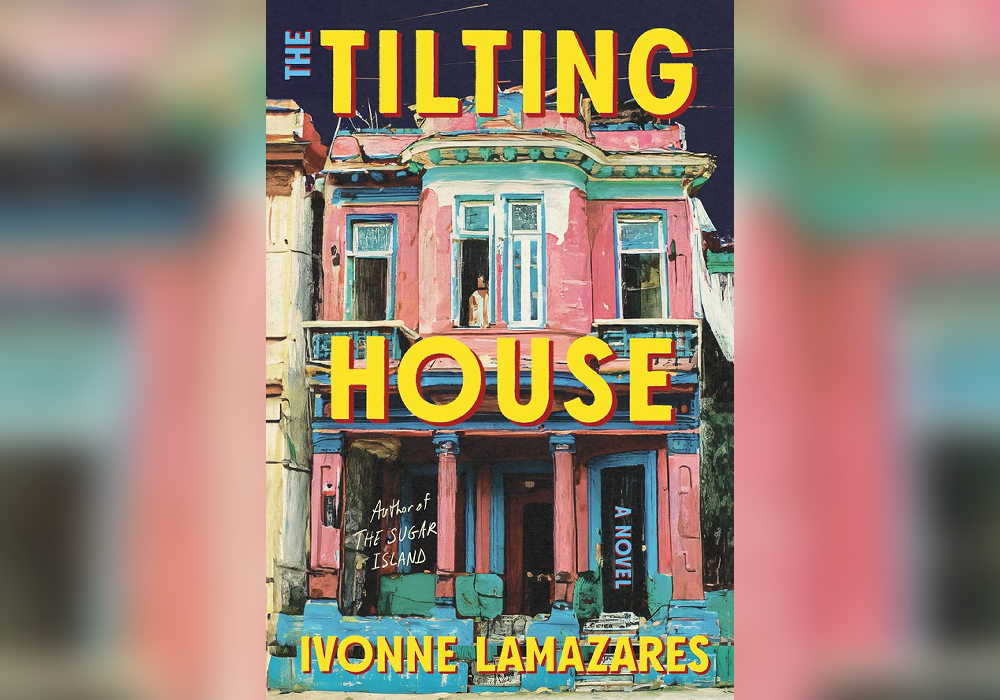
The Tilting House by Ivonne Lamazares follows Yuri, a Cuban teenager during the country’s Special Period, as she navigates the return of her formerly unknown sister and her escape to New York City. Mariela, Yuri’s sister, returns from la Yuma (the United States) in 1993 to uplift the Cuban people and her own artistic practice. Mariela is a disruptive and seemingly unstoppable force in Yuri’s life. The conflict between the sisters raised on opposite sides of a geopolitical conflict—between Yuma and Cubana, insider and outsider, Communist world and Capitalist—is the story’s beating heart. Unlike immigration narratives that focus on the experience of becoming an American, The Tilting House is grounded firmly in life in Cuba. Lamazares makes emigration and the place left behind the focus of her novel, providing a new perspective on the diasporic experience.
The space between emigrant and homeland is the main cause of conflict within the novel. Mariela returns at age thirty-four from la Yuma after having been sent away by her mother when she was five. Mariela claims Cuban identity as her own; Yuri disagrees, constantly referring to Mariela as la yuma. To Yuri, the place Mariela has lived her life is more significant than where she was born. Mariela dives into the Cuban art and political scene, which worries Yuri. At the end of the third section, Mariela returns to the United States, taking Yuri with her. In the final and shortest part of the book, an adult Yuri returns to Cuba in 2015. Over two decades have passed and she is now older than Mariela was when she returned to Cuba. Yuri is forced to confront how the island and her sense of self has changed since she emigrated.
The Tilting House examines several painful and complex questions about what belonging, home, and family mean to a young Cuban woman in the 1990s, following the collapse of the Soviet Union and a rise in Cuban poverty. In the first three sections of the novel, these themes are explored extensively through Yuri and Mariela’s relationship. The sisters butt heads with each other, their aunt, and governing forces in Cuba while they navigate the different levels of power and knowledge they each have as, respectively, a local and a returner. The portion of “El Focsa” dedicated to the sisters’ lives in New York City reinforces these themes; the sisters continue to fight and disagree about what their identities mean and what their responsibilities are to their people. The Tilting House explores and contrasts different relationships to migration, with Mariela’s return to an unknown homeland, Yuri’s escape to America, and Yuri’s eventual return to Cuba as an adult. These different experiences complicate concepts of immigration and diaspora, unpacking the concept of where home really is.
Yuri’s limited knowledge of the world brings to life the realities of Cuba during the Special Period. Yuri knew very little about the outside world by design, with the Cuban government imposing limits on her reality. Yuri’s matter-of-fact reporting on her life demonstrates the realities of Cuba under Castro without long exposition. Lazamares does not pontificate about how terrible things are for the people; instead, the pervasive poverty is demonstrated in events such as a party to show off a new microwave from America. Yuri and the other neighborhood kids are fascinated, while an adult points out there is not anything to microwave. Yuri’s naïve belief that governmental abuses of power can be rectified simply through addressing them, and her subsequent disillusionment when the abuse continues, bring to life the experience of Cubans at the end of the 20th century more than any list of laws or events could.
The final section of the book serves as a mirror of the opening. Yuri has assumed Mariela’s initial position, returning to a homeland she no longer knows. Twenty-two years have passed, and Yuri is brought back to Cuba as a reporter for Reuters. Not only is she an outsider due to the time and lack of connection with her former neighbors, Yuri – now going by the Americanized Julie – must maintain a level of detachment as part of her profession. She is paid to be an outsider. Lamazares recounts how Julie has navigated being an American in flashbacks, rather than the vivid descriptions of life in Havana that made the prior sections so lively and immediate.
Julie’s seemingly sudden change in attitude to her home country can be jarring and confusing, but this is purposeful; while life in America is more present for adult Julie, the reader is more effectively immersed in Yuri’s life in Cuba. Lamazares makes readers into insiders, allowing them to feel the distance not as Julie feels it, but as those left behind in Cuba do. The separation is a compelling device to show how migration impacts diasporic people’s sense of belonging. Yuri’s assumption of Mariela’s initial role is underscored by Mariela’s absence from this section. Being away from Cuba has changed how Julie, née Yuri, thinks about it. Julie’s editor at Reuters tells her, “Before it changes, go see your country.” Julie responds, “Not my country.” Lazamares’s point about the realities of diasporic identity is nuanced: while Julie cannot seem to connect with the people she has left behind, she admits she intentionally stopped corresponding with them. Lazamares explores the difference between being from Cuba and being Cuban, first through Mariela and Yuri’s conflict and then through Julie’s emotional return. The sisters, separated by over twenty years, have similar experiences even as the political situation in Cuba evolves. Though the particulars are different, the challenges of being a political refugee and being thoroughly cut off from a place that was once home are parallel struggles for them both.
With a perspective centered on life in Cuba, rather than life in the diaspora, The Tilting House is a layered exploration of the complexities of belonging in a country that people can neither easily leave nor return to. Ruth, Mariela, and Yuri’s complex relationships to their homelands and their governments are familiar, especially to immigrant communities. Lamazares has crafted a novel that will resonate far beyond the Cuban American experience she highlights.
 Pallas Gutierrez is a writer, teaching artist, and lighting designer from New York City. They are an MFA candidate in UC Riverside’s Low-Residency program. Pallas is the managing editor for The Coachella Review. Their essays about queer community can be found on Autostraddle. Outside of writing, Pallas enjoys crafting and volunteering in their community.