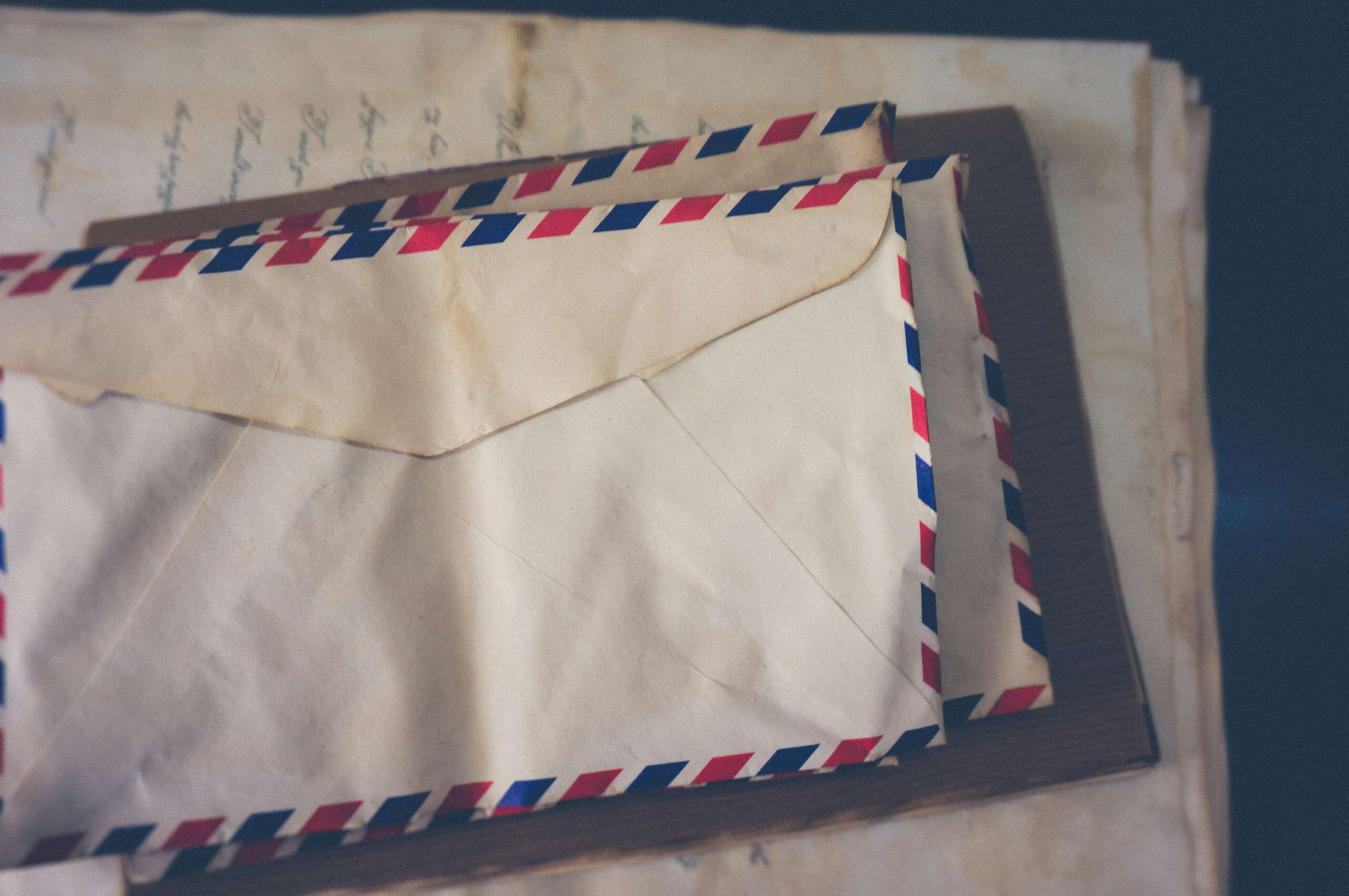
Drifting up to the bare light bulb overhead, Judy watches herself below on the concrete basement floor, her petite Peter Pan self with short blond hair and a nose that Jack describes as either “perky” or “pointed,” depending on his mood and hers. Peter Pan with crow’s feet. Is this truly her marriage, she wonders, her life?
Pages drop from Judy’s fingers that burn as if from ice. Scrap paper, junk paper. Smell the staleness, feel the dryness. Crumple those sheets into dust. No, re-read them, preserve the evidence in case of…?
Judy checks the date on the first page to confirm the letter is more than fifteen years old, this letter she never knew to have existed. Her hands clench into fists that she raises as though to pound the cracked cement floor, but doing so would hurt and she’s hurting enough as it is, so she does not pound. Instead, she folds the letter and shoves it back into its thin white envelope, which, in turn, she slips beneath the green rubber band. She leans forward again, this time to hurl the stack of letters across the basement floor—not to any particular place, just away.
Wooden beams overhead. Black electric cables. Steel pipes for water, the flow of life into the house and sewage out. Shit—call it what it is. Gray cinder block prison walls. Cool air, but musty and stale, at least as old as their twenty-five-year marriage. South Jersey humidity even in early November. Veterans Day, for wounded veterans of long marriages.
They’re not your letters, Judy scolds herself. Tampering with the mail is a federal offense, and obviously the Feds know what they’re doing in prohibiting wives from opening husbands’ mail—Judy should never have read beyond “My Dearest Jack.” She should never have read the signature on that first letter. None of her business. Not her letters.
It’s the way the truth revealed itself that has sucked the air out of her chest like a vacuum cleaner. New knowledge. New reality.
More rummaging through Jack’s carton for the sole purpose—the sole purpose, yes, the sole purpose—of organizing Jack’s mementos. That’s why she’s come to the basement in the first place: to organize her husband’s past and surprise him with the finished task when he arrives home for dinner. In a frenzy, she now tugs, lifts and shoves aside—cough cough cough from the dust. No other stacks of letters. Other stacks of letters would have meant other affairs; the absence of other stacks means the absence of other affairs. Affairs affairs affairs. Every woman considers the possibility of her husband’s unfaithfulness, but none wish to believe it truly possible, not in my marriage, in someone else’s, yes, what a shame, who could have predicted? But not in mine, oh I know my husband and he’s a man of his word.
So many mementos. The wooden T-square she bought Jack in college—smooth, no splinters or nicks. An empty Budweiser can with its metal tab rattling inside, a can that must have held special meaning for Jack to have kept it, although Judy doesn’t know that meaning. Despite herself, she smiles at an unframed photograph of Jack in a tux and of herself in a floor-length white gown sewn with faux pearls outlining her heart-shaped neckline—their wedding photo.
Oh! Jack kept the plaque she was awarded by CornIthaca Realty—Year’s Best-Selling Realtor; so Jack truly had appreciated her decision to put him through grad school and let him be the one to earn an advanced degree. Shhh, don’t tell Gloria Steinem. Shame on you, Judy. Shame. Yes, shame. Judy’s palm slides over the plastic frame gritty with dirt. How different would her life have been had she become a history professor as planned? She still has a career now, although selling real estate is not quite as intellectually stimulating for her as piecing together ancient realities. She flings the award across the room; it crashes into the cinder block wall, does not shatter, but chips in one corner.
A penitent on hands and knees, Judy crawls across the hard concrete floor, retrieves the award and slides it back into the carton, hoping that Jack will never notice the chip in the frame, that he will notice and care.
She crawls over to the letters, nudges them with her white-socked big toe, tentatively, as though checking they’re not alive. They don’t move, yet could surely bite or constrict or, at the very least, sting. Judy hooks the stack with her right toes, slides it to her side, tugs off the green rubber band so she can sift through the letters, old documents to be analyzed for a research paper. “One mark of a good scholar,” her American history professor instructed more than once, “is the ability to bring detachment to your research and to set aside preconceptions.” Judy shuts her eyes tight, strains to recover that undergraduate detachment. Air in. Air out. Don’t stall, Judy, read. You’re a big girl now. Eyes open.
Some letters are in envelopes addressed to Jack at his office and boldly marked in the lower left corner, “Personal/Confidential.” Chicken scratches. Nearly indecipherable scrawl. A psychiatrist would declare the writer insane or perverse or—she pinches off the incipient screed.
Objectivity recovered. She must figure out what happened and understand what it all means.
She recognizes the handwriting on other letters, ones not in envelopes, but on aging white, legal pad paper bordered with doodles of happy faces, some wearing earrings, others sporting mustaches—drafts of letters. Neat, graceful handwriting that reveals a man content at home and in love with his wife. But if he were in love with his wife, would Jack have written those drafts of letters or have crossed out some words and inserted others with care, presumably mailed the final, perfect-penmanship versions of them? The handwriting of a psychopath. Borderline personality disorder. Split personality disorder.
No, the drafts can’t be in Jack’s handwriting, none of them. It looks like his but isn’t. She wonders how a forger could have written on those yellowing papers and stuck them in a carton in Judy’s very basement. Or is it a different stack of letters, the love letters written to Judy two-and-a-half decades ago that had been forged, letters now stacked neatly, tied with a gold ribbon beneath a patchouli sachet on her bedroom closet shelf behind a pile of cloche hats she never wears? Judy tugs at her silver hoop earrings, her favorites, the ones Jack brought her from a business trip to Palm Springs so long ago. He always brought her earrings, necklaces, bracelets or pendants from his Palm Springs business trips. Fool fool fool. She twists the silver earrings until her lobes twinge. Yank them off, rip them off, tear them off.
She stops. The letters cannot mean what they say. They’re not historical documents, but fiction, and Judy has always loved reading fiction. Usually historical fiction, but also mysteries. Who did what to whom? How does the truth unravel? Judy already knows the ending: Jack stayed.
According to the dates, the letters and drafts were stacked in chronological order. Jack was nothing if not methodical; that much about him, Judy knows. Dear, dear, methodical Jack. Predictable Jack. Habit-forming Jack. Addictive Jack. One letter a week, it seems: a draft in Jack’s hand, a response in the other’s, providing themselves time to think and feel, lots and lots of time to think and feel, implying no need to rush because they expected to be in this for the long haul? So romantic. Six months’ worth. A rubber-banded stack she found wrapped in a brown paper bag and tied up with string… these are a few of his favorite things.
Judy reads, suspending evaluation or judgment. She reads.
The postmarks on the envelopes are all the same, Palm Springs. You should have guessed, Judy scolds herself.
As a young architect, Jack rarely traveled for more than a weekend away from home in safe, stable Cherryvale, New Jersey. But then a new client, a Mr. Owens, took a liking to Jack and asked him to be assigned to the Palm Springs project, six months of Jack’s traveling back and forth to meet with the client and draft plans that were ultimately rejected. Judy remembers specifically because something Jack did wrong on that project—some apparently major error with the floorplans—resulted in the loss of Jack’s job at Sommers Design Partnership. At least that’s what Jack said. Liar liar pants on fire. Hot pants Jack.
Maybe the drafts of these letters were written to her, not a stranger. Mmmmhmmm. Sure. Oh yes. Of course they were. Jack forgot to send them to Judy, that’s all, or scribbled the wrong address. After all, her lips have always been as “full and luscious” as his draft letters say and, thanks to evening leg lifts and morning jogs and weekend bicycle trips, her buttocks have always been “firm to the clutch,” especially fifteen years ago when Jack was writing the letters. Mmmmhmmm. Sure. Oh yes. Of course.
But Jack never loved to rub his face in Judy’s “crazy curly chest hair.” What a failing, Judy, what a terrible, hormonal failing on your part not to have crazy curly chest hair. She tries hard not to imagine Jack with this hairy-chested Robert, together with Robert the way Jack’s been together with her although that’s impossible no matter what they do. It’s impossible to replicate Jack and Judy because no one named Robert can be Judy in any way, shape, or form. Then a hazy picture takes shape even though she doesn’t know this Robert’s face—smooth or mustachioed like Jack’s or bearded or stubbly, brown eyes or green, receding hairline or curls—but she sees Jack’s face very clearly, his brown mustache hairs entangling with a hard chest’s crazy curly hair. First, she imagines the hair blond and sparse, then black and thick, so coarse a matting it obscures the man’s tiny nipples. Teensy weensy pathetic man nipples.
Better that Jack cheated with a man than a woman. He always said he loved Judy more than any woman on Earth. At least he never lied about that.
Has Judy ever noticed Jack looking at men?
She’ll have to divorce Jack now; it will be expected. She’ll demand the house, alimony, half Jack’s partnership assets and pension, the BMW. Jack can keep the Lexus, although Judy’ll miss the little mints left on the dashboard by her mechanics after each oil change.
Hold on a minute—Jack did, after all, stop the correspondence fifteen years ago. He chose Judy over that Robert. An apple over an orange. Or are you the orange, Judy? Could a man like Jack live on just one fruit alone?
Judy pictures herself alternately setting the stack of letters in the living room fireplace and igniting them or flushing them. Fire and water—classical, even biblical, solutions to immorality and abomination. No, must not destroy the evidence. She’ll tie the stack in blue—in pink—ribbons and set it on Jack’s white dinner plate; he’ll sit and stare and turn red and avoid looking up to meet her glare across the white kitchen table; he’ll freeze and flush hot, will open his narrow lips as if to sputter some excuse, but will only gurgle like the infant he apparently is. He’ll pick at his gray sideburns, tap his left foot and rock gently back and forth in his chair. “How’s your appetizer, Jack?” she’ll ask. He’ll claim temporary insanity or amnesia. He’ll tell her the affair was meaningless, physical, short-lived. Tears will streak his face right before he lifts hands to cover it and sob and she’ll feel oh so very powerful as she stands over him digging her pointy high heel through his cheating heart so that Dolly or Wynona will write a ballad just for Judy.
Jack sobbed the night he was fired so long ago. Without notice. Two weeks’ pay, not what Judy would have expected in a severance package after seven years of employment. Now she understands: the trouble was indeed related to the Palm Springs project, but not to Jack’s handling of floorplans.
You want to be with a man, Jack? You want to be with someone who won’t complain about the flecks of shaved beard you leave peppering the bathroom sink every morning? Someone who won’t nag you to clean up the wad of hair fallen from the top of your head now clogging the shower drain? Go and be with a man, Jack. See the hell if I care. When you’re groggy in the morning, don’t bother to lift the toilet seat before taking a piss; another man won’t care or even notice, but will gladly stand there pissing with you, crossing your yellow stream with his as you duel over the toilet like two little boys at sleep-away camp, won’t become furious the way I do when sitting on a seat sprayed wet and sticky with your piss, Jack, your piss! What the hell do you have anyway, Jack, a sawed-off shotgun for a penis? Can’t you even aim your piss straight? Piss piss piss piss piss!
That’s it, Judy, give him hell, at least when he’s not around to hear.
Jack’s back went out right after he was fired. From the stress. Judy thought it was the stress of being fired. Now she understands better, so much better. No sex together for weeks after he was fired. How psychosomatically convenient.
Reading bits and pieces of the letters, Judy realizes those silly boys thought it safe for Robert to send his love letters to Jack at the office. How surprisingly prone Jack was to naive behavior—leaving this stack of letters in his very own marital basement, for example. True, those naughty boys were so very smart to avoid a cellphone text-message record open to discovery by a snoopy wife. And how sweet they were, those lover boys, deciding not to use Snapchat messages (did Snapchat exist back then?) that would have been 007 disappearing-lemon-juice-ink perfect except that then they’d have no ability to re-read over and over their exchanged tender words of love. How clever, as well, not to risk sending love letters to and from Jack’s work email account that could be spied upon by the boss’s cyber security team.
“But you were not clever enough, Jack,” Judy imagines herself scolding. “Had you just come to me, I’d have advised you to get a post office box for Robert’s love letters. Then maybe your boss would never have found out.” Poor, naive Jack.
After Jack was fired, Judy and Jack had to cut back for half a year, reneging on their promise to send little Paulie to sleep-away camp for the first time. He’d been looking forward to that summer at camp, had boasted about it to Lizabeth and all his other friends at school. “But you said I could. You promised.”
Judy explained over and over and said not to complain to Daddy because doing so would make him terribly sad. Dear Paulie obeyed, whined only to her.
While Jack was out at job interviews or mowing the front lawn or playing catch with Paulie, Judy was brushing up on her old real estate training manual. Given that she’d had little time to work while a new mother, Judy feared she might have grown obsolete.
Finally Jack found a job at a firm that was to love him and promote him, whose senior partner, Alan Engel, often remarked to Judy over cocktail party martinis how he couldn’t fathom why his competitors had let Jack slip through their fingers. Alan Engel retired years ago, but Judy now thinks to call him and solve the mystery. Maybe Jack’s other partners would be interested, too. How does one go about getting a story into The South Jersey Reporter? She could endure the public humiliation because she’d be the pathetic victim; pathetic victims are adored because they help everyone else feel momentarily grateful for their lives.
But, she thinks, she cannot turn Paulie into the object of scandal. How could Paulie ever understand his father’s interest in a man? Paulie always idolized his dad—jumping into Jack’s arms like a puppy the instant Jack returned home from work, staying up late in the living room armchair the night Jack was due back from a trip, scanning the high school pool’s bleachers to check that Jack had seen Paulie’s record-breaking front crawl and was now thrusting fists heavenward with a double thumbs-up. At sixteen, Paulie sought out Jack’s advice about how far to go with girls on a date. Judy wonders at Jack’s advice.
No. She’ll be direct with Jack instead of cute or vindictive. “Jack, I found these letters. I’m a big girl now, and I want to know the truth. We’ll go to therapy together, we’ll work this out… What do you mean there’s nothing to work out?” She’s heard the pop-psychology notion that fantasy during sex is important, and she believes this. But, she won’t ask if he ever thinks about men while making love with her—too much honesty can be deadly.
Deadly? Oh God. Oh God oh God oh God. Should she get a blood test? How careful was Jack? How considerate of his wife if not of himself?
Judy jumps up, runs to the basement’s deep, white utility sink, heaves. After retching three times, she turns on the tap and rinses her mouth. “No,” she says aloud, “I won’t cry. I won’t.” Her throat burns, her upper palate feels raw. She splashes water to clean the sink, paces around the basement, looks up at the black iron bars across the windows for protection, dried flies in the corners, clumps of spider-webby fuzz, cement caulking points sticking sharply out between cinder blocks.
In a perverse way she hopes Jack has given her a fatal disease because he’d feel terribly guilty and that would serve him right.
She bites her lower lip and tastes blood. Come on! Be a modern woman! Take care of yourself!
She can’t think about this now but promises she will tomorrow or the next day. Mental note: remember to consider the possibility that you might have contracted a fatal disease. There, all taken care of.
Judy gives a tug on her t-shirt’s twisted shoulders. Should she have worn frilly blouses with bows? Skirts instead of the usual shorts or jeans or slacks? Should she have done her hair up in curls, permed or even tinted it? Who the hell knows what really satisfies a man? Apparently, Jack does. Maybe he’d have been more satisfied if she shaved her head, wore flannel shirts and Timberland boots. Sandals or penny loafers—you were a fool, Judy! It was your shoes! And you never should have shaved your legs or armpits. Maybe if you’d pasted fake hair on your chest. You could do that now if you really want to save your marriage.
Who is Jack? Who, Judy, are you?
To be fair, Jack never actually lied about the letters or, for that matter, the affair. He just never got around to mentioning them, that’s all. If she’d asked, he surely would not have lied. Jack was not a liar. A goddamn cheat, maybe, but not a liar. And he left the letters right where she could find them any time she looked. Did he expect her to? Hope she would? They weren’t buried in the bottom of his old memento carton, but lay on top of his Beatles and BeeGees CDs although, granted, under both Simon and Garfunkel—some perverse scavenger hunt clue? A confession in waiting? Has he wanted her to find them? Yes, for fifteen years he’s been tormented by guilt. Good. He’s wanted her to find the letters and grant him absolution. Could she be that forgiving?
“I can’t do this anymore,” he wrote in the very last draft letter. Did he ever actually send that letter? Or did he end it by phone call? Or after one final in-person hurrah? “I’m sorry. I know this hurts you. But I love my wife and my son. I can’t hurt them.” Sure you can, Jack, if you really try.
He stayed. That means something. Because he loved her. And loved his Paulie. Judy’s father-in-law walked out on Jack’s family for another woman when Jack was a boy. At least Judy didn’t suffer that humiliation. Jack spared her because he loved her, his dear darling one-and-only. Nor did Jack up and die like his sister Martha’s husband. Jack stayed.
Judy has always thought of her marriage as basically sound. Jack’s usually home for dinner at 7:00, except on occasion when he plays poker or has drinks with the guys from work. At least that’s where he says he is those evenings. She and Jack make love most Saturday nights—and Jack seems to want to, although Judy often tends to be the one to reach over in bed and give the initial shoulder caress. They attend church together at least once a month, or every other month, sing words of holy love together, take turns shaking the minister’s hand. Jack takes her to office parties and on business junkets to the Cayman Islands and Bermuda. And two Monday nights a month, Judy and Jack speak, one after the other, on the telephone with Paulie away at Duke.
She doesn’t wish to shatter his world, their son’s. Would he fear being unable to commit to monogamy in genetic imitation of his father? Would he impregnate the first girl he can to prove himself a “real” man? They raised Paulie to believe in the normalcy of a range of desires. Judy tests herself—yes, she still believes in that. Truly. But vows are vows. Secrets are secrets. And betrayal is betrayal.
Tension gathers in Judy’s forehead and drapes over her eyes like sheer curtains. Gathering the letters and drafts together, she folds them neatly, squeezes them back into the green rubber band which, to her surprise, has not lost elasticity after all those years. She wraps the brown paper and string around the stack and places it back between the layers of Jack’s CD’s. She can reconsider any time. The letters will still be there tomorrow or the next day. Or the next.
She looks at her watch: nearly 6:00, time to start dinner for Jack.
Judy stands, stretches, pats blood back into her thighs, massages the sharp pain she suddenly notices in her lower back. Slightly hunched, she climbs the steep basement steps.
She’ll bake potatoes, poach salmon steaks, and steam spinach. Jack loves potatoes and salmon and spinach. She’ll prove herself better than him, more devoted to their marriage. She’ll take immense satisfaction in proving herself better than Jack.
She switches off the light, closes the door behind her, leaves part of herself to hover, like a disoriented moth, around the extinguished basement light bulb.
 Daniel M. Jaffe is a prize-winning writer whose short stories and personal essays have appeared in dozens of anthologies, newspapers, and literary journals in over half a dozen countries. He is the author of numerous published novels and short story collections including Foreign Affairs: Male Tales of Lust & Love, that Kirkus Reviews selected as one of the Best Indie Short Story Collections of 2020. Daniel taught creative writing for 30 years. Read more at www.DanielJaffe.com.