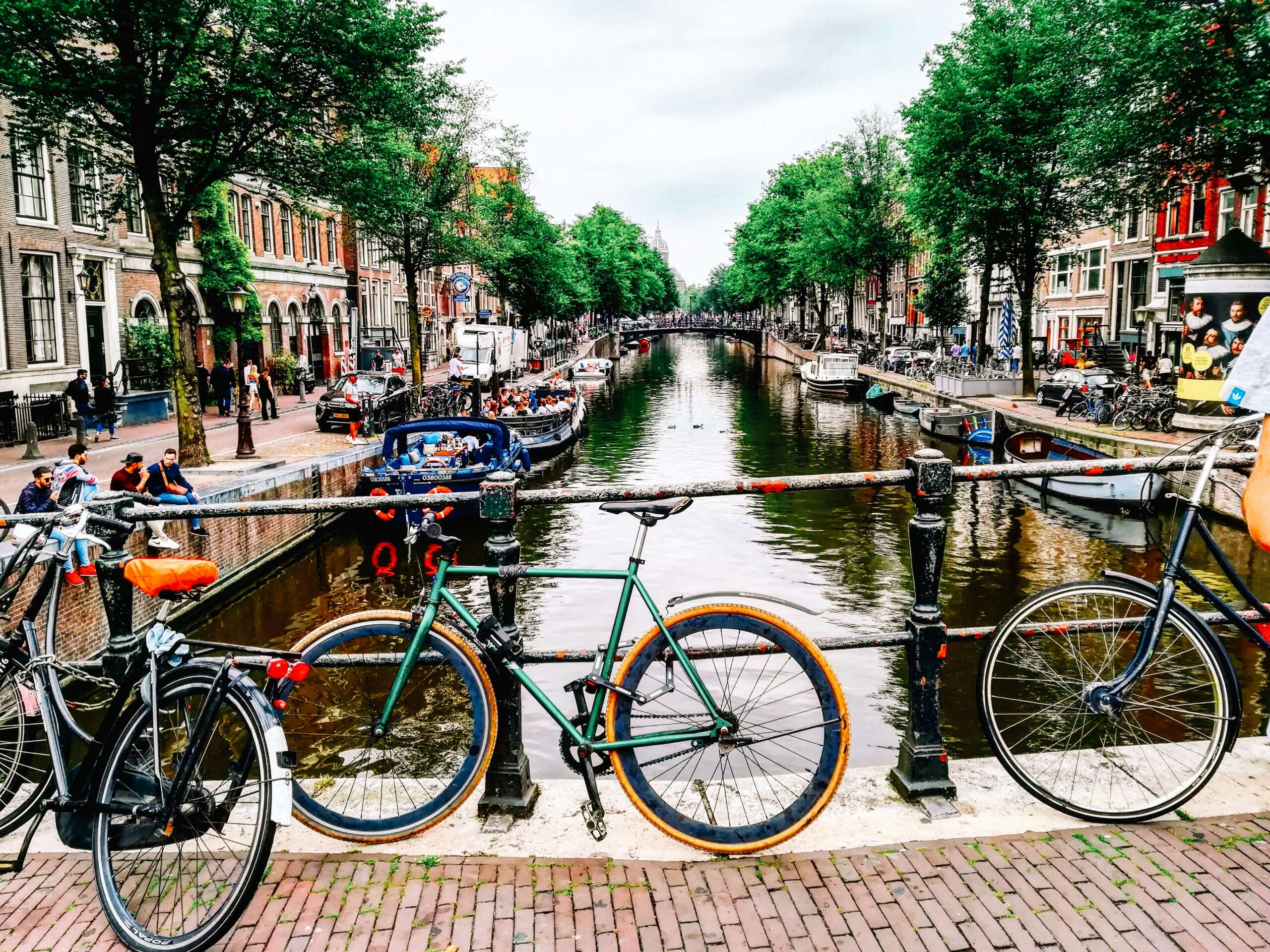
The cobbles under my wheels make my old bike bounce as I ride along, its loose bell jangling ever so quietly, the noise echoing through the stillness of the Oud-West. I have a little headlight that gains more power the faster I pedal, and I like to keep it bright-bright-bright. I am heading home from work, away from the bustle of the Leidseplein: a quick hop over the Leidsegracht to Marnixstraat, and then onto the Nassaukade. Some of the bridges are curved enough that I have to stand up on my pedals to get up and over, and then fly down the other side, merging seamlessly with the other cyclists. Most everyone I see is cycling alone this late in the evening, no small children sitting in the wooden boxes at the front of their bikes.

You picture your own children eating stamppot or ertwensoep,
singing little Dutch nursery rhymes in the bath,
settling into warm pajamas decorated with pictures of Nijntje, the unsmiling bunny.
The light from their bedroom window bounces off the canals below,
creating a shimmering light show;
the houseboats are floating in a sea of tiny candles.
When I think of it now, I can feel the thrum of the machine under my weight, my legs pumping and pushing, my body swaying side to side. Just seeing a map of Amsterdam brings those sensations back, that tingle in my legs, the whipping wind against my ruddy cheeks. The feeling of heading home, even when home is abstract. How long will this place be home for me?
On the corner of the Nassaukade where DeClercqstraat meets the Rozengracht, I kick one leg over my bike and sail to a stop, hoping I look as graceful as the Dutch women I learned this from. I pull the key from my speed lock, and duck into De Sterck, a corner store the locals would refer to as a “night shop,” but which Google inexplicably describes as a “cold cut store.” It smells like homemade bread.
“Goeie avond,” the woman behind the counter trills. Her voice is clear and distinctive and loud, her hair bleached blonde long past the point at which it should be grey. She looks like someone who back in the day sang with Andre Hazes, the old Dutch folk singer, or at minimum did a great rendition of “Zij Gelooft in Mij” when closing down her local pub. Her name may be Geerta, or Magda; I can’t remember. Let’s call her Lotte.
“Goeie avond,” Lotte says.
“Goeie avond,” I say, affecting my best Amsterdamse accent, so guttural and such fun to roll around my mouth. “Alles goed?”
“Alles goed, mevrouw,” Lotte says, beginning to ring up my groceries, approval in her voice as she baptizes each item, announcing my purchases to anyone waiting in line behind me. I make a point not to buy tampons here.
“Lekker appelflaap,” Lotte says—delicious apple turnover, my favorite.
“Lekker kersenflaap,” she adds—delicious cherry turnover, my husband’s favorite.
“Lekker koffie. Lekker melk.”
Near the counter you spot almond cookies, and realize
you want her to say “Lekker gevulde koeken,”— for the children.
You want to buy them a surprise, a treat they’ll wake up to,
sleepy eyes coming to life as they spot the pastry bag on the counter,
the morning quiet interrupted by their boisterous chatter.
I pull out my card. Long before Americans are in the habit of using debit cards, the Dutch slide their chip cards into readers and enter pin codes on the tiny machines. It feels like the future because it is the future.
Lotte grips the waxy paper pastry bags with her long fingernails and places them delicately atop the bag of coffee and the carton of milk. I gather my groceries and say good night.
“En fijne avond,” she cries out in return, and the bell rings above my head as I step into the night.
Back on my bike, slowly-slowly now, nearly home. A boat cruises by—colleagues out for a ride after work or a couple with a bottle of wine onboard. I’ve been that person, been on those boats, my laughter the laughter that carried across the water. If bicycles are the melody of the city, boats are its harmony; the water courses through and under and beside everything, and only winter slows it down.
Once, in the deepest part of a very cold night,
the canals finally froze over,
and from a bridge on the Prinsengracht
you saw a solitary ice skater making looping figure eights,
her hands held loosely behind her back.
It was the most effortless and lovely thing you could imagine.
By the time you bought yourself skates the next day,
the ice was already starting to melt.
You had missed your chance.
When I step off my bicycle, I swing my right leg over the low bar and perch it by my left leg on the left pedal. I ride the last ten, twelve, fifteen feet like that, both feet together, standing on one pedal, before stepping off and hoisting my bike up and in between the bars of the rack across the Nassaukade from my apartment. I turn the key on the speed lock, pull the chain lock out of my saddle bag and wrap it swiftly around the bars. Tap-tap-tap—the boots I bought in Den Haag click across the street and I push the door open and walk up five flights of stairs. The first few flights I could fly up, but then I’d be breathless and slow, so I learn to pace myself and arrive at the top with enough air left to open the door and greet my husband quietly. He’s watching The Wire, and if he is homesick for the States he’s eating a Snickers bar or nacho cheese Doritos, the two American junk foods we can reliably find next to the aisles and aisles of black licorice and ribbon candy.
You hear the children breathing softly in their sleep.
You move as soundlessly as possible across the creaking floorboards.
Her arm is looped over his chest, his leg tangled in the blankets.
You adjust the covers, and he stirs a little, a soft moan escaping as he burrows under.
I put the milk in the fridge, the pastries on the counter, the coffee in the cupboard. I look out the window and across the canal to the bar that we never go to but like looking at. I like seeing people out there late into the night, their movement comforting, their laughter like the sound of rain against the window. I take the chips from my husband’s hands and we climb quietly into bed together. It will be morning before long, and we’ll hear the clacking of wheels on cobblestones from five floors up. Across the city, Amsterdammers will load their children on the front of their bakfietsen and head out into the chilly morning.
You won’t, though. Your children won’t be on the front of your bike, and they won’t wake to gevulde koekjes. Your children aren’t yet born when you live in Holland. Your husband isn’t there either, come to think of it—or, that is to say, he is there, but he isn’t your husband yet. It will take New Year’s Eve on an Amsterdam rooftop with fireworks on all sides, then a trip to Paris to find a vintage style ring made of mother-of-pearl that you’ll put on for the first time in a park outside the Louvre. It will take moving back to the States, and a wedding that is supposed to be small but ends up being pretty big, a wedding where you sing “I Don’t Want to Lose Your Love Tonight” at the top of your lungs, sober as a stone.
Your children will come later, the girl first—fiery red hair laid against your chest as your heart pounds in the aftermath of her birth, unblinking eyes which seem to understand the mysteries of the universe—then the boy, his breathing labored, the sound of his efforts marking time as you pray he will grow into his body, grow you out of this worry and fear. But in your imagination, you spent mornings with them both at the playground a block from your apartment, steps from the canal. Your daughter greeted the man at the flower market, helped you choose the ranunculus that would last the longest. Your son toddled around the Albert Heijn grocery store, reaching for a jar of crunchy pindakaas, his pudgy fingers exploring every fallen grape in the produce aisle. Maybe they were there after all—tucked in the pockets of your warm winter coat, or perched on the windowsill, tiny fairy-legs swinging, eating almond cookies. Maybe they were your denkbeeldige vrienden—your imaginary friends. More likely, you didn’t notice they weren’t there, because there was no hole where they should be. It is only now that you feel the hole, a hole like a missing tooth that your tongue wants to worry.
One day, you think, you will go to Amsterdam together, the four of you. Your husband will pedal the bakfiets, his legs better able to handle the weight of the little one on the front of the heavy-framed bike. The bigger one will cycle behind her dad, in front of you—a row of Americans in the bike lane, conspicuous and slow. You will take them to the brown cafes where you played board games and ate plates of aged cheese and apple tart and drank glasses of Belgian beer. You will take them to museums, and get on a train just to watch the flat countryside fly by. They will meet your friends, and you will think they better understand something about you now, but they probably won’t.
The song you picture Lotte singing is called “Zij Gelooft in Mij,” and in Dutch the lyrics are “Zij gelooft in mij. Zij zie toekomst in ons allebei.” It’s a Kenny Rogers song, and the first line means “She believes in me,” and the second line means “She sees a future for us together.” You think you understand that—what the future holds for you, and your husband, and the family you create. But, of course, the future has always been with you, just as the past has been: you were thirty in Amsterdam, but you were also twelve, and you were forty-four, and you were every age you will ever be. Your children were there, because everything you’ve done has brought you to them, and them to you. The future happened long ago, on a winter night in Amsterdam, and it happens still.
 Elizabeth Bolton holds an MFA in creative writing from the University of Alaska Fairbanks. She was a winner of the AWP Intro Journals Project, and her essays have been published in Puerto del Sol, River Styx, The Forge, West Branch, The Dodge, and wildness, among others. Her work has been nominated for the Pushcart Prize, Best of the Net, and The Best American Science and Nature Writing anthology. Her debut essay collection is forthcoming from Red Hen Press.