Reviewed by T.J. Tranchell
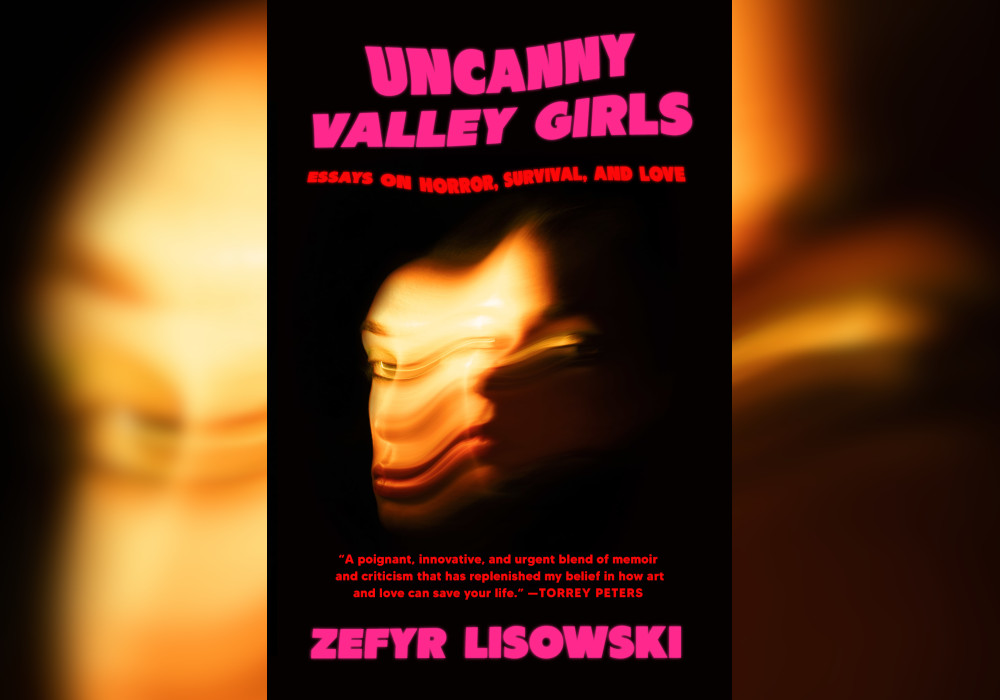
Certain books defy expectations, even when a reader goes into one without them. Uncanny Valley Girls, the new memoir by poet Zefyr Lisowski, adeptly subverts even the expectations that seem to be set up by the author. Lisowski brings a self-deprecating sense of humor along with an expansive openness to this recounting of her life as a poet, a trans woman, and a horror movie fan. These identities coalesce and break apart repeatedly, highlighting the difficulty in being a person, let alone one whose existence is seen as less-than by many people in the author’s life.
Among the preconceptions a reader might bring to this memoir is a notion of narrative time. Memoirs often present a fragment of time or center on a particular event. Lisowski, however, writes with a poet’s time, jumping back and forth throughout her life after establishing her earliest days were spent not in the United States but in the Virgin Islands before her family moved to the rural South. That fractured chronology comes after we learn of Lisowski’s unique relationship with horror films. Rather than a linear catalogue of her life, Lisowski provides moments, sometimes only snapshots and other times detailed, drawn-out experiences. The creative and fluid narrative highlights the disjointed nature of memory for Lisowski. It allows the reader to accept that an experience that might at one point have seemed positive or neutral then unravels into a horrifying remembrance of abuse by purported friends or from school bullying taken too far.
The films Lisowski explores range from The Ring and Black Swan to Scream and The Texas Chain Saw Massacre, among others. This conceit suggests the book will catalogue films and their individual impact—something like Blue Light of the Screen by Claire Cronin or even Quentin Tarantino’s Cinema Speculation. That, however, is an expectation readers must give up. This is not an account of watching movies. It is a memoir of the life of someone who watches movies. The films function as a tool to help Lisowski understand herself and her memories, and to guide the readers into a similar understanding. Her poetic sensibility is evident in lines such as, “How sad, to see only yourself when conjuring up what you fear most, to be alone when envisioning danger.” Here, Lisowski is writing about Darren Aronofsky’s Black Swan but also, of course, about herself, referencing the changing, violated body she does not quite understand but must find a way to live in.
And that is where things become even more complicated. Uncanny Valley Girls, at its heart, is the story of a mental and physical breakdown. Lisowski hints at her trans identity without directly naming it until later in the book, but she includes a prologue clearly stating that this book project was conceived during and after a stay in a psychiatric hospital. Lisowski’s trans identity and her stay in the psychiatric ward are weaved throughout the book and become rare fulfilled expectations for readers within the memoir. We are told about her time in the hospital early; we are given hints about the narrator never being allowed to be a girl. She compares herself to Samara from The Ring as a person who both seemed beyond the help of traditional medical care and also someone never allowed to be “cured” but rather pushed aside and made into a monster, or at least perceived as monstrous, dangerous, different, and othered.
The movies were always there for her, even when people weren’t. But Lisowski understands that our favorite movies, like our favorite people, can betray us. Franklin, the wheelchair-bound character from The Texas Chain Saw Massacre, becomes an example of a differently abled person who not only torments the other characters with his apparent neediness but also bothers disabled audiences because he is a caricature. Like many horror movie victims, Franklin becomes another person we viewers wait to see meet his terrifying end while we identify more with the monster or the killer than the cannon fodder victims. Lisowski’s goal is not to seek pity or whine about her various ailments like Franklin does. Rather, she seeks understanding and if not that, a simple acceptance of her existence.
As Lisowski clears things in her own space, both physically and mentally, some conflicts remain. She addresses the paradox of writing a trans memoir while not wanting to read another trans memoir. The message that far too many trans people have learned to hate themselves via patriarchy and other social constructs is devastating and yet all too common. Lisowski manages to walk a fine line between being “just another trans writer” and something wholly unique to herself. While still giving readers a variety of “coming out” scenes, she maneuvers away from them in a way that shows those moments aren’t what define her life.
The real power of the narrative, however, remains in Lisowski’s identification with others rather than isolating herself from dangerous and unfulfilling relationships or continuing to separate from the art that other people are creating. The final chapter is devoted Lisowski’s experience in engaging with the artist Greer Lanton’s exhibits and then continuing to delve deeper into her prior work. The initial avoidance of Lankton’s work eventually turns into something near worship, even subsuming the place many of the horror films held before. The analysis of Lankton’s art combined with biographical research suggests Lisowski might have initially considered writing a Lankton biography rather than a memoir. That book, however, would likely not allow Lisowski to use Lankton as a reflection of her own journey as an artist, a trans person, and a human being. Instead, Lisowski uses her space in discussing Lankton to delve deeper into her own psyche and her own trans identity. “I suspect many other trans women have experienced awakenings similar to the one I did in response to Greer’s work,” Lisowski writes near the conclusion of the book. “I suspect this because so many other trans writers have written about her.” Here again, we see Lisowski both joining and separating herself from a community, remaining divided even within herself. But as she demonstrates through her connection to Lankton’s art, Lisowski finds solace in unexpected places and characters. She recognizes herself in characters who perpetrate violence against others while she inflicts emotional damage to herself, again subverting the expectations she has built for us. She includes her father’s anti-trans messages from his deathbed, but thankfully he proves not to be the dominating parental personality. She quotes a text message from her mother, received upon her exit from the psychiatric hospital: “I’m here,” she [Lisowski’s mother] said. “I’m so glad you’re alive.”
Zefyr Lisowski’s Uncanny Valley Girls is a book that feels alive and still evolving, and like the human lives involved, it is at times frustrating to read Lisowski work against her own best interests but fascinating to read how honest she is about her shortcomings and her struggles. By the end, we read of hope not just for the author but for all marginalized people. We read that survival and love is possible not just for those who can speak their truth to the world but also for those who haven’t yet found their voices.
 T.J. Tranchell was born on Halloween and grew up in Utah. He has published six books, including The Blackhawk Cycle, a hardcover omnibus. In October 2020, The New York Times called his book Cry Down Dark the scariest book set in Utah. He holds a master’s degree in literature from Central Washington University and is pursuing an MFA through the UCR-Palm Desert Low Residency program. Tranchell has also published work in Fangoria. He lives in Washington State with his wife and son and teaches at a community college.