Reviewed by Eric Martin
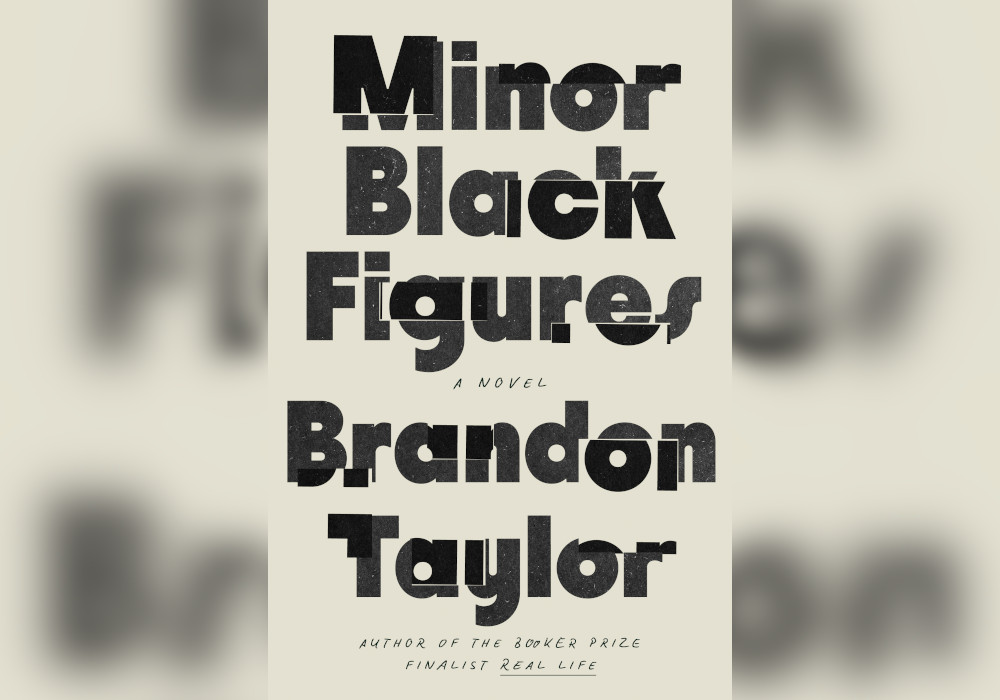
Minor Black Figures finds Brandon Taylor taking up art and artists as his subject, as he did in his novel The Late Americans. This time, the setting is New York City and the artists aren’t writers. They’re painters. They’re sculptors. They make videos. Importantly, they’re also insiders in a small circle of ambitious artists, a milieu where gossip is a high-stakes art of its own.
Taylor deftly interweaves the personal and the political, exploring a painter’s artistic crisis through a set of contemporary social concerns, from sexuality and faith to the racialized framing of artistic merit. Taylor’s ability to probe and prod without preaching is remarkable—as is his ability to sensitively portray an artist’s crisis around his art as something layered and profound while also mildly adolescent. It’s a dance with many difficult steps, but Taylor performs it well.
New York, Present Day
Protests in Central Park and news of a gallery show featuring local art celebs form the background of a deeply thoughtful novel directly engaged with the fraught social politics of contemporary life. The central character in Minor Black Figures is Wyeth, a gay Black painter, but looming behind him is a meticulously observed art scene marked by money and antagonism and bound tightly to a progressive ethos. It’s a world where no one can escape the exigencies of the political moment, and most don’t want to.
In the wake of George Floyd’s murder, the importance of being perceived as having the right views becomes an active pressure, but–no surprises here–this also creates opportunities for profiteering. The right political posture shared on the right social media platform can make a person’s career. Taylor depicts this pressure to conform with real sensitivity, even urgency, while also offering a nuanced view of the temptations to cash in on the politics of the moment for personal gain.
Taylor uses the Manhattan of Black Minor Figures to comment on many strains within contemporary culture: virtue signaling, performative outrage, the surveillance state, the housing crisis and encounters with unhoused people, the ethics of representation in and around protest movements, social politics in art, immigration, hustle culture, and more.
What’s notable about so much of this material is that the writing examines the emotional and discursive frame around these issues. Taylor isn’t merely writing about the housing crisis. He’s writing about the politicization of our attitudes about the housing crisis. Put another way, Minor Black Figures probes the divide between discourse and reality. These are real, human problems, but Taylor offers an examination of the ways we often distance ourselves from that basic fact, opting to hide behind popular attitudes, talking in terms of “issues” instead of in terms of people.
Wyeth
This approach to social and political topics aligns closely with the strains within Taylor’s protagonist: cynical, insecure, introspective, and emotionally distant, caught up in the challenge of finding his way as a Black artist in today’s cultural climate. Wyeth has been talked into moving to New York City after struggling through long cold winters and bad jobs in the Midwest. He also struggled there with his art, which has not progressed since his graduation from art school, where he painted Black figures into scenes from white European films.
After the summer of 2020, Wyeth’s fellow Black students turned to activism, infusing their art with political statements. Wyeth felt pressure to do the same, but was unable to get past his many questions about tensions between ethical obligations for Black artists and the basic fact that he “didn’t know how to paint any other way. What he had was what he had.”
Wyeth brings that struggle with him to New York. The conflicts he feels as a BIPOC artist are only amplified in this insular and highly critical social setting, as exemplified in a gallery show that Wyeth attends early in the novel, which features work by MangoWave, a trendy cadre of artists who “had no qualms about turning their identity into a political glaze to be slathered all over their brand because it was a brand more than it was an ethic.” This idea resounds across the novel, both as a critique and as a question about what it means to achieve success as an artist in the twenty-first century.
Taylor’s take on this issue has both force and gravity in the narrative and makes Minor Black Figures a sharp, serious account of the intersection of art as self-expression and art as the expression of social politics in contemporary culture. Wyeth exists in a state of tension within this world. He wants to be successful. He wants to be on the right side of things. He’s just not always sure that it’s possible to do both. His conflict is essentially emotional—essentially human—yet the vocabulary of his introspection is political. One of Wyeth’s studio-mates sums up this thematic strain at one point, saying, “Should is a kind of death sentence for art […] Should is for propaganda.” Yet Wyeth struggles to quiet his conscience in an era where “shoulds” crop up at every turn, especially in his judgments of himself and the artists around him.
Faith, Integrity, and Art
Wyeth’s artistic conflict is paralleled by a romantic one. He meets a man named Keating, who recently abandoned his dream of becoming a Jesuit priest. As Wyeth and Keating become involved in an on-again off-again affair, Wyeth finds himself unsure of his feelings, partly because Keating’s crisis of faith reminds him of his own departure from religion, which occurred when Wyeth was a child and was made to kneel in a shed and chant religious mantras. The memory becomes a recurring metaphor in the talks between Wyeth and Keating, a representation of a shared yearning for a certainty that’s been fatally subverted by experience.
This existential desire for faith and purity is also bound with Wyeth’s artistic dilemma. He draws the connection as he thinks back and wonders—about himself and Keating and everyone he knows—“if they all weren’t kneeling in the shed still, waiting for some answer from the other side of the universe, one way or the other” and “What was that if not art?” Wyeth and Keating share a deep need to move past questions like this, but faith, it would seem, cannot be both the question and the answer. Wyeth’s reflexive posture is a defense under constant threat of collapse. Taylor’s narrative leans into that fragility, fixing Wyeth’s internal uncertainty as the central question posed by the plot. His hot and cold affair with Keating pressures Wyeth to open up emotionally even as the relationship remains undefined. The story follows Wyeth’s movement toward accepting the idea that not all questions can be answered, but there is significant doubt around whether he can generate enough inner strength to embrace that acceptance.
Wyeth’s sensitivity rings true in Taylor’s writing. On the page, Wyeth is every inch the striving artist—striving against himself and his surroundings to find a way to be authentic and to be brave enough to do so. Taylor crafts a complex and relatable character, shaped with great specificity by a consciousness of race and sexuality and politics but not defined by any of these exclusively. Wyeth struggles in Minor Black Figures; it’s a struggle not to be more than the sum of his parts, but to step away from identity categories into a new and sturdy identity as an artist.
 Eric Martin is a writer and college instructor living in California’s Antelope Valley. He is currently pursuing an MFA in the UCR Creative Writing program in Palm Desert. His work has appeared in Steinbeck Now, The Write Launch, and elsewhere.