

By Pallas Gutierrez
The last time The Coachella Review checked in with Daniel A. Olivas, we published a review of his short story collection My Chicano Heart, a work that we described as both experimental and expertly crafted, starkly realistic and deeply magical. In his latest work, Olivas takes the experiments further with his first play, Waiting for Godínez. Inspired by Samuel Beckett’s Waiting for Godot, Olivas’s play thrums with truth and tension as main characters Isabel and Jesús endure the absurdity of immigration enforcement while they wait for the titular Godínez. Jesús is locked up every night and escapes every morning, while Isabel always watches over him and always falls asleep.
The Coachella Review reached out to Olivas to talk about Waiting for Godínez, the process of adaptation, the influence of his legal career on his writing, and how writers carry legacies.
The Coachella Review: Waiting for Godínez is your first play. How did you find your writing process changed?
Daniel A. Olivas: Certainly very different in terms of structure and the process of getting it up and out into the world. During the first Trump administration, I had already written some fiction and nonfiction to address the anti-immigrant policies and actions of that administration. I frankly have never seen in my lifetime such blatant governmental bigotry against immigrants or people who look like immigrants. I wanted to do something that was bigger than, say, a short story or an op-ed or essay. I wanted to do something that would maximize the humanity involved in draconian immigration policies. I thought that writing a play would be the way to go.
TCR: What exposure did you have to plays before writing one?
DAO: I loved watching plays ever since I was a young person. The very first play that I saw was in high school. It was Equus in 1975 in Los Angeles. Anthony Hopkins played the psychiatrist as a very young man. I saw that in conjunction with a class that was taken in high school to plays. I knew about plays. I read plays, I watched plays, I enjoyed plays, I wanted to write a play.
So, I needed to think about a couple things. I needed to think about structure. I needed to understand the professional side of writing a play. I did research, and I found various formats that are considered the proper professional format for submitting a play. I chose the standard kind of classical version. And I then thought, Well, what is the play going to be about? Clearly, I want to address the anti-immigrant policies, but what would be my story? What would be my plot? And the more I thought about it, the more I realized how absurd our immigration policies were. For our country to survive, we need immigrants.
My grandparents were Mexican immigrants. They came to this country one hundred years ago. They had very little education, and they did what most immigrants do when they come to this country: They worked at jobs that a lot of other people wouldn’t take. My grandfather on my dad’s side was a cook. My mom’s parents worked at a laundry. I had studied some Beckett in high school, and Beckett, of course, is the preeminent playwright when it comes to absurdity. I decided to reread Waiting for Godot. Then, I went on YouTube and watched three or four different versions of it, including an amazing Spanish language version from the 1960s, I think, which is just mind-blowing. My Spanish is not great, but I knew the play well enough to follow along. So it dawned on me after rereading Waiting for Godot and watching several versions that I could do one involving immigrants. And so I just started to write, and I wrote it in about thirteen days.
TCR: I know those thirteen days were during the first Trump administration, and Waiting for Godínez has been performed at a few theaters over the last five years. How has the play evolved since those thirteen days to now?
DAO: That initial version was probably about twenty or thirty pages shorter. I submitted it to several theaters, and it was accepted, initially, by Playwrights’ Arena. That was the first theater to accept it into a program where they would choose about eight plays. Then each one would be developed with a professional director and actors, and then there would be a Zoom reading presented. So, my play went through readings with several theaters: three in Los Angeles, one in New York. At Playwrights’ Arena, I eventually did a shorter pandemic showing where Waiting for Godínez was done outdoors. We all wore masks, and every chair had a hand sanitizer bottle. And the play was shortened into one act, so talk about killing your little darlings. Eventually, the full production of it had a world premiere in Sacramento last year [at] the Teatro Espejo, which is a venerable Latinx theater in Sacramento, I think founded in the mid-1970s. So once it gets produced, fully produced, for the stage, then typically that’s when you can look for a publisher.
When I would go to a play, I had no idea most plays had years of development. In the development stage, every time there was a reading and working with the director and the actors, the play would get tweaked and expanded because there would be notes given to me as the playwright from the actors and the director. Sometimes, it’d be something as simple as, This line here, it needs just a little bit more meat just so folks understand what the character’s going through.
TCR: I’ve found in my dramatic writing practice that you can understand a script so well and then go in and have actors ask you questions, and they ask questions you’ve never thought of, or they read a line out loud and go, that’s not a sentence. How was the process of working with actors illuminating to the work, especially considering this was your first play?
DAO: Some of my actors throughout all the readings and full productions are undocumented. Working on the play was a very emotional experience for a lot of my actors, and that by itself told me that certain storylines within the play, certain elements worked.
At the same time, those actors, as well as other actors who were documented, did give me some notes, particularly with respect to the relationship of the two main characters and what their history was. I must say that I was blessed because the actors and my directors, without exception, were incredibly helpful and intelligent and thoughtful and creative.
The truly surprising thing for me as a writer was to watch how different actors can embody the same character and give that character a different kind of life, a different kind of existence— contours of personality and temperament that the actor alone is bringing to the table. And that, for me, as a writer, was exhilarating. There was nothing like it. It’s so strange to sit and watch words that you wrote [being performed] and, in enjoying the performance, feel as if you never wrote those words. It really is something very, very special.
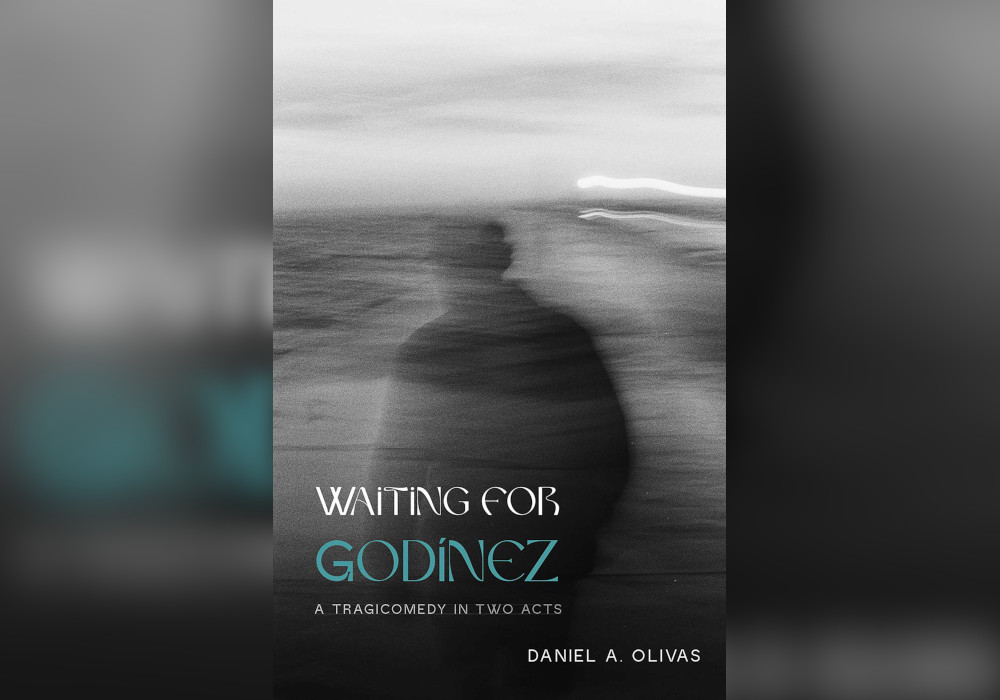
TCR: You mentioned the absurdist nature of our immigration policies leading you to Beckett, leading you to Waiting for Godot, which inspired Waiting for Godínez. How did you balance making the material fresh for people who are familiar with Beckett and still understandable and intelligible to people who haven’t read Waiting for Godot?
DAO: One of the things I do as a writer is I never write down. I don’t dumb down stories or poems or, now, plays. In my play, those people who’ve never seen or read Waiting for Godot could still enjoy it on the level of the play itself—my play. However, those people who know Beckett and know Waiting for Godot will see the Easter eggs in there. They’ll see the reverberations of the original not only in the structure of the play, in the character of the play, but also the particular references, say, to the Bible. In the original Waiting for Godot, there was a discussion of the pretty pictures in the Bible. In my play, Jesús does a rather long storytelling of his own, a recounting and mangling in his own special, funny way. Two stories from the Bible, he turns into one.
The other element, I think, that works for those people who have not ever read Waiting for Godot is the fact that in my play something actually does happen. Waiting for Godot is famously a play about nothing. In my play, what is happening is absurdly repetitive in the same way we see repetition within the original. But we’re addressing the issue of ICE and immigration raids and locking up one of my main characters in a cage every single night with the intent to deport him. For audiences that have never read or seen Waiting for Godot, I think this will be a story unto itself. For those who do know the play, I think it will be an interesting counterpoint.
TCR: One Easter egg that I noticed is one of the phrases that Isabel attributes to great Mexican philosophers is Beckett’s line, “Nothing is funnier than unhappiness.” I was wondering what you hoped your audience would draw from Isabel’s repeated assertion of ideas from famous artists and philosophers as belonging to a great Mexican thinker.
DAO: That repetition within my play is sort of an inside joke for me. Growing up in the 1960s and ‘70s, watching television with my family, very often there’d be some old movie and my dad would say, you know, that actor, he’s half Mexican. I was trying to find our people in the old movies that were being replayed on TV. It became a running joke within the family, but of course it manifested itself in that way because of the way Hollywood erased us even though we were there. Maybe we weren’t on screen, but we were always there driving the trucks, feeding the actors, making the stages and the sets and working on the costumes. That became a running joke to my family. So my character, Isabel, in attributing all of these quotes from various people who were clearly not Mexican, except for one, was a nod to my late father. But also in many ways, it points to the universality of human experience, because all those quotes have to do with life in some way. They’re very similar to the Mexican dichos that I know my grandmother used—these bite-sized pearls of Mexican wisdom; for example, “My bag is heavy, but at least it’s my bag”—things like that. That’s what Isabel’s doing. She’s finding wisdom out there and making it her own and making it Mexican.
TCR: Your recent book, Chicano Frankenstein, is also a retelling of a story by a white author that then goes into Chicano perspectives. How do you approach adapting or like taking inspiration from white stories and making them Mexican?
DAO: All writers are building on those who wrote before. All the Shakespeare plays were based on other plays that had existed, other stories and histories that existed. Shakespeare and other playwrights at the time knew their audiences would already know the plot lines. That’s been going on from the very beginning.
One of the beauties of using a famous piece of literature as a jumping off point for your own take is that it allows you as a writer to play with expectations. You can take those expectations and shake them up and play with them, create ironies out of them. But you can also find the center of truth within that work of literature and use it for your own. It allows you to play against expectations. When a story is told repeatedly and people kind of get used to a plot line, sometimes the meaning of the story is lost because it becomes just too familiar.
There’s a playwright, Luis Alfaro, who took the Greek tragedies and wrote his Chicano East LA versions. And they’re wonderful, absolutely wonderful. And I know you did an adaptation of… was it The Odyssey?
TCR: Yeah, I did a post-Afghanistan Odyssey with a hero returning home from the war to New York State. Like you said, it gives you so much to already work from, and then [you can] develop your own characters and situations and reverse expectations and really question who gets to be a hero. I love adaptation as a format.
DAO: So you’ve experienced this as a writer, and there’s something that is particularly gratifying in shaking up the canon in this way. It also, I think in some ways, allows the reader, or in the case of a play, the audience to re-examine things that they take for granted.
TCR: You mentioned you don’t have an MFA, but you have a law degree from UCLA, and you work for the California Department of Justice in environmental enforcement, land use, and affordable housing. How does your work in that field inform your writing practice or inform your themes or process, if at all?
DAO: In terms of process of writing, I’m a fast writer and that comes from my legal practice. I’m not afraid to get in there and write, edit, kill my darlings, and tell a story. This is one of the things about legal writing that non-lawyers don’t understand. Legal writing is not dry, boring writing. Bad legal writing is. Good legal writing—legal writing that is successful—is legal writing that tells a story that is compelling, that uses active language, that tells a judge, This is why we should win. This is why justice should be done. That’s good legal writing. So I use that in my creative writing. And I think my legal writing has gotten better as I’ve written more and more fiction and poetry and plays. It kind of goes both ways.
Because I do have a full-time job, I write typically on weekends, holidays. For example, writing Waiting for Godínez, I wrote in the early morning before work. After dinner, I would spend some time writing. And so, I don’t worry about writer’s block because I’m sort of like a starving man. It’s like any time I could find to write, I will write. And I don’t worry about things like inspiration because when the story is ready to come, it will come, you know; the ideas will come.
TCR: You’ve written thirteen books and edited two anthologies. What drew you from law to writing?
DAO: I started writing very late, at age 39 in 1998. I was a young lawyer, a young father, and I ended up writing my first short novel, which is now out of print. But in many ways, I think I denied myself the right to become a writer because of what my late father went through. My late father wanted to be a writer, as well. He had worked in a factory in Watts. And as a young father, during the day, because he worked the night shift, he would write on a manual typewriter, a Royal Quiet Deluxe, which I now own. He wrote a novel, and he wrote poetry. But he was rejected. This is in the late ’50s and early ’60s. He never got published, so he burned everything and stopped writing. He and my mom went back to college, and they had five kids in tow when they went back to college in the mid-60s. They went to community college, LACC, and became Head Start teachers. My mom opened up her own school, and then my dad continued to get educated. He eventually became the first Chicano in management with the Rapid Transit District [predecessor to the Los Angeles Metropolitan Transit Authority] in the 1970s. He wore a suit to work, which was something very special to him. But he always read voraciously. He introduced me to writers like Somerset Maugham and James Joyce and Mark Twain, Virginia Woolf, when I was in fifth, sixth grade. Maybe he planted the seed of literature in me in that way. It was kind of funny: Near the end of his life, whenever I visited with him, he didn’t want to talk about my legal practice. He wanted to talk about my writing.
TCR: You mentioned, and I relate to, having middling-to-poor Spanish, but your work consistently integrates Spanish phrases, sentences, conversations. How do you approach translation, including Spanish in your writing? How is that inclusion different in a play than in a short story?
DAO: I know enough Spanish to use certain phrases that I heard growing up. I would have to look things up to make certain that I’ve gotten the grammar correct. In terms of the audience expectation, I think it’s okay for there to be Spanish or French or any other language sprinkled in within a play where, for most people, the context will tell them what the words or phrases mean. Now, sometimes not. There is a name-calling match in my play which mirrors one in Waiting for Godot. In my play, it’s in Spanish with the punchline, making fun of my day job.
TCR: He calls her a lawyer, right?
DAO: Yes, in Spanish. It’s okay for audience members not to fully know, because I’ve seen that performed. The reaction is wonderful from the audience. There may be some whispers here and there, people telling what the words mean. I trust the audience. I have to tell you, when I go to a play I don’t always understand every single reference, and that’s okay. There’ll be things that connect with you and things that might not, and that’s fun.
TCR: Do you plan on writing any more plays? Do you have a specific idea for what’s coming next? Or like you said, are you just waiting for the story to come and tell you what form it needs to be told in?
DAO: Well, I have written another full-length play. It’s an adaptation of a novel that I wrote, The Book of Want. I submitted the proposal to write that play with Circle X theater in Los Angeles, where basically they were asking for playwrights to submit an idea of a play they wanted to write that they were afraid to write. But why would it be difficult for me to adapt my own novel into a play? I explained what my fear was. My biggest fear is that I had never done it before. The second fear was how the hell do you take a novel that has a lot of interior type of elements and turn that into dialogue and make it work as a play. The result is a play, a full-length play, with a reading that was directed by Dr. Daphne Sicre, who teaches at UC Riverside now and used to teach at Loyola Marymount [University in Los Angeles].
TCR: Is there anything that I haven’t asked about that you’d like to share with the readers of The Coachella Review about Waiting for Godínez in particular or everything you’ve done so far in your career?
DAO: I think writing politically can be entertaining. Yes. And when I say political, I mean that in several different ways. One way is that just by centering people who look like me and my family and the people I grew up with, that is a political statement by itself. By presenting the Los Angeles that I know, through the people that I know, is a statement.
But going beyond that and doing a play like Waiting for Godínez that directly addresses ICE raids and mass deportation can still be something more than a diatribe or someone standing on a soapbox. Because my play—I believe, in the same spirit as Samuel Beckett’s Waiting for Godot, —is funny. Joni Mitchell said something in one of her songs [“People’s Parties”] that laughing and crying, it’s all the same release. I prefer to laugh. I prefer to point to the humor in our existence, even in writing about difficult issues. They’re laughing and they’re enjoying humor. Maybe the message will get across, and maybe there will be something that will help them not only deal with what we’re going through right now but maybe even move them to action.
 Pallas Gutierrez is a writer, teaching artist, and lighting designer from New York City. They are an MFA candidate in UC Riverside’s Low-Residency program. Pallas is the drama editor for The Coachella Review. Their essays about queer community can be found on Autostraddle. Outside of writing, Pallas enjoys crafting and volunteering in their community.