Reviewed by Noelle Trost
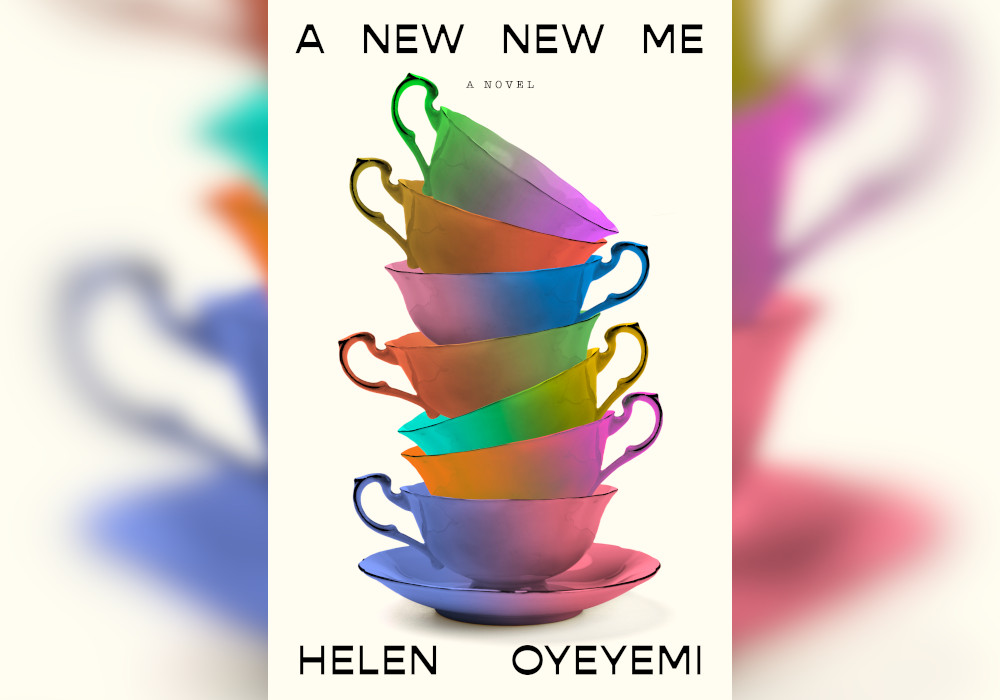
Helen Oyeyemi has long been celebrated for her blending of the surreal with the everyday. She casts reimagined fairytales with a coating of her own formidable imagination—such as in Mr. Fox and Boy, Snow, Bird—reworking familiar stories in opulent, detailed, and extravagant ways while maintaining a sharp eye for human relationships. Her latest novel, A New New Me, turns that attention and artistry inward, a pinpoint focus on the inner life of a single character with many minds. The result is a character study infused with the similar lush strangeness inhabiting her previous works, but entirely its own creation in terms of inventiveness and claustrophobic intimacy.
The protagonist of A New New Me is Kinga Sikora, a Polish-born woman living in Prague whose sense of self is fractured at an ill-fated high school reunion. This original Kinga (dubbed “OG Kinga”) plunges into her own subconscious and abdicates control to seven different personalities, each taking over for a different day of the week according to their strengths: Kinga-A is responsible and efficient, making her a good fit for Mondays, while Kinga-F, the party girl, takes Saturdays. The narrative follows them over the course of a week in their shared diary.
Oyeyemi takes her signature dreamlike approach to new extremes, abandoning the fairytale scaffolding to dive into an eccentric psyche that can overwhelm. The story admirably commits to its own peculiarity and bizarre premise. The Kingas who work possess strange jobs: Kinga-A and Kinga-B are matchmakers for employees at a bank attempting to win a government-issued “Fidelity Award,” given to couples married for fifty years (complete with presidential handshake); Kinga-C is an immersive adventure holiday planner in a role that requires her to play at being a window cleaner and a nun; Friday’s Kinga-E is a muse to a perfumer. The world they inhabit is just as absurd and strange. There is a mob, run by a man named Mr. Calcium, that stuffs people into suitcases and fills the suitcases with teeth. Tortoises rain down from the sky in silk parachutes strapped with Czech korunas. Ironically, the Kingas’ closest brush with normalcy comes from their memory of the COVID-19 lockdown. This quarantine also serves as the source of resentment amongst them: Kinga-A took over the body for three weeks rather than stick to her allotted Monday.
This is not a clinical portrayal of dissociative identity disorder, nor does that seem to be Oyeyemi’s intention. She takes to the extreme what all of us experience already: Some days, you are the version of yourself who has to sit in traffic, go to work, and wash the dishes. Other days, you are the version of yourself that goes on vacation, sleeps in, and takes bubble baths. In crafting the character of Kinga Sikora, Oyeyemi explores the possibility of what the different versions of ourselves might say to one another if they had the chance.
In a story navigating split personality as a metaphor for the warring parts of the self, Oyeyemi’s maximalist abundance—every page inundated with anecdotes, tangents, and details—is effective. The Kingas are uncompromising in the creation of their own lives, steadfast in their dedication to their own idiosyncrasies in a way that is commendable. They all have their own friends and romances, their own workplace worries, with little concern placed in presenting a single unified “Kinga” to the world. They avidly defend their carved-out days and lives, intensely suspicious of one another following Kinga-A’s three-week coup. It is a tenuous democracy, and their diary can read like the group chat of seven spiteful college roommates. Their chaotic world works in advancing this metaphor of self-loathing that arises from the friction of our competing desires. Self-loathing, as Oyeyemi suggests from the Kingas’ bickering, is not profound, but rather petty.
The absence of escalation beyond bitter threats and insults can frustrate, however. The inciting mystery of which Kinga tied up a strange, handsome man, Jarda, in their closet disappears almost immediately. As it turns out, Jarda placed himself there willingly, to use the Kingas’ apartment as a hideout and to fake ransom photos for reasons that even the Kingas don’t seem to care much about. Though each Kinga finds him varying degrees of attractive, they share a passivity toward Jarda. They are far more consumed by their own internal turf war, which simmers but never boils. Anyone close to the Kingas, such as family and some friends, is highly accepting of their reality and their boundaries. Without the pressure to perform a unified identity for the outside world, it raises the question of why they need to keep such a detailed diary in the first place.
Yet their inaction also feels oddly true. People often fail to make decisions that would help them move forward; they circle round the same arguments, stuck in familiar ruts. The result reads less like a plot-driven novel than like a week-long character study. Oyeyemi captures the meandering logic of a diary, where any stray thought is recorded regardless of whether it advances some predetermined “story.” In a stroke of realism from Oyeyemi, the Kingas’ (in)actions have little bearing on the conclusion in a way that also rings true: our problems tend to work out in ways that are beyond our control.
If anything, the one-week structure of the novel proves limiting. With the baton handed off day-to-day, early-week Kingas never get the opportunity to react meaningfully to later entries within the presented timeframe. In her chapter, Kinga-B eviscerates Kinga-A, citing her COVID takeover as evidence of tyranny. Kinga-A has no opportunity for rebuttal, so Kinga-B gets the last word. The result is a conflict that feels intentionally muted. While realistic (this is, after all, a voyeuristic peek into Kinga’s diary), this restraint limits the depth with which we can appreciate the intergroup dynamics of the Kingas, making their pettiness read as more random than deliberate.
In presenting this diary to us in all its chaotic glory, Oyeyemi nevertheless takes a confident step into her own writing and imagination. Though at times excessive and exhausting, it also exhibits a thrilling resolve to break new ground and craft a canon of unique fairytales. A New New Me is a surreal and oddly faithful study of a fractured self. To get the most out of it, a reader ought to be like OG Kinga: one who is willing to abdicate herself to madness.
 Noelle Trost is a fiction writer based in New York City. She earned her Bachelor’s in Neuroscience from USC in the spring of 2024 and has been working as a special education paraeducator. Her short stories have been published previously in The Bangalore Review and And Gallons. Noelle lives with her cat, Jonesy, named after the one in Alien so she can feel like Ellen Ripley.