Reviewed by Jessica Ribera
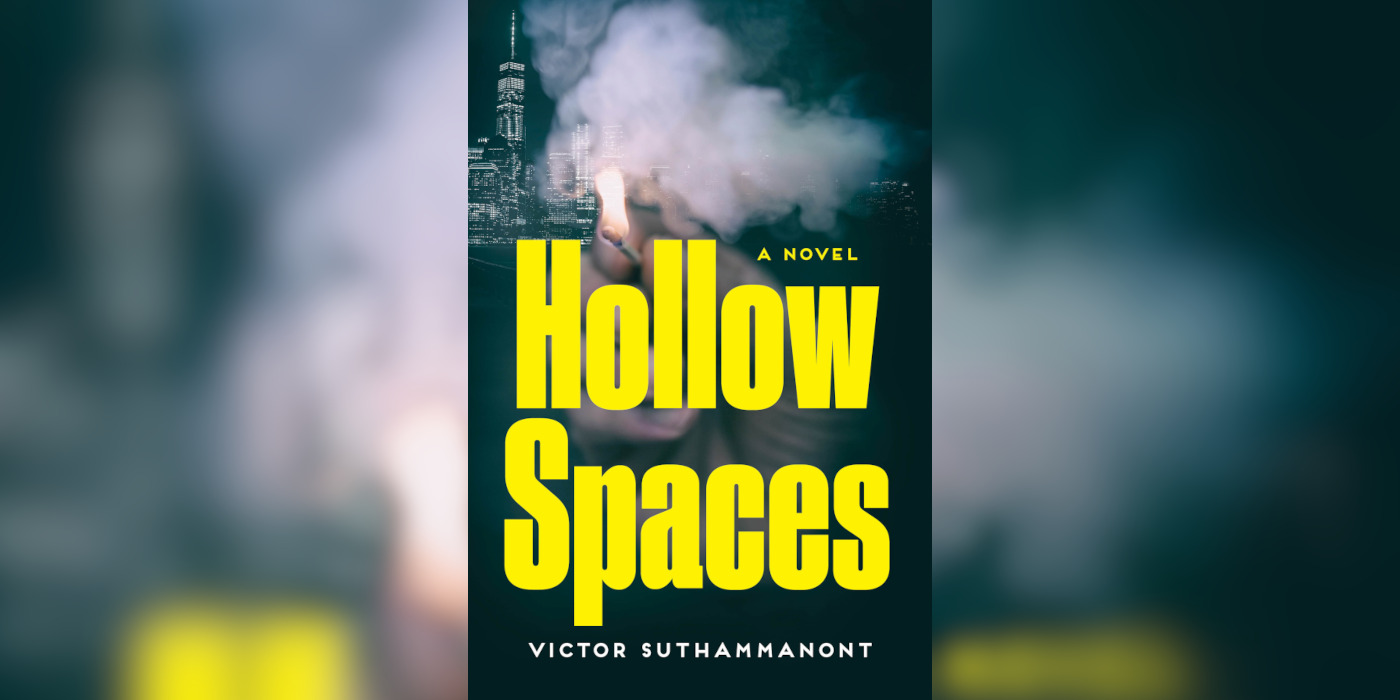
Evoking riveting murder and courtroom dramas from its start, Victor Suthammanont’s debut novel Hollow Spaces combines the satisfaction of solving a mystery and the adrenaline of a thriller. With tight, descriptive language and carefully developed depictions of emotion and relationships, it also presents as a literary family drama in which the siblings’ opposing beliefs about their father’s guilt have driven them into lives they aren’t sure they want.
John Lo, the only Asian American partner at a prestigious New York law firm, was acquitted of murdering an associate lawyer. But the trial—and the affair he was having with the associate—destroyed him and his family anyway. Thirty years later, facing the impending loss of their mother, Hunter and Brennan, John’s estranged children, choose to re-investigate the murder in an attempt to understand what really happened, reconnect with each other, and integrate the tragic events of their childhood.
Suthammanont makes the characters’ stakes very clear and more personal than simply a desire to know “whodunit.” Having built their lives and personal values around their disparate claims about their father, Hunter and Brennan must accept that if they solve the murder, they will know which of them has always been wrong. Brennan has always believed her father was innocent and she bears the burden of being the only person she knows who retains any reverence for him. She is a successful lawyer like her father was before his fall, but she also has serial affairs, raising the question of whether she’ll repeat her father’s failures. Hunter is convinced his father is a murderer—something easy for him to surmise based on the violent history revealed in Hunter and John’s memories. Hunter is a journalist drawn to documenting the brutalities of war-torn places, and—like the other members of his family—he struggles to let anyone really know him.
“You’ll risk all your memories of him,” John’s lawyer warns, as Hunter and Brennan use their professional skills and resources to discover what really happened. Suthammanont explores the kinds of questions and doubts so many sets of children—grown or not—might have about the previous generation: Who were they? Will I ever understand—or outrun, or deserve—their legacy and its effects on me? What didn’t they tell me? What do their truths reveal about me?
Tension builds through interweaving timelines. The events of thirty years ago—including the aftermath that no one told the children about—alternates with the siblings’ unfolding efforts to solve the murder. Suthammanont gives the plot a driving beat and deepens the character development with this structure, using the timeline shifts to create cliffhangers while also building empathy. Despite their flaws and often selfish actions—potentially terrible and criminal in John’s case—the principal characters were all once children who didn’t get the consistent care they deserved and needed. Skillful use of time stamps and other structural guideposts make the layers and time-jumps easy to follow.
Suthammanont provides direct access to what Hunter and Brennan desperately want—their father’s memories—dropping clues to the case for the reader while also creating the sense that truly knowing someone, even our own family members, may be impossible. This is accomplished especially well through scenes that show us the characters in similar situations, like being scolded by a father. Brennan recalls a time as a child when she dropped out of a footrace she knew she couldn’t win. “I don’t ever want to see you quit again,” John said. She absorbed the words, developing a belief that if she just kept working hard enough, her father would be happy with her and their family could somehow be okay again. In the pages immediately following, Hunter recalls lying as a child to protect Brennan. John responded by grabbing Hunter’s chin, shaming him, and aggressively telling him never to lie. “If you do, and I catch you,” John says, “I’ll throw you off this fucking bridge, do you understand me?” Given his painful past, Hunter resents Brennan’s love for their father and feels no obligation to preserve his legacy. From here, the timeline shifts to convey a scene of John remembering the impact of his own father’s parenting choices. These mirrored series of scenes throughout the book form a pattern that underscores the novel’s themes of generational trauma, the nature of truth, legacy, and identity. As Brennan says: “Nobody is any single thing they do or think!”
Supporting characters—particularly the mother and John’s murdered lover—are richly developed and exert pressures that force John, Hunter, and Brennan forward to decision points. John must decide whether or not he’ll continue his affair—his choices propelling him toward the day his lover is killed. Hunter and Brennan wrestle with their mother’s opinions and meet characters from John’s past, forcing them to continually reassess their beliefs. When they begin receiving anonymous threats because of their investigation, the stakes rise even higher.
Asian American experience and identity is an integral aspect of plot and character development. Scenes of racist treatment of John—beginning in childhood and later, into the workplace—increase suspicion that his case was mishandled while also giving readers a window into the pain and injustice that Asian Americans can experience. Suthammanont is especially effective at using analogy to express characters’ feelings, such as when John expresses his frustration at how his immigrant parents were treated: “The indignity of being a human water pipe—something everyone needed and nobody ever paid attention to. Things they buried in the walls and in the ground.” Teochow words and phrases, descriptions of Chinese foods and cooking techniques, and illustrations of New York’s Chinatown effectively provide bursts of colorful sensory detail alongside the starker scenes of cold, corporate New York and the siblings’ bleak loneliness.
In successfully layering his timelines, writing beautiful prose, dropping clues to the mystery, and building suspense through carefully timed revelations, Suthammanont serves the great things offered by thrillers and rich family novels. Because his book is both, the themes in Hollow Spaces are vividly clear, engaging, and satisfying to consider.
 Jessica Ribera is an MFA candidate in the University of California Riverside Palm Desert Low-Residency program. She’s a nonfiction editor for The Coachella Review, and her memoir, The Almost Dancer, is available now. Her stories about ballet, parenting, and whales can be heard on The Moth Podcast. Her first fictional short story was recently shortlisted for The Masters Review Debut Fiction Prize.