Reviewed by Eric Martin
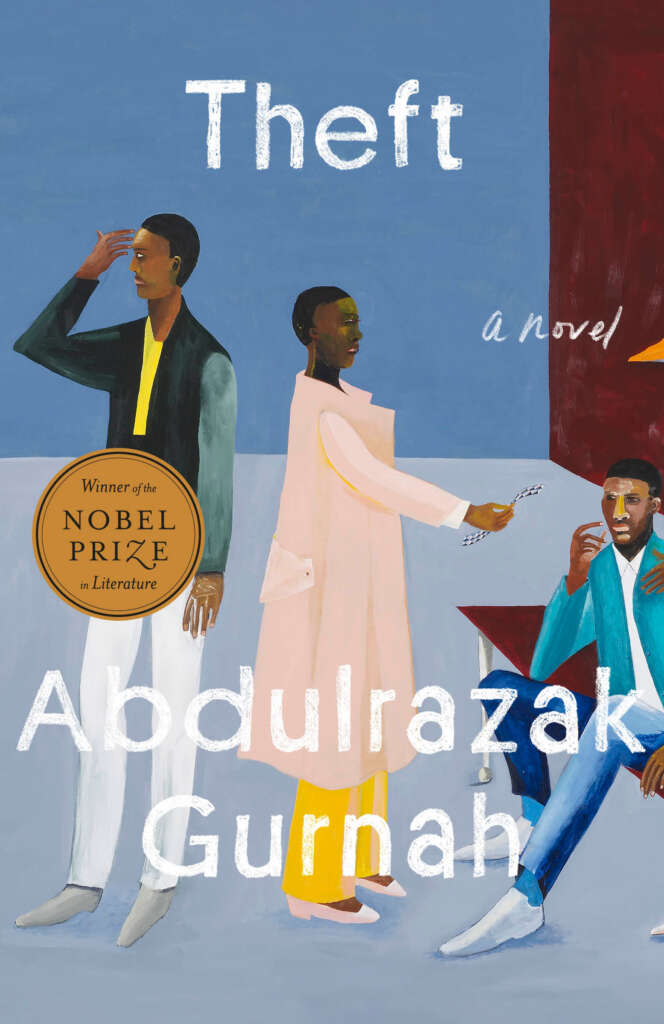
In his latest novel, Theft, Nobel Prize winner Abdulrazak Gurnah spins a tapestry of interwoven lives in Tanzania, where social mores both connect and divide. It’s a world defined by family—historic and impromptu, broken and reimagined. In this world, the lives of individuals are powerfully shaped by a family history that the individual has no power to control. Consigned by choices made by parents and grandparents, children grow into adults who are confronted with the question: Can I find a way to be anything other than the sum of my history?
To emphasize the relationship between person and personal history, the novel fittingly evokes a sense of “historical time” throughout. Which is to say, time is slippery in this novel.
In one chapter, years might pass, and in the next the events of a single week. Time expands and contracts fluidly, as measured by whichever character narrates the chapter.
Much of Theft follows Karim from his childhood—which is largely defined by his absent parents—through college and later into adulthood, as he becomes a self-possessed and self-centered young man bent on achievement and success. Additionally, the lives of Badar and Fauzia are narrated in parallel to Karim’s to form a trio of central point-of-view characters, but Badar and Fauzia’s personal histories break from Karim’s timeline.
Karim is already in college before Badar and Fauzia are introduced as children, their appearances propelling the narrative backwards chronologically as we learn about their lives in successive chapters. Gurnah resists revealing early on how the characters are (or will be) connected to one another. They exist side-by-side in the story without touching one another. The tendrils of the story become suddenly loose.
The multiple points of view and characters create a broadening of the story’s narrative focus and slow momentum as a result, but focus is not Gurnah’s principal aim here. Instead, his interest in the communal and viscous nature of history suggests a link to Tolstoy’s War and Peace, where history is both theme and subject. Thus, each narrative perspective adds to a sense of interconnection among the characters. And time moves both forwards and backwards along the connecting lines.
In keeping with this thematic idea, there is a distinct throughline from past circumstances to present conditions for each of the narrators. Thirteen-year-old Badar, for example, knows his sudden removal from his home and subsequent position as a live-in servant originate from decisions made by his father, though Badar has no real knowledge of his father or what he did. Badar asks questions, but no one is willing to offer more than vague descriptions of bad behavior. Only when Badar’s servitude abruptly ends years and chapters later does he learn how his father’s actions led to him being orphaned then placed into servitude.
Without power to alter or determine his own fate, Badar’s journey is defined by his response to the conditions he finds himself in. Badar’s emotional struggle to see himself as something other than a victim becomes central to the story, even as the narrative bounces from him to Karim to Fauzia. Of the three central figures, Badar is the most sympathetically drawn, but he is also the most static. It’s ironic that so much of this novel leads us to identify with Badar and root for him to achieve the transformation that would grant him agency in his own life even though, as much as this character refuses to see himself as a victim, he also refuses to change. The message hews to a stoic idea that joy can only come from humility. By letting go of the will that drives the illusion one can control things or shape one’s own life, the story suggests, a person can find peace. It’s an unexpected message to be conveyed via a character who has been lied to and mistreated. If anyone should reasonably want more out of life, it is Badar.
This thorny and stubborn choice is one of several surprising elements in a novel that features a unique story structure and some notable stylistic decisions. Gurnah eschews quotation marks and paragraph breaks for dialogue, presenting conversations in italics within the body of larger paragraphs. Rather than seem showy, the unbroken paragraphs situate the dialogue as part of a larger experience, an intact if sometimes swirling series of impressions and events. It’s a fitting craft element for Theft—a novel about the flow of time and the ways in which individuals are caught in that flow, tossed in it, and made to struggle blindly against its force—to plunge its readers into an experience of time that is sometimes confusing and confused because it’s not controllable.
Late in the novel, though, the paragraphs begin to break. Dialogue is treated conventionally now, beginning a new line on the page each time a different character speaks, a change that coincides with the three main characters arriving at adulthood. At this stage of the story, Fauzia, who had “the falling sickness” as a child, has to choose how to approach parenthood: Will she let her past illness keep her from becoming a mother? Karim and Badar are tested in different ways, but the deepest conflict is the same for each of them: Will they be defined by their parents, by their own personal histories—or will they break free? The line-breaks underscore this individualization process and the dynamism that results from it. It’s a stylistic choice that, while subtle on the page, conveys a dramatic shift.
One of the novel’s most notable strengths comes from Gurnah’s depiction of place and setting. This is where the writing is at its most lyrical, where Gurnah paints word-pictures and decorates the world of his story: “When the moon was full, the tide was also in, and Fauzia would hear the slap of waves on the shore, hissing on the sand and then hitting the seawall. The shutters were open and the glow from the sea filtered in and brightened the room.” The vivid image-making invites the reader into the world Gurnah has created with physical, sensory detail and a poet’s touch.
But Theft is not best described as a poetic novel. It is a thematically focused but narratively loose work of contemporary fiction, taking stylistic risks in service of its central ideas. Concrete images and a great specificity in the story’s physical world exist side by side with a set of characters who refuse to fully resolve the questions the narrative asks of them. The world is fixed in place. The people have been assigned a place in it. The novel’s initial question of whether or not these individuals have the power to change their place in the world is replaced, in the end, with a different one: Should they want to?
 Eric Martin is a writer and college instructor living in California’s Antelope Valley. He is currently pursuing an MFA in the UCR Creative Writing program in Palm Desert. His work has appeared in Steinbeck Now, The Write Launch, and elsewhere.